






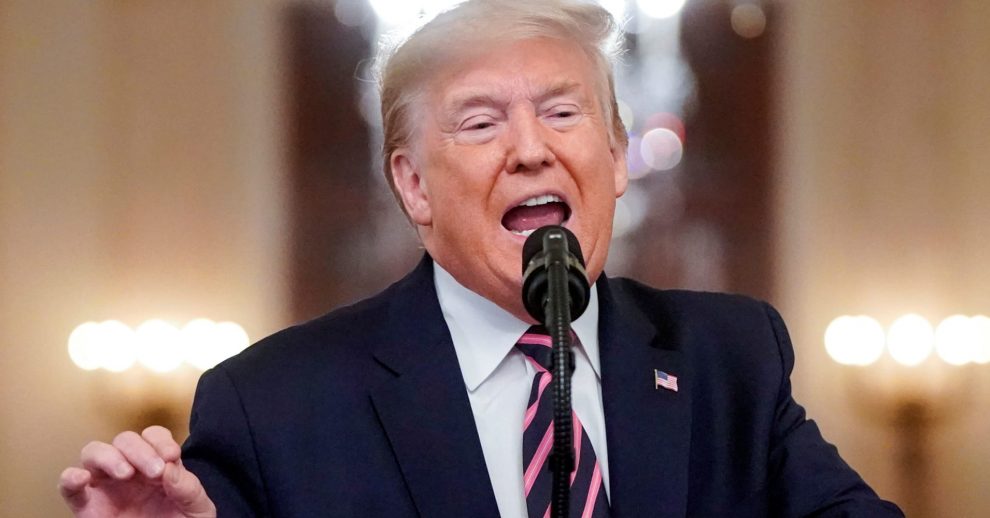
President Donald Trump’s re-election campaign sued The New York Times for libel on Wednesday, alleging the paper falsely reported about collusion between the president and Russia.
The lawsuit, filed in New York state court, claims the news organization “knowingly published false and defamatory statements” about Trump claiming he had an “overarching deal” with “Vladimir Putin’s oligarchy” to “help in the campaign against Hillary Clinton.”
“The statements were and are 100 percent false and defamatory,” Jenna Ellis, a lawyer for the campaign, said in a statement, The Hill reported.
“The complaint alleges The Times was aware of the falsity at the time it published them, but did so for the intentional purpose of hurting the campaign, while misleading its own readers in the process,” Ellis added.
The complaint notes The Times’ “own previous reporting had confirmed the falsity of these statements.”
AOC doubles down on call for Trump’s ouster even after ceasefire announcement
Inside Antifa-linked group’s plan to ‘structurally change’ the US as May Day unrest approaches
Michigan Senate hopeful Abdul El-Sayed’s unapologetic embrace of Hasan Piker
Terror suspects indicted after allegedly throwing bombs at NYC protest outside mayor’s mansion
A-10 Warthog given new maritime role targeting boats in Iran after efforts to retire aircraft
Breaking: Oil Plummets After Trump Announces Iran Ceasefire
Abortion pill mifepristone stays available by mail for now as FDA faces 6-month review deadline
Pope Leo calls out Trump’s Iran rhetoric before last-minute ceasefire emerges
Liberals tighten grip on battleground state Supreme Court in low-key but high-stakes election
American couple chasing retirement dream in Bahamas boating mystery were ‘inexperienced’: Friend
Swalwell campaign rejects ‘outrageous’ allegations of sexual misconduct as Dem activists issue viral warning
Watch: The Country Would ‘Come Unglued’ – Tim Burchett Reveals Alien Life Briefing He Attended 2 Weeks Ago
Texas man tackled by church security after bringing loaded gun, ammo to Houston service
ESPN Set to Begin Layoffs Due to ‘Unexpected Revenue Dip’: Report
Trump-backed Republican pads GOP’s fragile House majority by winning showdown for MTG’s former seat
“But The Times published these statements anyway, knowing them to be false, and knowing it would misinform and mislead its own readers, because of The Times’ extreme bias against and animosity toward the Campaign, and The Times’ exuberance to improperly influence the presidential election in November 2020.”
The Trump campaign’s legal team pointed specifically to an Op-Ed by Max Frankel titled “The Real Trump-Russia Quid Pro Quo,” published March 27, as the source of the defamation against the president’s election team.
In the article, Frankel, who served as The Times’ executive editor from 1986 to 1994, claimed, “There was no need for detailed electoral collusion between the Trump campaign and Vladimir Putin’s oligarchy because they had an overarching deal: the quid of help in the campaign against Hillary Clinton for the quo of a new pro-Russian foreign policy, starting with relief from the Obama administration’s burdensome economic sanctions.
“The Trumpites knew about the quid and held out the prospect of the quo.”
The complaint highlights the fact that Frankel offered no proof to back up his claims of Trump-Russia collusion.
Further, Special Counsel Robert Mueller’s report, released on April 18, found no evidence of coordination between the Trump campaign and Russia.
AOC doubles down on call for Trump’s ouster even after ceasefire announcement
Inside Antifa-linked group’s plan to ‘structurally change’ the US as May Day unrest approaches
Michigan Senate hopeful Abdul El-Sayed’s unapologetic embrace of Hasan Piker
Terror suspects indicted after allegedly throwing bombs at NYC protest outside mayor’s mansion
A-10 Warthog given new maritime role targeting boats in Iran after efforts to retire aircraft
Breaking: Oil Plummets After Trump Announces Iran Ceasefire
Abortion pill mifepristone stays available by mail for now as FDA faces 6-month review deadline
Pope Leo calls out Trump’s Iran rhetoric before last-minute ceasefire emerges
Liberals tighten grip on battleground state Supreme Court in low-key but high-stakes election
American couple chasing retirement dream in Bahamas boating mystery were ‘inexperienced’: Friend
Swalwell campaign rejects ‘outrageous’ allegations of sexual misconduct as Dem activists issue viral warning
Watch: The Country Would ‘Come Unglued’ – Tim Burchett Reveals Alien Life Briefing He Attended 2 Weeks Ago
Texas man tackled by church security after bringing loaded gun, ammo to Houston service
ESPN Set to Begin Layoffs Due to ‘Unexpected Revenue Dip’: Report
Trump-backed Republican pads GOP’s fragile House majority by winning showdown for MTG’s former seat
In a letter to congressional leaders summarizing Mueller’s findings made public on March 24 (three days before Frankel’s story), Attorney General William Barr quoted directly from the full report regarding collusion.
“The investigation did not establish that members of the Trump Campaign conspired or coordinated with the Russian government in its election interference activities,” Barr quoted the report as saying.
The Trump complaint faults The Times for failing to reach out to them for a response prior to publishing its “defamatory article,” which offers “further evidence of The Times’ actual malice.”
“The Times decided to publish the Defamatory Article when it did, in advance of the Mueller Report, knowing that the Mueller Report was likely to exonerate the Campaign from allegations of collusion with Russia regarding the 2016 election,” the complaint reads.
“Once the Mueller Report was released, The Times knew that any claims of conspiracy would not be credible.”
The Frankel story is part of a larger effort to undermine the campaign, according to the Trump campaign’s lawyers.
The paper “has engaged in a systematic pattern of bias against the Campaign, designed to maliciously interfere with and damage its reputation and seek to cause the organization to fail.”
“There is extensive evidence that The Times is extremely biased against the campaign, and against Republicans in general,” the complaint further reads. “This evidence includes, among other things, the fact that The Times has endorsed the Democrat in every United States presidential election of the past sixty (60) years.”
AOC doubles down on call for Trump’s ouster even after ceasefire announcement
Inside Antifa-linked group’s plan to ‘structurally change’ the US as May Day unrest approaches
Michigan Senate hopeful Abdul El-Sayed’s unapologetic embrace of Hasan Piker
Terror suspects indicted after allegedly throwing bombs at NYC protest outside mayor’s mansion
A-10 Warthog given new maritime role targeting boats in Iran after efforts to retire aircraft
Breaking: Oil Plummets After Trump Announces Iran Ceasefire
Abortion pill mifepristone stays available by mail for now as FDA faces 6-month review deadline
Pope Leo calls out Trump’s Iran rhetoric before last-minute ceasefire emerges
Liberals tighten grip on battleground state Supreme Court in low-key but high-stakes election
American couple chasing retirement dream in Bahamas boating mystery were ‘inexperienced’: Friend
Swalwell campaign rejects ‘outrageous’ allegations of sexual misconduct as Dem activists issue viral warning
Watch: The Country Would ‘Come Unglued’ – Tim Burchett Reveals Alien Life Briefing He Attended 2 Weeks Ago
Texas man tackled by church security after bringing loaded gun, ammo to Houston service
ESPN Set to Begin Layoffs Due to ‘Unexpected Revenue Dip’: Report
Trump-backed Republican pads GOP’s fragile House majority by winning showdown for MTG’s former seat
The Times responded to the lawsuit on Wednesday after its filing.
“The Trump campaign has turned to the courts to try to punish an opinion writer for having an opinion they find unacceptable,” Eileen Murphy, a spokeswoman for The Times, said in a statement.
“Fortunately, the law protects the right of Americans to express their judgments and conclusions, especially about events of public importance,” she added. “We look forward to vindicating that right in this case.”
Story cited here.


