




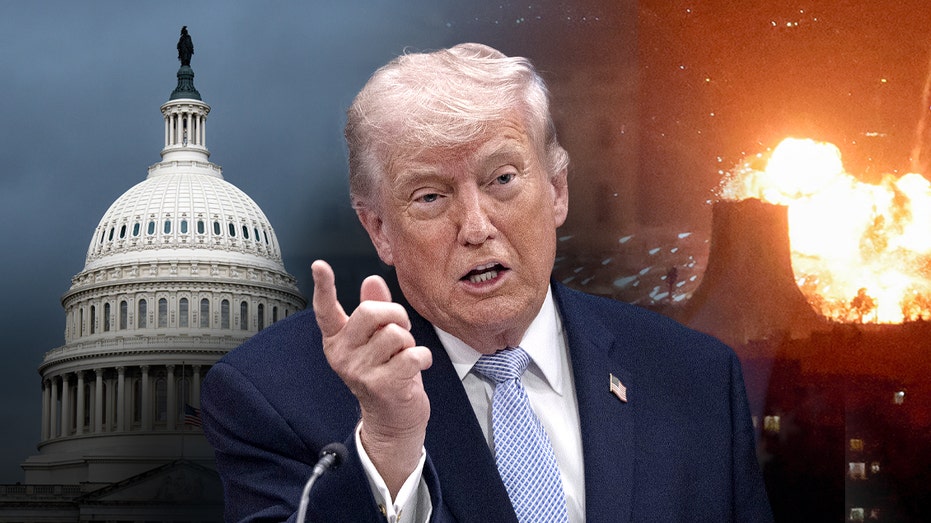
President Donald Trump informed Congress Friday that a ceasefire with Iran has ended hostilities and reset the clock on congressional war powers limits, but legal experts say ongoing military operations complicate that claim.
“For War Powers Resolution purposes, the hostilities that began on Saturday, February 28 have terminated,” a senior administration official told Fox News Digital.
“Both parties agreed to a 2-week ceasefire on Tuesday, April 7 that has since been extended,” the official went on. “There has been no exchange of fire between U.S. Armed Forces and Iran since Tuesday, April 7.”
The White House formally notified Congress in a letter Friday under the War Powers Resolution that it considers hostilities to have ended following the ceasefire.
“Despite the success of United States operations against the Iranian regime and continued efforts to secure a lasting peace, the threat posed by Iran and its proxy forces remains significant. Accordingly, the Department of War continues to update its force posture in the AOR in select areas to counter Iranian proxy forces’ threats and to protect the United States and its allies and partners,” Trump wrote in a letter to Congress Friday.
“As the situation evolves, I will continue to update the Congress on noteworthy changes in the United States Armed Forces presence, consistent with the War Powers Resolution.”
For decades, presidents of both parties have pushed the limits of the War Powers Resolution, seeking flexibility to conduct military operations without being hindered by a congressional vote.
The law requires the president to end the use of U.S. forces within 60 days of entering hostilities unless Congress authorizes the operation, with a limited extension allowed for withdrawal.
The more than two-month conflict has exposed sharply different interpretations of the law and whether the White House must seek congressional approval. Bombing ceased on April 7, but U.S. forces continue enforcing a naval blockade in the Strait of Hormuz — an operation widely considered an act of war.
“A ceasefire does not automatically suspend the War Powers 60-day clock,” said John Bellinger, who served as legal adviser to the State Department and National Security Council under President George W. Bush.
He pointed to the continued presence of U.S. warships and thousands of troops enforcing a blockade in the Strait of Hormuz, arguing American forces “are clearly still conducting military operations and are in potential danger.”
U.S. forces have continued boarding and seizing vessels suspected of violating the blockade, at times using force to disable ships before Marines conduct inspections.
Stephen Pomper, policy chief at the International Crisis Group and a former senior National Security Council official, was more direct.
“I don’t think it’s a very credible interpretation. It’s certainly not based on the text of the statute,” Pomper said.
“There’s still an enormous American deployment. There’s an active blockade, which is an act of war.”
Trump is far from the first president to test the limits of the War Powers resolution, experts noted.
During the late 1980s “Tanker War” with Iran, the George H.W. Bush administration argued that individual naval engagements did not amount to sustained hostilities. In 1999, the Clinton administration maintained that congressional funding for the Kosovo campaign effectively constituted authorization.
More recently, the Obama administration argued that U.S. involvement in Libya did not rise to the level of “hostilities” under the War Powers Resolution, even as American forces supported air operations. The Biden administration made similar arguments in defending certain U.S. deployments tied to Yemen.
“We have seen Republican and Democratic administrations alike bypass the act in creative ways,” Nicholas Creel, Associate Prof. of Business Law at Georgia College and State University told Fox News Digital.
Congress has periodically challenged similar interpretations in past conflicts but has rarely forced a withdrawal of U.S. forces. Courts have also largely stayed out of War Powers disputes, leaving presidents with significant latitude to define the scope of hostilities.
If Congress does not act, the administration could continue operations without new authorization.
“It’s really up to Congress, and as often as not, Congress doesn’t want to push back,” Pomper said.
Matt Zierler, an international relations professor at Michigan State University, told Fox News Digital that Congress likely does not have the “real will” to fully execute the War Powers Act because other powers, such as passing appropriation bills that would restrict defense spending, would be more effective. Even so, Zierler said sequestration measures could come at a political loss.
“It’s a big political loss, potentially for Congress, if they start cutting off funding,” Zierler said, suggesting that the president could claim the cut in funds by Congress is hurting troops and national security.
“It is a political or symbolic game, but it’s not necessarily something that most members of Congress want to play, because, you know, they don’t have all the intelligence,” Zierler said. “They don’t know what’s going on, and it can get really messy.”
Asked about the 60-day clock on Thursday, Senate Armed Services Committee Chairman Roger Wicker, R-Miss., told reporters: “I have not spent a great deal of time worrying about that.”


