







EXCLUSIVE — The Department of Transportation’s Federal Aviation Administration is beginning to deliver major results in its sweeping effort to overhaul the nation’s air traffic control system, a colossal project that aims to transform how Americans fly by 2028.
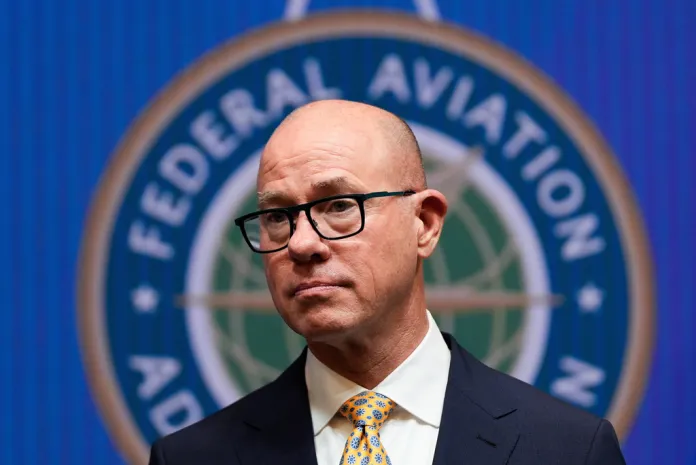
In a sit-down interview at the DOT’s Washington headquarters, FAA Administrator Bryan Bedford laid out how the Trump administration is fulfilling the agency’s decadeslong wish to modernize air travel by implementing more than 10,000 changes before President Donald Trump leaves office.
“When the president and the secretary not only said we’re going to modernize, but we’re going to do it in three years, we had to be very deliberate and very strategic,” said Bedford, a former aviation executive.
Commercial air travel has soared to all-time high levels of nearly 3 million passengers per day since the pandemic, according to the Transportation Security Administration. The FAA has struggled to maintain enough air traffic controllers and to operate using antiquated flight-tracking systems and ground infrastructure amid a series of high-profile aviation incidents, all as more people choose air travel year over year.
The problems have become increasingly visible to the traveling public, with frequent flight delays and cancellations. One in 12 flights was delayed more than an hour last year, making 2025 the year with the worst on-time performance in more than a decade, according to DOT data reviewed by the nonprofit Public Interest Research Group.
</p>
<p> ” data-large-file=”https://conservativemodern.com/wp-content/uploads/2026/08/trump-administration-races-to-overhaul-americas-air-traffic-control-system-by-2028.webp” src=”https://conservativemodern.com/wp-content/uploads/2026/08/trump-administration-races-to-overhaul-americas-air-traffic-control-system-by-2028.webp” alt=”FILE – Federal Aviation Administration administrator Bryan Bedford looks on as Transportation Secretary Sean Duffy speaks during a news conference on new drone regulations, Aug. 5, 2025, at the Department of Transportation in Washington. (AP Photo/Julia Demaree Nikhinson, File)” class=”wp-image-4699004″ style=”aspect-ratio:1.4967908867905508;width:501px;height:auto” srcset=”https://conservativemodern.com/wp-content/uploads/2026/08/trump-administration-races-to-overhaul-americas-air-traffic-control-system-by-2028-2.webp 1024w, https://conservativemodern.com/wp-content/uploads/2026/08/trump-administration-races-to-overhaul-americas-air-traffic-control-system-by-2028-2.webp?resize=300,201 300w, https://conservativemodern.com/wp-content/uploads/2026/08/trump-administration-races-to-overhaul-americas-air-traffic-control-system-by-2028-2.webp?resize=768,514 768w, https://conservativemodern.com/wp-content/uploads/2026/08/trump-administration-races-to-overhaul-americas-air-traffic-control-system-by-2028-2.webp?resize=150,100 150w, https://conservativemodern.com/wp-content/uploads/2026/08/trump-administration-races-to-overhaul-americas-air-traffic-control-system-by-2028-2.webp?resize=696,466 696w” sizes=”auto, (max-width: 1024px) 100vw, 1024px”><figcaption class=) FILE – Federal Aviation Administration administrator Bryan Bedford looks on as Transportation Secretary Sean Duffy speaks during a news conference on new drone regulations, Aug. 5, 2025, at the Department of Transportation in Washington. (AP Photo/Julia Demaree Nikhinson, File)
FILE – Federal Aviation Administration administrator Bryan Bedford looks on as Transportation Secretary Sean Duffy speaks during a news conference on new drone regulations, Aug. 5, 2025, at the Department of Transportation in Washington. (AP Photo/Julia Demaree Nikhinson, File)“Sometimes I think the airlines like to go with the, you know, easiest, most understandable explanation for the trouble, which is either weather or it’s air traffic control. It’s never the airline,” Bedford said. “It is very frustrating for consumers and for flight crews as it is for the FAA personnel in the towers that have to deal with all the aircraft that are stuck. So, you know, I think the challenge that we face is we’re dealing with archaic infrastructure.”
In December, the DOT revealed plans for the Brand New Air Traffic Control System, known as BNATCS. Bedford said the modernization effort will dramatically improve the speed and efficiency of the nation’s air traffic system, benefiting both controllers and travelers. The goal, he emphasized, is not to make an already safe airspace safer, but to make the system more streamlined.
“The price of not modernizing isn’t safety,” Bedford said. “The price of not modernizing is efficiency, and convenience, and predictability, and reliability.”
Plotting a course forward
The Trump administration began early in 2025, looking at how to overhaul the air traffic control system.
Bedford worked in aviation for 35 years prior to the FAA, including as president and CEO of Republic Airways. He was nominated in March 2025 and confirmed by the Senate in July 2025, days after Congress passed $12.5 billion in funding that the FAA and DOT could use toward the modernization plan. Transportation Secretary Sean Duffy said the overhaul’s price tag would come in at $31.5 billion, with the first major part funded and to be completed by the end of 2028.
IT’S HAPPENING
For years people said they would modernize the airspace. They failed.
No more broken promises. Thanks to President Trump, new tech like this surface radar are rolling out nationwide
What we celebrated today at Newark International Airport is just a tiny… pic.twitter.com/8bocgAsi7E
— Secretary Sean Duffy (@SecDuffy) August 11, 2026

Sen. Jerry Moran (R-KS), chairman of the Senate Commerce Subcommittee on Aviation, Space, and Innovation, said in a December 2025 hearing that the FAA and DOT’s plans to remake air traffic control were a historic undertaking.
“The scale and scope of this comprehensive modernization is enormous, and has and will continue to require industry-wide mobilization of public-private partnerships to manage and modernize on expedited timelines,” Moran said during the hearing.
The FAA endeavor has not been without turbulence. The United States saw the most deadly aviation accident since the 9/11 terrorist attacks in January, when an American Airlines jet collided mid-air with a U.S. Army Black Hawk helicopter seconds before the plane was slated to land at Reagan National Airport. All 67 passengers and crew were killed.
Getting the wheels turning
The $12.5 billion in funding covers the cost of scaling up the air traffic controller workforce and modernizing infrastructure. An additional roughly $19 billion that Congress has set to allocate for the project would cover how the agency navigates aircraft once they are airborne.
“Last year, when we published the workforce plan, in total, certified controllers, developmental controllers, academy trainees, we had just over 14,500 men and women in the workforce, and of that 14,000, only about 10,500 were actually fully certified in the facilities that they were managing,” Bedford said. “We have this huge population of trainees or developmentals that we need to get through the system.”
Part of that is driven by 2,000 new hires brought in this past year. Duffy announced earlier this month that the FAA had launched a hiring initiative that specifically targeted people who play video games, which brought in 2,000 hires.
“They multitask. They have to think on their feet,” Duffy told Fox News host Laura Ingraham on Aug. 13. “They work with their hands and their eyes, and they’re making great controllers. We had 14,000 applicants, 8,000 qualified. We were getting the best and the brightest.”
In April, we launched a NEW CAMPAIGN to recruit video gamers as air traffic controllers — and supercharged the entire hiring process to get the BEST & BRIGHTEST in faster. The results are HISTORIC
94% of hiring goal met — fastest time ever to reach target… pic.twitter.com/gN3OGmEIBB
— Secretary Sean Duffy (@SecDuffy) August 9, 2026

But Dave Riley, a retired air traffic controller who spent 33 years in the profession, was skeptical of the administration’s emphasis on recruiting gamers, arguing that getting applicants in the door is only the beginning of a much more difficult process.
“You know, everybody’s talking about this recruiting part. Oh, and we’re focusing on gamers now,” Riley said. “What is there a separate box on there that says I play Call of Duty or I play Roblox, so therefore I’m more qualified than somebody else? No, there’s not.”
Riley said the bigger challenge is getting prospective controllers through the FAA’s lengthy training process and ultimately certified to work on their own.
“It’s just to hype it up that they’re focusing on this part of the workforce,” Riley said, pointing out that military veterans with previous air traffic control experience have long provided another recruiting pool for the agency.
The FAA has added an additional 2,200 new hires to its training pipeline, but roughly 30% of those trainees will make it through in a year, according to Bedford.
 Rep. Bill Shuster said he would make moving air traffic control from the government to a nonprofit a key part of the FAA reauthorization bill. (AP Photo/Seth Wenig) | Seth Wenig
The agency has projected it will lose up to 6,900 controllers through 2028 due to retirements, resignations, transfers, and those who do not complete training. Bedford maintained that attrition is “remarkably low.”
“This has been a decadeslong problem in the making, and it’s going to take time to fix,” Bedford said. “Once we get a controller through the facility training, they rarely quit.”
Decades-old infrastructure replaced
The FAA has begun to replace infrastructure, including radar, software, hardware, and telecommunications, through more than 10,000 projects nationwide, all of which are being tracked.
“Replace radars, to replace copper lines with fiber and low Earth orbital satellites and LTE solutions,” Bedford said. “We’re going to modernize voice switches to go from analog TDMI to [Voice over Internet Protocol], which most of the country did back in 1990. But we’re the last guys to leave the TDMI party. But that’s happening, and it’s happening at record speed.”
The flight tracking system is so outdated that air traffic controllers track individual flights on pieces of paper known as flight strips. Twenty of the 89 control towers that use the antiquated paper strips have swapped them for electronic displays that give controllers real-time information.
More than 60% of the nation’s legacy copper telecommunications lines have been replaced with high-speed fiber-optic and wireless infrastructure. Manual buttons and analog patch boards are being replaced with digital communications and switches.
As of late August, the FAA had replaced 44% of its 220 surface awareness initiatives; converted 380 of 1,581 radio sites; transferred 166 of 450 voice switches to IP voice switches; and deployed 9 of 612 new radar systems nationwide, according to the government’s Modern Skies website that tracks the progress of projects.
Looking to the horizon
Air traffic controllers rely on four separate software programs to manage air traffic, and the programs cannot operate together, meaning one system monitors upper altitudes, a second handles the terminal environment, a third focuses on trans-Atlantic and transpacific traffic, and the fourth hones in on the tower environment.
“These programs are very sort of meat cleaver, brute force programs that lack precision,” Bedford said. “We can absolutely do better, and we will begin to do better when we go from a, you know, sector by sector by sector, you know, traffic management solution to a national optimization solution.”
That solution is a single system that can streamline all data from the ground, sky, and towers into one product, called Strategic Management of Airspace, Routes, and Trajectories.
Airlines for America, a trade organization that advocates major U.S. airlines, emphasized the importance of securing the rest of the $331 billion from Congress to see this flight not just get off the ground but ensure it arrives at its intended destination.
“The United States has the safest airspace in the world but maintaining that standard requires continued investment in the infrastructure that keep millions of travelers and thousands of tons of cargo moving safely and efficiently every day,” Airlines for America said in a press release shared with the Washington Examiner.
Thanks to @SecDuffy and @FAA_Bryan , Americans will get the air traffic system they deserve. pic.twitter.com/3rTIuzgkxu
— ASI (@AirSpaceIntel) June 23, 2026
“Over the next 12 months, I do hope that the Congress will give us the funding that we need,” Bedford said. “If we can get that, then all of a sudden, you know, these outages are going to disappear. Reliability is going to go up. Safety is going to go up. And our ability to manage traffic will be unlike anything we’ve had before.
“I do believe the American traveling public is going to feel a big difference in the quality and the reliability,” he said. “But I’m sure if there’s a problem, the airlines will still blame us.”
Samantha-Jo Roth contributed to this report.


