




A massive influx of applicants filed to take advantage of Minnesota’s new paid leave law before benefits even went into effect, as fraud watchdogs warn that the taxpayer-funded assistance program, which is open to “undocumented workers,” will be widely abused.
Approximately 18,000 applications have poured in since the Minnesota Paid Family and Medical Leave Program started accepting submissions in early December, according to the Department of Employment and Economic Development, the state agency administering PFML.
Minnesota began paying out claims on Jan. 1, but the state government encouraged prospective PFML participants last month to “get a jumpstart” on claiming eligible life events in the coming year.
At least 3,510 approved applicants are already on paid leave less than a week into the program’s implementation, DEED announced Tuesday afternoon.
The deluge of early submissions “shows just how motivated people are to engage with this new program,” DEED Commissioner Matt Varilek said in a statement.
Out of the 6,300 claims screened as of Friday morning, more than three-fifths, or 63.5%, were authorized for payment processing, per Axios Twin Cities.
A bulk of the accepted filings came from parents racing against their child’s first birthday. Residents can retroactively claim “bonding time” for a baby born in 2025 or a child recently taken into their care. So far, DEED has accepted around half of the 7,000 or so paid leave petitions filed by parents who say they welcomed a new child, including infants, adopted children, and foster care placements, in the past 12 months.
Deputy Commissioner Evan Rowe told reporters that the flood of applications is attributable, in part, to the sign-up portal’s early rollout and noted that the numbers at this point are not “out of whack with projections.”
Based on an actuarial analysis, DEED expects the department to approve about 130,000 applications in PFML’s inaugural year, equaling an estimated 10,800 approved claims per month.
Fraud risks versus program integrity safeguards
Over a 12-week coverage period of one’s choosing, PFML provides payments to Minnesotans purportedly in need of time off from work for “serious health” reasons or to take care of a family member, such as a newborn or a sick relative.
The program’s stipulations broadly define who is considered a family member to include almost anyone, encompassing those “like family” that are dependent on a claimant, “even if not related by blood.” The threshold is simply an “expectation and reliance for care.” Multiple caregivers can take paid leave for the same person, and parties named on the paperwork do not have to live together, either.
Claimants can “double dip” by combining both types of claims to take off a total of 20 weeks within a single year. For instance, a person could technically take 12 weeks to care for a close companion, then claim another eight weeks for personal medical problems, enjoying months of what is essentially an extended paid vacation.
Program beneficiaries may “top off” their leave of absence by adding on paid time off, sick days, and vacation hours, an optional perk known as “supplemental payment,” if their employer agrees to offer the added-on benefits.
While on paid leave, program beneficiaries receive partial pay worth between 55% and 90% of their regular wages, depending on income level. The maximum amount allowed is currently capped at the state’s average weekly wage of $1,423, which amounts to a $74,000 annual salary.
Workers who were hired a minimum of three months ago are eligible, so if someone has worked in a job for 90 days, they can claim up to 20 weeks, or five and a half months, of paid time off from work.
DEED administrators expressed confidence in the program’s vetting protocols aimed at fraud prevention.
“Paid Leave was built with strong systems in place to verify identities and work histories and to detect and prevent fraud,” a DEED spokesperson told the Washington Examiner. “We accept tips about potential fraud from all sources, and we investigate all reports.”
The agency representative added that every employee’s paid leave claim requires certification from an appropriate professional attesting that their time off is essential. PFML also employs a variety of administrative data sources to cross-check information and ensure accuracy, the department spokesperson said.
WALZ ALLIES LED STATE AGENCIES THAT OVERSAW MASSIVE ALLEGED SOMALI DAY CARE FRAUD
The program’s certification process is “streamlined,” the state says. Applicants fill out a certification form, which is then signed by a healthcare provider. Qualified certifiers for medical leave include a wide range of professionals, such as dentists, optometrists, social workers, alcohol and drug counselors, and mental health professionals. Medical providers outside of Minnesota, including those practicing outside of the United States, can certify paid leave.
DEED pointed the Washington Examiner to a Republican-led House Fraud Prevention and State Agency Oversight Policy Committee hearing held in November to review PFML’s anti-fraud measures. There, the deputy commissioner of DEED testified about the program’s integrity components. During the oversight hearing, Minnesota Legislative Auditor Judy Randall remarked that she was “impressed” with much of what was presented before the committee, though her office does not conduct prospective assurance reviews.
“I can’t say anything definitive, of course, but I listened to the presentation, and honestly, I was impressed with a lot of that,” Randall said.
Illegal immigrants among ‘prioritized’ program prospects
Under a Democratic governing trifecta, the 2023 paid leave law passed without a single Republican vote in the state legislature, making Minnesota the 13th state in the nation to provide such government assistance. Since the law’s enactment, the program’s execution took more than two and a half years of design, construction, and testing.
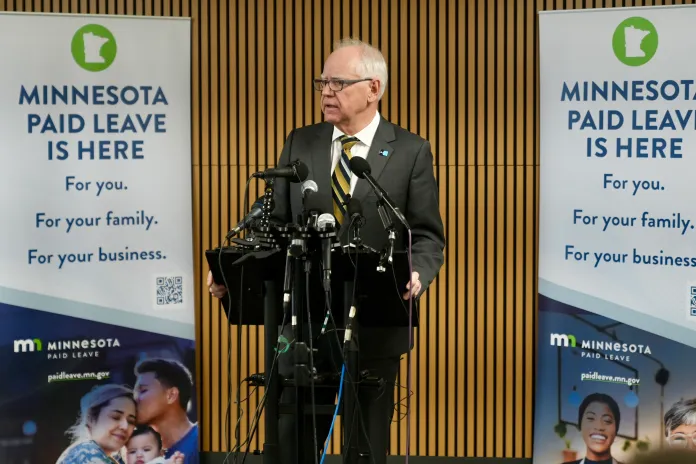
Gov. Tim Walz (D-MN), who is accused of allowing welfare fraud to proliferate under his administration, signed PFML into law and heavily promoted the program ahead of its unveiling.
Pressed about whether PFML would be a target for fraudsters, Walz said it is “disrespectful” to assume that ailing Minnesotans will try to scam the benefits program.
Walz has especially been defensive of the Somali immigrants living in Minnesota, dozens of whom face criminal charges for stealing millions in tax dollars from the state’s social services.
Following reports of Somali-run sham nonprofit groups exploiting programming meant for struggling Minnesotans, Walz even embraced the idea of more Somalians settling across the state.
WALZ SAYS HE WOULD ‘WELCOME MORE’ SOMALIS AS FRAUD INVESTIGATION INTENSIFIES
Employers are required to display a PFML poster at their respective workplaces notifying employees about the paid leave program. The poster, available in a variety of languages with more versions coming soon, must be displayed in any foreign language that is the primary tongue of at least five workers.
In the lead-up to the paid leave program’s launch, the state awarded public outreach grants to community groups, such as Sub-Saharan African Youth & Family Service and African Economic Development Solutions, supporting efforts to ensure that certain employees, employers, and self-employed individuals from “priority populations” are aware of PFML.
Emphasizing “equity,” the grant program prioritizes proposals aimed at increasing awareness and access among “undocumented communities,” ethnic minorities, LGBT people, and limited English proficiency speakers.
Funding for the grants comes from an earmarked portion of the projected PFML payments. An available fund of $1.9 million went toward the grants for fiscal 2026 and will increase to $3.7 million the following year.
The burden on taxpayers
The paid leave program itself is funded through a payroll tax split evenly between employers and employees. Workers, including illegal immigrants, who pay into the program have their half deducted from their wages.
Thanks to almost $800 million in seed money allocated toward PFML’s startup costs, a nest fund allowed the state to start paying out claims immediately on Jan. 1, the program’s start date.
Payroll taxes, now set at 0.88%, have already been increased since PFML’s passage, hiked up from the initial 0.7% rate originally proposed in 2023. DEED is slated to adjust the rate annually after a yearly actuarial evaluation.
It remains to be seen whether officials will continue to raise the payroll tax rate to cover the costs of demand. Economic policy experts suspect so, saying that state leaders are grossly underestimating the number of applicants who will seek paid leave.
FOUR TAKEAWAYS FROM HOUSE OVERSIGHT’S HEATED MINNESOTA FRAUD HEARING
“That’s been the pattern after every new social benefit introduced,” said Bill Glahn, a former research consultant for the Minnesota House of Representatives, who advised the economic development and finance committees.
Glahn previously told the Washington Examiner that he predicts “a huge uptake” based on those trends. “They’re immediately going to find themselves in the hole, having to raise that payroll tax again.”


