







Former House Speaker Nancy Pelosi (D-CA) and President Donald Trump do not agree on much. In fact, they hate each other.
But Pelosi, 85, and Trump, 79, do share one professional characteristic. They each regained jobs at the pinnacles of government power after spells in the political wilderness. Trump is nearly a year into his second term, while Pelosi is wrapping up nearly 40 years in Congress, including stints as House speaker, second in line of presidential succession behind the vice president, from 2007 to 2011 and 2019 to 2023.
Pelosi is retiring on Jan. 3, 2027, the end of this Congress. She has represented a San Francisco-based district since winning a special election in June 1987. Pelosi is among the 15 House members who have announced their retirements so far, while 27 House lawmakers are running for statewide office, a mix of bids for Senate and governor, with one state attorney general candidacy thrown in.
Pelosi secured her place in political history as the first woman to serve as House speaker when she won the gavel after the Democrats’ 2006 triumph, which resulted in the party’s first majority in 12 years. In that first stint as speaker, Pelosi muscled through the Affordable Care Act, the signature domestic achievement of former President Barack Obama’s time in office. That was among many other elements of Obama’s legislative agenda that Pelosi played a big role in pushing into law.

“Here’s a hard truth Republicans don’t want to hear: Nancy Pelosi was a more effective House speaker than any Republican this century,” Rep. Nancy Mace (R-SC) wrote in a Dec. 8 New York Times op-ed lambasting House Republican leadership.
“I agree with her on essentially nothing. But she understood something we don’t: No majority is permanent,” Mace added. “When Democrats hold the majority, they ram through the most progressive policies they can. They deliver for the coalition that elected them while they are in power.”
Yet, whatever Pelosi’s political acumen and legislative achievements, her second speakership bears a blemish — the creation of House proxy voting during the COVID-19 pandemic.
House Democrats adopted the remote voting rule on May 15, 2020. This landmark, but temporary, rule change allowed members to vote by proxy on the House floor and participate in virtual committee proceedings. A member unable to physically attend proceedings could submit a letter to the House Clerk authorizing another member to cast votes on their behalf with specific instructions. Members voting by proxy still counted toward achieving a quorum.
Allowing remote voting for the first time may have been well-intentioned during the virus’s early months, in spring and summer 2020, when the public health threat of COVID-19 was unclear. Yet House members soon began abusing the privilege for decidedly non-COVID-19-related reasons.
Rep. Greg Stanton (D-AZ) participated remotely in a House Transportation Committee hearing from a boat in July 2020. The move lent “a leisurely appearance to a job often held in scorn by the public, especially during a pandemic and recession,” the Arizona Republic reported at the time.
Stanton, in his first House term, apologized in an X post (then known as Twitter), while a spokeswoman said he appeared from Utah, where he was visiting family, and was on a boat.
In April 2022, news reports revealed that then-Democratic Florida Rep. Charlie Crist only voted in person four days that year. Crist’s absence extended to congressional hearings, including at least five closed briefings with top military officials, according to the Miami Herald.
In the most egregious case, former Democratic Hawaii Rep. Kai Kahele was found in April 2022 to have used proxy votes on all but five of that year’s 125 roll calls. His congressional website at the time said he was “an active commercial airline pilot with Hawaiian Airlines,” flying domestic and international trips on Airbus A330 wide-body aircraft.
In a statement, Kahele’s office said he piloted three flights that year, work necessary to keep up his commercial aviation accreditation. Like everyone who has voted by proxy, he submitted a required letter attesting he was “unable to physically” vote at the Capitol. He cited “the ongoing public health emergency.”
Pelosi kept proxy voting in place through the end of her speakership. House Republicans quickly banned it when they took over in January 2023.
Every rose has its campaign thorn
House members chafe at senators’ claims to be Congress’s “upper chamber.” After all, both sides of the Capitol must pass legislation, and then send it to the president for his signature or veto. And pay is largely the same at $174,000 for most lawmakers.
Yet the Senate undoubtedly has some advantages, which is why so many House members are willing to risk often-safe political seats for a Senate bid. The Senate allows potentially unlimited debate on legislation (the filibuster) and possesses unique powers, such as confirming presidential nominations and ratifying international treaties.
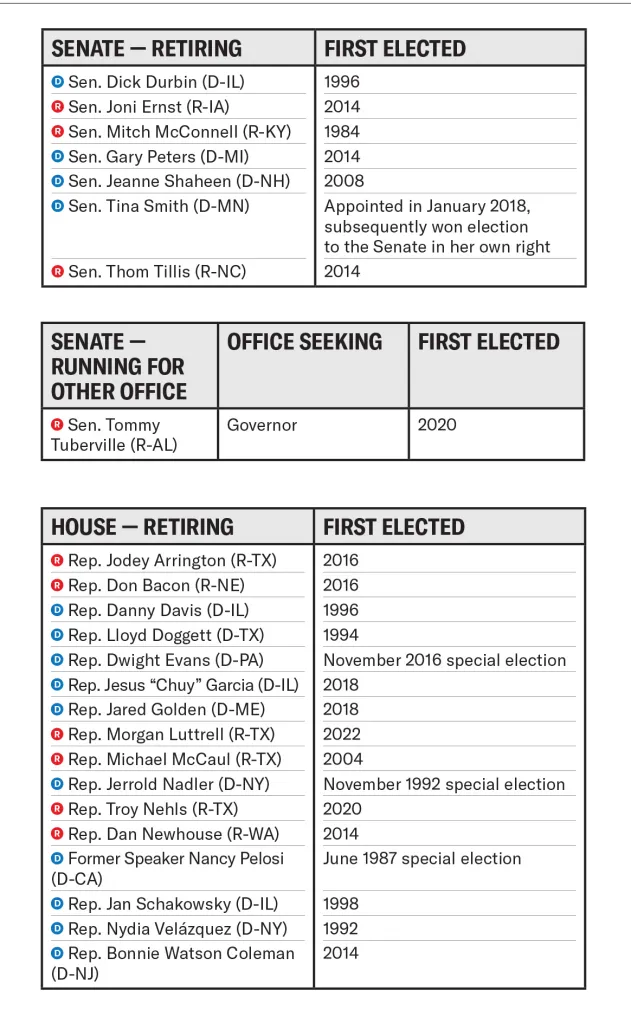
In a broader sense, senators often consider their chamber superior since they are in a more exclusive club — just 100 members versus 435 in the House. And senators represent entire states, as opposed to mere districts in the House.
Cross-Capitol rivalries aside, senators have a stark political advantage when seeking other offices. The difference is playing out ahead of the Aug. 6, 2026, Tennessee gubernatorial primary, pitting Sen. Marsha Blackburn (R-TN) against Rep. John Rose (R-TN), among other candidates. Blackburn is not up for reelection in the Senate until 2030 (she was first elected in 2018 after 16 years as a House member). But Rose is giving up his House seat, covering eastern Nashville, the suburbs, and rural areas nearby, to run for governor.
This means Rose has much more political skin in the game than Blackburn, who can simply return to the Senate if her GOP gubernatorial bid falls short. Rose, though, will be out in the political cold if he loses his campaign for the Tennessee governorship in the 2026 election cycle, which became open with state term limits forcing Gov. Bill Lee (R-TN) from office.
Top Democratic committee spot finally opens
On Feb. 28, 1998, Celine Dion’s tear-jerker Titanic ballad “My Heart Will Go On” topped the pop charts. Medical drama ER was television’s most-watched show. And people visiting the internet had to endure dial-up service. This made for a slow, noisy, and often frustrating experience defined by screeching modem sounds, tying up the phone line, and waiting ages for simple web pages or downloads.
While in Washington, D.C., Rep. Nydia Velázquez (D-NY) assumed the ranking member’s spot on the House Small Business Committee. Velázquez went on to hold the top Democratic committee spot, including as chairwoman from 2007 to 2011 and 2019 to 2023, when her party was in the majority, for more than 28 years.
Velázquez, 72, is retiring from the House at the end of this Congress, having been first elected in 1992 to a forerunner of the northern Brooklyn and western Queens district she represents. Her decadeslong hold on a plum committee assignment is a late 20th- and early 21st-century twist on the old congressional tradition of staying put once you are in a position of power or influence. It was a form of political art, perfected during the Democrats’ 40 years in the majority, often by committee chairmen, often from the South.
Velázquez, who was born and raised in Puerto Rico before graduating from school in New York and getting involved in Democratic politics, was only chairwoman for a fraction of her long committee tenure. Still, it’s representative of how committee politics are played in the House Democratic Caucus versus the Republican conference.
GOP lawmakers are subject to strict term limits of six years either as chair or ranking member of a committee. It’s a rule implemented by House Republicans in early 1995, after they broke the Democrats’ four-decade-long hammerlock on power, and one they have kept in place for more than 30 years.
Democrats, though, have no term limits on top committee spots. They have historically prioritized the seniority system. This system is often defended by members of the Congressional Black Caucus and others as a way to ensure a level playing field and promote diversity in top ranks over time.
In recent years, there have been renewed internal debates and challenges to the seniority system. Younger and more junior members have mounted challenges to long-serving senior members for key committee roles, with mixed results. Proposals to institute a six-year term limit similar to the Republican rule have been introduced. Though the most recent, led by Rep. Bill Foster (D-IL), was voted down by the full House Democrat Caucus in late 2022.
The retirement of Velázquez from Congress will open up a rare top committee spot, one that is especially coveted since Democrats have a decent shot at winning the House majority in 2026.
Brother Act in Congress?
It’s no exaggeration to say retiring Rep. Troy Nehls (R-TX) may be replaced in the 22nd Congressional District he represents by a familiar face.
The departing lawmaker’s identical twin brother, Fort Bend County Constable Trever Nehls, is running for the conservative district, covering the southern Houston suburbs and exurbs. Trump has endorsed Trever Nehls, who will face conservative activist Rebecca Clark in the March 3 Republican primary.
The winner is virtually assured to be the next representative for the congressional district. Its new iteration, due to a 2025 Republican gerrymander of Texas congressional district at Trump’s behest, would have backed the president 60% to 38% over Democratic rival Kamala Harris.
Troy Nehls, 57, announced on Nov. 30 that he would retire from Congress after six years in office. Trever Nehls announced a bid on the same day and immediately drew his brother’s endorsement.
Troy Nehls has been an eager congressional ally of Trump for nearly five years. He drew attention during former President Joe Biden’s 2024 State of the Union by donning a T-shirt emblazoned with Trump’s mugshot and the caption “NEVER SURRENDER!”
The Nehls brothers would be a rare, perhaps even first, set of identical twins in Congress, though at different times. But hardly any of the online members of Congress have an identical twin.
Rep. Joaquin Castro (D-TX) has an identical twin, Julian Castro, who was the mayor of San Antonio and then House and Urban Development secretary during the Biden administration.
Rep. Eugene Vindman (D-VA) has an identical twin brother, Alexander Vindman, who gained national fame — or infamy in the view of Trump and supporters — for his tenure as a National Security Council aide. His testimony during Trump’s first impeachment only ratcheted up the president’s contempt for him and his now-congressman brother.
HOUSE APPROPRIATORS EYE SMALLER SPENDING DEAL TO AVOID ‘NIGHTMARE’ JANUARY
Another Trump political enemy, Sen. Mark Kelly (D-AZ), has an identical twin, Scott Kelly. In November, Mark Kelly drew Trumpworld’s wrath after he and other Democratic lawmakers released a video reminding military personnel of their legal obligation to refuse illegal orders. The senator is currently under investigation by the Pentagon over the matter.
Both Kelly brothers are retired astronauts. Each flew on space shuttle missions, with Scott Kelly completing a yearlong mission on the ISS, leading to NASA’s unique Twins Study comparing their biology.