







Playwright Peter Shaffer (1926-2016) chased the same idea for 30 years. A mild-mannered, rule-bound protagonist meets a counterpart who is wild at heart. Our hero is at first repelled but soon becomes fascinated, envious, even obsessed. Theatergoers who remember Five Finger Exercise (1958), The Royal Hunt of the Sun (1964), Equus (1973), and Lettice and Lovage (1987) will recognize the theme. Virtue may be its own reward, but passion is the only sure road to transcendence.
Amadeus, winner of the 1981 Tony Award for Best Play, is perhaps Shaffer’s clearest expression of this conceit. Set in 18th-century Vienna, the play concerns the relationship between staid court composer Antonio Salieri and brilliant vulgarian Wolfgang Amadeus Mozart. Convinced that “music is God’s art,” Salieri despairs to realize that his unworthy rival has been chosen as the Almighty’s vessel. (“Let your sound enter me! Let me be your voice!”) Thus dejected, Salieri sets out to destroy his adversary, aware all the while that Mozart has lived and worked in a higher register than Salieri will ever reach.
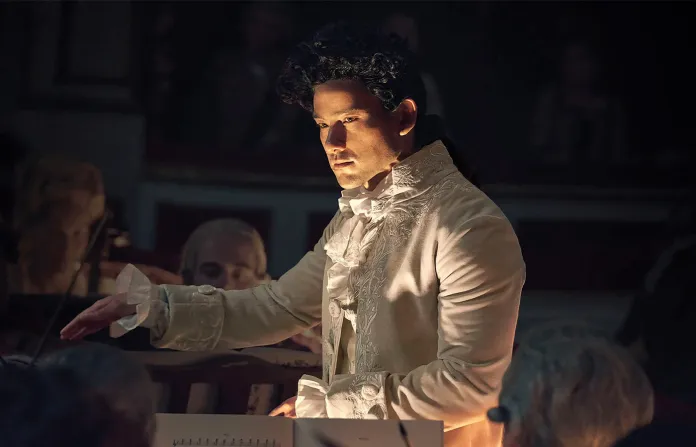
The new five-part take on Shaffer’s masterpiece, airing on Starz, preserves this tension. (The series premiered late last year on Sky Atlantic.) Played by a wan Paul Bettany, Salieri is a broken man, increasingly possessed by the notion that God has blessed the wrong servant. Mozart, lent reckless bravado by The White Lotus’s Will Sharpe, is an infuriating genius, careless of his gift and far more concerned with his seduction of soprano Constanze Weber (Gabrielle Creevy). Viewers of this television adaptation will inevitably hearken back to Amadeus, the film, Milos Forman’s Oscar-winning 1984 version starring F. Murray Abraham as Salieri and Tom Hulce as Mozart. Let’s clear things up right now: The movie is far better. Nevertheless, the series is not without its appeal. Given room to expand, Shaffer’s source material proves more than able to support an expanded TV runtime.
It is aided by a pair of compelling supporting performances. As Mozart’s illicit-lover-turned-wife, Creevy captures well the equipoise required of a strong woman among self-worshiping men. Note the insouciance with which, in an early episode, she disarms an unwanted advance by revealing a pregnant belly. Even better is a scene-stealing Rory Kinnear as Emperor Joseph, an arts patron so world-weary he can barely remember which opera plots he’s banned. Taken together, these characters make a clever joke of the Enlightenment: Suppress rape and despotism, and one is left with sexual harassment and ministerial feuds. Yet Creevy’s work, at least, is not entirely comic. While Mozart is writing and conducting his world-bestriding Marriage of Figaro, Constanze is at home, abandoned, mourning in solitude the death of the pair’s infant son.
</p>
<p> ” data-large-file=”https://conservativemodern.com/wp-content/uploads/2026/06/the-wish-to-be-like-wolfgang-review-of-amadeus.webp” height=”658″ width=”1024″ src=”https://conservativemodern.com/wp-content/uploads/2026/06/the-wish-to-be-like-wolfgang-review-of-amadeus.webp” alt=”Will Sharpe in Amadeus. (Adrienn Szabo/Sky UK Ltd)” class=”wp-image-4617002″ style=”width:801px;height:auto” srcset=”https://conservativemodern.com/wp-content/uploads/2026/06/the-wish-to-be-like-wolfgang-review-of-amadeus-1.webp 1400w, https://conservativemodern.com/wp-content/uploads/2026/06/the-wish-to-be-like-wolfgang-review-of-amadeus-1.webp?resize=300,193 300w, https://conservativemodern.com/wp-content/uploads/2026/06/the-wish-to-be-like-wolfgang-review-of-amadeus-1.webp?resize=768,494 768w, https://conservativemodern.com/wp-content/uploads/2026/06/the-wish-to-be-like-wolfgang-review-of-amadeus-1.webp?resize=1024,658 1024w, https://conservativemodern.com/wp-content/uploads/2026/06/the-wish-to-be-like-wolfgang-review-of-amadeus-1.webp?resize=150,96 150w, https://conservativemodern.com/wp-content/uploads/2026/06/the-wish-to-be-like-wolfgang-review-of-amadeus-1.webp?resize=696,447 696w, https://conservativemodern.com/wp-content/uploads/2026/06/the-wish-to-be-like-wolfgang-review-of-amadeus-1.webp?resize=1068,687 1068w” sizes=”auto, (max-width: 1024px) 100vw, 1024px”><figcaption class=) Will Sharpe in ‘Amadeus’. (Adrienn Szabo/Sky UK Ltd)
Will Sharpe in ‘Amadeus’. (Adrienn Szabo/Sky UK Ltd)Shaffer’s drama, in its original form, was not long enough to give full humanity to its eponymous enfant terrible. The show, by contrast, attempts the task but fails, largely on the basis of poor casting. Like Jesse Eisenberg or Adam Driver, Sharpe belongs to a class of actors so contemporary in manner that they ought not to play last week, never mind last millennium. Bro-ish, halting, and more than a little reminiscent of a young Keanu Reeves, the 39-year-old is about as believable in the Habsburg Empire as Twain’s Connecticut Yankee was in King Arthur’s court.
Weirdly, showrunner Joe Barton’s scripts suffer from the same flaw. In place of Shaffer’s period-appropriate stylizations (“The devil take the lot of them!”), we get such au courant cliches as “Well, anyway” and “Yes, no,” two discourse-marking tics that occur dozens of times in the show’s five episodes. Why not go the whole distance and replace Mozart’s letters with pings on Slack? The problem with these departures from verisimilitude is that authenticity is like Chesterton’s fence: tear it down at your peril. Rather than sustaining the viewer’s passage through his historical world, Barton deliberately challenges it.
Given the universality of Shaffer’s ideas, this is the very opposite of wisdom. To “presentize” 18th-century Vienna in speech or style is to suggest that jealousy and obsession are merely contemporary concerns, an implication that bears less than a moment’s scrutiny. Indeed, if Shaffer’s oeuvre demonstrates anything, it’s that mankind’s fundamental sins are the same in Austria as in Incan Peru, among bourgeois Brits as among melancholic shrinks. One is reminded of the Roman playwright Terence: “I am human, and nothing human is alien to me.” This updated Amadeus series would have done well to keep the dictum in mind.
A CRITIC TAKES THE MEASURE OF ‘BLUEY’
Yet the show is not, on the whole, badly done. Bettany, a welcome presence on my screens at least since 2003’s Master and Commander: The Far Side of the World, holds his own in a role previously filled by Paul Scofield, Ian McKellen, and David Suchet (in addition to Abraham, in his Oscar-winning turn in the Forman film). And, though compromised by the show’s 21st-century affectations, Shaffer’s themes and characters have the strength to hold audiences’ attention. In creating a man just skilled enough to recognize his own mediocrity, the playwright gives us a type who really is, as Salieri so dearly wishes to be, immortal.
The crowning touch, of course, is Mozart’s music, used frequently and well throughout the show. I defy anyone not to be moved as the second episode cuts between the composer’s Great Mass in C Minor and Salieri’s pained recognition of his rival’s brilliance. Even on first hearing, our hero understands that Mozart’s notes are eternal. Just for a moment, we wish, along with him, that we had written them.
Graham Hillard is the TV critic for the Washington Examiner magazine.


