







When it comes to foundational movie genres, we are told that the Western is dead and the romantic comedy is on life support, but the horror movie is alive, well, and, er, presumably bleeding. The modern entrants in this genre may not be good or even well-made, but enough of them still become hits to sustain the form. This year, the studios have already subjected moviegoers to 28 Years Later: The Bone Temple, Send Help, The Strangers — Chapter 3, and, heaven help us, Scream 7.
Yet, these gruesome, gory movies do not only do violence to the moral and intellectual sensibilities of those who watch them but to the genre itself, which, once upon a time, was a perfectly respectable form of mass entertainment. In the old days, the best horror movies tapped atmosphere and inference, and encouraged audience deduction. Is that a shadow on the wall or something more sinister? Classic movies ranging from Jacques Tourneur’s Cat People to Robert Wise’s The Haunting to M. Night Shyamalan’s comparatively recent The Sixth Sense each induced fright by means subtler than blood and guts.
Last month, the classy, horror-oriented studio A24 released its latest offering, Undertone, and to a striking and surprising degree, it represents a genuine attempt to revive that older tradition. The film does not mean to bludgeon the viewer but to sit him down and compel him to lean in — as one might at a campfire. Nina Kiri stars as Evy, a hipster with a dying mother, a troubled personal life, and a relatively cushy source of income: With her more credulous co-host Justin (the voice of the unseen Adam DiMarco), Evy is the voice of a paranormal podcast, also called Undertone. Although Evy is presented as a “trust the science” type apt to offer earthbound explanations for things that go bump in the night, she finds herself seriously unnerved by audio recordings of uncertain provenance and authenticity that seem to depict the ongoing and escalating demonic possession of a married couple. The movie slipped into theaters in mid-March and is probably destined to slip out sometime soon, but it’s worth seeking out when it turns up on streaming.
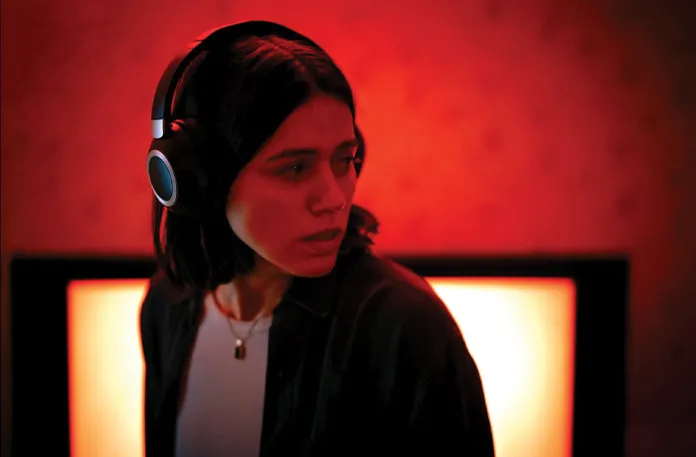
From the film’s opening moments, first-time writer-director Ian Tuason proves himself as adept at building soundscapes as the late David Lynch (Blue Velvet, Mulholland Drive), whose aptitude for auditory effects was among his greatest gifts. The sounds summoned by Tuason include the labored breathing of Evy’s terminally ill mother (Michele Duquet), to whose home Evy has decamped during her mother’s seemingly imminent decline. Because Tuason confines the film to that sole location, our ears perk up at any and all noises, including innocuous ones: the flick of a light switch, the tick of a wall clock, the echoey reverberations of an unattended television set. One particularly delightful effect comes when Evy puts on her headphones to record her podcast: We inhabit, along with her, the muffled coziness of tuning out the rest of the world, including, sad to say, her dying mother. “This is the only thing keeping me sane right now,” Evy says to Justin about their podcast.
Throughout these scenes, Tuason is priming the audience to be alert to the sonic world of the film. This stands in contrast to Evy, who, in the early going, is decidedly not shook up by those mysterious audio recordings that have been sent in to the podcast. On the recordings, we hear breathing and walking and a couple bickering — so what? Justin, who rather casually skips ahead minutes or hours when he sees a jump in the sound, is persuaded that he hears ominous signs of sleepwalking, or worse. He also goes down a rabbit hole in which he perceives messages in mumbled or garbled talk or when hitting the “reverse” button on nursery rhymes, especially “Baa, Baa, Black Sheep.” One of the most accurate, au courant touches in the film is when Evy repeatedly Googles things like “Hidden messages in children’s songs” while Justin is doing his rampant speculating. Who knew the font on Wikipedia could look so menacing?
As the film unfolds, some of the sounds that Evy and Justin hear on the recordings seem to be spilling into Evy’s mother’s house — outside of her headphones, that is. And some of what is described on the recordings, such as faucets running without having been turned on, seems to be happening in the house, too. There is a hackneyed quality to all of this, but the film certainly kindles a mood. We, as Justin does from the get-go and as Evy does in time, start to think we hear odd things on those recordings. And as the camera glides through a house that Evy keeps ill-advisedly dark — often illuminated only with low-wattage lamps — we start to think we can make out figures or shapes. The relative obscurity of the movie’s leading lady, Kiri, and the actual obscurity of the rest of the cast — in the sense that most of them are not seen — contributes to its believability.
Despite what seems to be her unhappy relationship with a never-seen boyfriend, Evy learns she is pregnant, which means, as is typical in nearly all movies released today, that she considers an abortion, or, as she euphemistically puts it, her “options.” Yet Tuason — who makes Evy some sort of lapsed Catholic, her mother a devout Catholic, and laces the film with religious imagery — seems to connect Evy’s reluctance to be a mother to the child-hating demon that apparently has possessed the couple on the recording. But these strands are not tied up in a particularly convincing manner. (Among horror movies, Undertone is hardly the robust defense of religious institutions that The Exorcist was over 50 years ago.) Nonetheless, Tuason deserves some credit for resisting or at least complicating the feminist agitprop so common in modern horror movies.
In the end, though, what makes Undertone worthwhile is not its themes or even its storytelling. Its power resides wholly in its artful marshaling of the simplest of effects, such as the whistle of a tea kettle, the clang of a set of keys, or the voicemail-preserved words of a dying, now-silent parent. The most shocking thing about the movie is its firm insistence on not shocking the audience.
Peter Tonguette is the film critic for the Washington Examiner magazine.


