







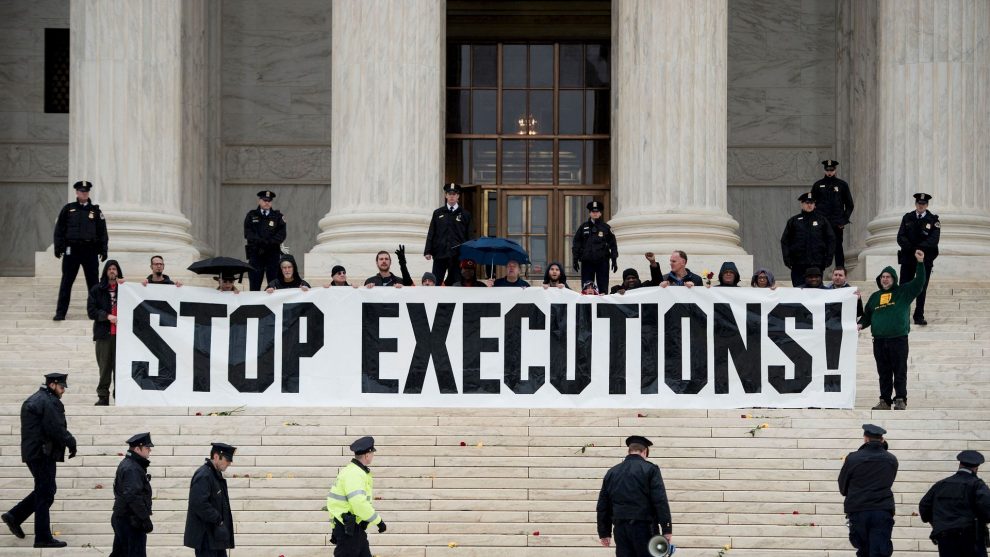
Pointed divisions within the Supreme Court over capital punishment reemerged Monday, as the justices issued new opinions rehashing recent last-minute death penalty appeals.
The Court has barely concealed its sharp internal disagreement over late-arriving death penalty cases in recent months.
One such dispute arose in Alabama, where inmate Christopher Lee Price asked to be put to death with nitrogen hypoxia, as opposed to a lethal injection protocol. Price asked the high court to stop his execution on April 11. The Court denied Price’s application, over a seething dissent from Justice Stephen Breyer.
Thomas wrote a separate opinion to “set the record straight” Monday, hitting notes frequently sounded by the conservative justices in recent death penalty cases.
“[Price’s] strategy is no secret, for it is the same strategy adopted by many death-row inmates with an impending execution: bring last-minute claims that will delay the execution, no matter how groundless,” Thomas wrote. “The proper response to this maneuvering is to deny meritless requests expeditiously.”
The justices were scheduled to meet in private conference on April 12 to review pending petitions. Breyer proposed holding Price’s case over for discussion at that meeting in his dissent. In a biting rejoinder, Thomas dismissed that notion out of hand, saying Breyer’s plan was so unconvincing it might not have been an earnest idea.
Tyler Robinson preliminary hearing: Judge orders redactions to ex-lover’s video testimony
Social media influencer and model, 22, killed in violent highway crash
Trump threatens troop withdrawals if ‘very good deal’ on Greenland isn’t struck
House Dem back in the spotlight as brother faces up to 10 years in prison if convicted
Platner drops out of crucial Senate race after bombshell rape allegation torpedoes campaign
Franklin Graham Gives McDonald’s ‘Free Advice’ on How to ‘Bring Happy Customers Back’
Who is Valli Geiger? Meet the Maine Dem that Platner urged to run for Senate
Mike Rowe Sues Discovery for $2 Million in ‘Deadliest Catch’ Dispute
Erika’s Heartbreaking Reaction to a Woman She Saw in the Courtroom Crying Over Charlie’s Murder
Former Wisconsin Judge Who Was Convicted of Helping an Illegal Alien Evade ICE Gets Light Sentence
Bernie-backed socialist who allied with Platner could supplant him on ballot
WATCH: Dana White drops 2028 hints while raving about his favorite Trump cabinet secretary
Donald Trump sparks intrigue by ditching new Qatari jet for old Air Force One
Potential 2028 Dem contender unloads on Netanyahu, admits US-Israel ties at ‘crossroads’
Trump contemplates assassinating more Iranian leaders, warns he ‘may be gone too’ after topping Tehran’s ‘kill list’
“Insofar as Justice Breyer was serious in suggesting that the Court simply ‘take no action’ on the state’s emergency motion to vacate until the following day it should be obvious that emergency applications ordinarily cannot be scheduled for discussion at weekly (or sometimes more infrequent) conferences,” Thomas wrote.
Ultimately Price’s execution did not proceed. The state’s death warrant expired at midnight on April 11, and the Court’s decision on his stay application did not issue until the small hours on April 12 because of Breyer’s dissent.
The justices also returned to a March 28 death penalty dispute involving a Texas inmate denied access to his preferred religious adviser in the death chamber. The inmate, Patrick Henry Murphy, is a practicing Buddhist. Though Christian and Muslim clerics are allowed in the execution chamber, Murphy’s Buddhist chaplain was not permitted entry under state policy.
Murphy claimed that policy violates the Constitution, as well as a federal law called the Religious Land Use and Institutionalized Persons Act (RLUIPA). The Supreme Court stayed Murphy’s execution so he could pursue those claims. The decision was somewhat strange, since the Court allowed Alabama to execute a Muslim prisoner named Domineque Hakim Marcelle Ray just weeks earlier on a 5-4 vote in a case presenting similar facts.
Justice Samuel Alito dissented in the Murphy case, but in an unusual move published an opinion on Monday, six weeks after the stay application was granted. Alito said he wrote separately because “late stay applications present a recurring and important problem and because religious liberty claims like Murphy’s may come before the Court in future cases.” Thomas and Justice Neil Gorsuch joined the dissent.
Tyler Robinson preliminary hearing: Judge orders redactions to ex-lover’s video testimony
Social media influencer and model, 22, killed in violent highway crash
Trump threatens troop withdrawals if ‘very good deal’ on Greenland isn’t struck
House Dem back in the spotlight as brother faces up to 10 years in prison if convicted
Platner drops out of crucial Senate race after bombshell rape allegation torpedoes campaign
Franklin Graham Gives McDonald’s ‘Free Advice’ on How to ‘Bring Happy Customers Back’
Who is Valli Geiger? Meet the Maine Dem that Platner urged to run for Senate
Mike Rowe Sues Discovery for $2 Million in ‘Deadliest Catch’ Dispute
Erika’s Heartbreaking Reaction to a Woman She Saw in the Courtroom Crying Over Charlie’s Murder
Former Wisconsin Judge Who Was Convicted of Helping an Illegal Alien Evade ICE Gets Light Sentence
Bernie-backed socialist who allied with Platner could supplant him on ballot
WATCH: Dana White drops 2028 hints while raving about his favorite Trump cabinet secretary
Donald Trump sparks intrigue by ditching new Qatari jet for old Air Force One
Potential 2028 Dem contender unloads on Netanyahu, admits US-Israel ties at ‘crossroads’
Trump contemplates assassinating more Iranian leaders, warns he ‘may be gone too’ after topping Tehran’s ‘kill list’
Alito agreed that the questions Murphy and Ray raised “are important and may ultimately be held to have merit.” Still, he cautioned that death row inmates and their attorneys must litigate in a timely manner, instead of reserving claims for the last minute in a bid to delay executions.
In Murphy’s case, Alito noted that the Texas policy at issue has been in place since 2013. What’s more, Murphy was informed that his Buddhist chaplain would be denied access to the death chamber on March 5, but his attorneys waited until March 26, two days before the execution, to sue in federal court.
“If the tactics of Murphy’s attorneys in this case are not inexcusably dilatory, it is hard to know what the concept means,” Alito wrote.
The Alito opinion prompted a short rebuttal from Justice Brett Kavanaugh, who voted to grant Murphy a stay. Chief Justice John Roberts joined Kavanaugh’s opinion.
Kavanaugh pointed out that Texas amended its policy within five days of the Court’s decision in Murphy’s case. Religious advisers now observe executions from an adjacent viewing room, and are categorically excluded from the death chamber. Because Texas changed its protocol so quickly, Kavanaugh said it was clear Murphy raised the issue in a timely manner, since Murphy asked prison officials about his chaplain’s access a full month before the execution date.
“This Court’s stay facilitated the prompt resolution of a significant religious equality problem with the state’s execution protocol and should alleviate any future litigation delays or disruptions that otherwise might have occurred as a result of the state’s prior discriminatory policy,” Kavanaugh wrote.
While Kavanaugh believed Murphy’s case warranted relief, he joined Alito in emphasizing that the courts should not allow death row inmates to engage in 11th hour gamesmanship.
Tyler Robinson preliminary hearing: Judge orders redactions to ex-lover’s video testimony
Social media influencer and model, 22, killed in violent highway crash
Trump threatens troop withdrawals if ‘very good deal’ on Greenland isn’t struck
House Dem back in the spotlight as brother faces up to 10 years in prison if convicted
Platner drops out of crucial Senate race after bombshell rape allegation torpedoes campaign
Franklin Graham Gives McDonald’s ‘Free Advice’ on How to ‘Bring Happy Customers Back’
Who is Valli Geiger? Meet the Maine Dem that Platner urged to run for Senate
Mike Rowe Sues Discovery for $2 Million in ‘Deadliest Catch’ Dispute
Erika’s Heartbreaking Reaction to a Woman She Saw in the Courtroom Crying Over Charlie’s Murder
Former Wisconsin Judge Who Was Convicted of Helping an Illegal Alien Evade ICE Gets Light Sentence
Bernie-backed socialist who allied with Platner could supplant him on ballot
WATCH: Dana White drops 2028 hints while raving about his favorite Trump cabinet secretary
Donald Trump sparks intrigue by ditching new Qatari jet for old Air Force One
Potential 2028 Dem contender unloads on Netanyahu, admits US-Israel ties at ‘crossroads’
Trump contemplates assassinating more Iranian leaders, warns he ‘may be gone too’ after topping Tehran’s ‘kill list’
“I fully agree with Justice Alito that counsel for inmates facing execution would be well advised to raise any potentially meritorious claims in a timely manner, as this Court has repeatedly emphasized,” Kavanaugh wrote.
Whatever divisions emerged among the high court’s conservatives in the Murphy dispute, all five were united in an April death penalty decision which suggested a reorientation in the Court’s approach to capital punishment.
Story cited here.


