



Theodore Roosevelt, the New York-born president who embodied an unapologetic America-first outlook and projected American strength abroad without hesitation, turned the White House basement into his personal training ground.
A Harvard boxer who later sparred regularly with military aides and even professional fighters, Roosevelt installed mats for wrestling and practiced judo throws on visiting diplomats. He once brightened a state luncheon by demonstrating a judo hold on the Swiss minister, to the delight of the assembled guests. Physical vigor, in Roosevelt’s view, was inseparable from national character. He preached the “strenuous life” in a famous 1899 speech, calling on Americans to embrace toil, effort, hardship, and strife rather than settle for ignoble ease.
As president, he lived that creed: He boxed until a sparring partner detached his retina in 1905, after which he took up jiu-jitsu to stay fit. Roosevelt saw no contradiction between prioritizing American interests and wielding muscle when necessary. More than a century later, another New York president, equally blunt and equally dismissive of political correctness, has invited the octagon to the South Lawn in the same spirit.
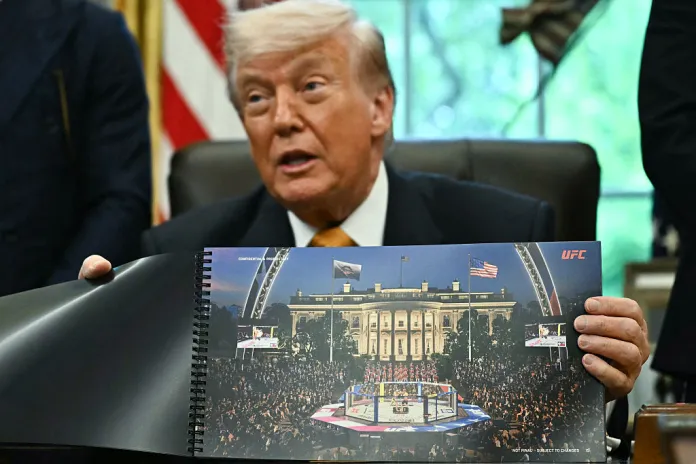
On June 14 — Flag Day, President Donald Trump’s 80th birthday, and a centerpiece of America’s 250th anniversary celebrations — UFC Freedom 250 will transform the White House grounds into the site of the first professional sporting event ever held there.
The main event features lightweight champion Ilia Topuria defending his title against interim champion Justin Gaethje in a unification bout. In the co-main event, Alex Pereira faces Ciryl Gane for the interim heavyweight title. The stacked card also includes Sean O’Malley against Aiemann Zahabi, along with additional bouts featuring rising contenders such as Derrick Lewis, Michael Chandler, Bo Nickal, and others.
Construction crews have already begun erecting the temporary octagon, along with risers for roughly 4,000 seated fans and massive screens on the Ellipse to accommodate an overflow crowd. Weigh-ins will take place at the Lincoln Memorial. The event will air live on Paramount+, with select preliminary bouts broadcast on CBS, presented by Crypto.com and Ram Trucks.
This gathering represents more than a night of elite mixed martial arts competition. It marks a deliberate alignment of combat sports’ emphasis on merit, resilience, and unfiltered outcomes with the symbolic power of the presidency itself, staged on the historic lawn where American leaders have long welcomed allies and commemorated national milestones.
First professional fight on presidential grounds
No previous president had ever hosted a full professional combat sports card on White House property. Ceremonial gatherings, Easter egg rolls, and military reviews have long occupied the South Lawn, but never an octagon with title fights, fighter walkouts, and the electric atmosphere of a live pay-per-view event.
Trump first floated the idea publicly at a 2025 Iowa rally, declaring that UFC President Dana White would make it happen. By October of that year, during a speech at Naval Station Norfolk, he confirmed the Flag Day date, tying the spectacle directly to the nation’s semiquincentennial observances. The timing elevates the evening into an unofficial launch for a summer filled with patriotic reflection and celebration.
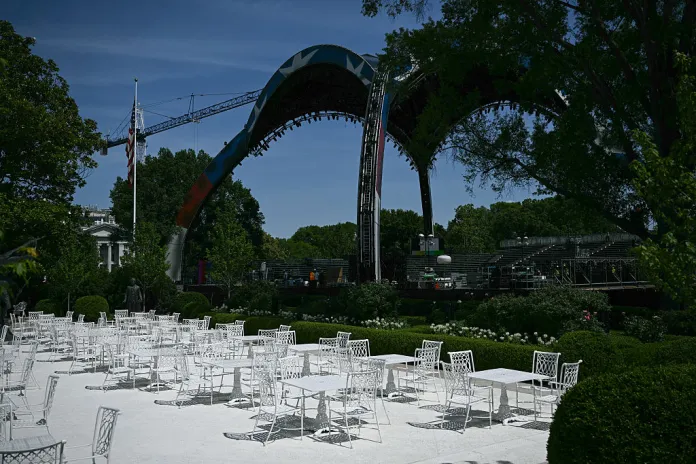
The physical setup promises to be unforgettable. Floodlights will illuminate the South Lawn in red, white, and blue hues. The octagon will stand prominently framed by the Executive Mansion, its eight-sided geometry a bold symbol of competition set against the backdrop of American presidential power. Priority access goes to service members and their families, a fitting acknowledgment of martial tradition. For the broader public gathered on the Ellipse, the experience expands into a vast open-air arena, where the people’s house becomes a coliseum for the people.
A president who understands the fight
Donald Trump has maintained a deep appreciation for combat sports throughout his public life. His longstanding engagement with professional wrestling, which I explored in these pages through the story of the late Hulk Hogan’s transformation into a MAGA icon, highlighted a shared taste for spectacle, resilience, and raw drama. Hogan’s memorable 2024 Republican National Convention appearance, in which he tore off his shirt to reveal a Trump-Vance tank top while roaring a Trumpified version of his signature catchphrase — “let Trumpamania run wild!”— captured that same unscripted energy.
Trump’s connection to mixed martial arts runs even deeper. Decades ago, when the UFC struggled for legitimacy and major venues refused to host its events, he opened the doors of the Trump Taj Mahal in Atlantic City for early cards such as UFC 30 and UFC 31. He arrived early, remained through the entire evening, and treated the fighters like stars at a time when polite society still dismissed the sport as barbaric.
The athletes headlining UFC Freedom 250 embody the same demanding ethos. Topuria, the undefeated Georgian champion, has risen through unrelenting talent and preparation. Gaethje, the American warrior celebrated for his relentless pace and highlight-reel finishes, exemplifies heart and determination. Pereira, the Brazilian kickboxing transplant who has claimed multiple UFC belts, and Gane, the rangy Frenchman known for elite striking, bring international excellence to an unmistakably American stage. These competitors cut weight, endure grueling training camps, and enter the octagon fully aware that only skill, strategy, and will separate victory from defeat.
In early May, President Trump hosted several of the headliners in the Oval Office. He unveiled a custom UFC White House championship belt and addressed the fighters directly as champions. The moment underscored a broader conviction: In an era when too many institutions appear to reward grievance over genuine achievement, excellence forged in competition remains a vital standard.
UFC Freedom 250 would not have come to fruition without the enduring friendship between Trump and White, a relationship that spans more than 25 years. When White and the Fertitta brothers acquired the struggling UFC in 2001, the sport faced widespread rejection from arenas and broadcasters who viewed it as too violent for mainstream audiences. Trump provided an early platform by welcoming the promotion to his Atlantic City properties. White has often recalled how Trump not only granted access, but showed up personally, from the first preliminary fight until the final bell, offering the kind of support that lent the young organization crucial legitimacy at a vulnerable moment.
That loyalty has proven mutual and enduring. White spoke at the 2016 Republican National Convention, endorsed Trump, and played a visible role in the 2024 campaign, helping connect with young male voters. Their bond, White has emphasized in interviews, remains fundamentally personal rather than purely transactional. When Trump first suggested staging a fight on the White House grounds while the two men watched a live event together, White embraced the proposal without hesitation. The logistical challenges of an outdoor card on the South Lawn were formidable, yet the partnership moved forward swiftly. In many respects, the collaboration reflects a shared worldview: Both men value toughness, showmanship, and an unfiltered authenticity that defies the preferences of coastal elites. While legacy media and cultural institutions have sometimes recoiled from combat sports, Trump and White have built lasting influence by appealing directly to audiences who prize results over refinement.
The visual impact of the event will resonate long after the final bell sounds. The octagon rising on the South Lawn places the raw intensity of mixed martial arts squarely within the heart of presidential pageantry. For years, Washington insiders have tended to regard MMA as entertainment suited primarily for audiences outside the Beltway. President Trump has upended that perspective by situating the cage where formal state dinners and diplomatic receptions have historically taken precedence. The resulting imagery, fighters competing beneath the American flag with the White House illuminated behind them, carries unmistakable populist weight. Service members in attendance will witness their own culture of discipline and sacrifice mirrored in the athletes inside the octagon. The overflow viewing on the Ellipse extends the invitation to tens of thousands more, turning the evening into a shared national experience.
Critics have already offered familiar objections, labeling the gathering everything from gaudy to militaristic. Such reactions only highlight the cultural contrast at play. Here stands a president who celebrates the very qualities Roosevelt once insisted were essential: physical fitness, mental fortitude, and an unyielding commitment to national vigor. The South Lawn card speaks in a language readily understood by working-class and male demographics who have felt increasingly distant from elite cultural conversations. UFC events consistently draw precisely those audiences — young, diverse, and appreciative of displays of courage and competence — because they deliver genuine stakes and decisive outcomes.
Roosevelt’s doctrine of the strenuous life resonates powerfully with the occasion. In his 1899 address, he urged his countrymen to reject the temptations of ease and instead pursue lives defined by labor, endeavor, and willingness to confront hardship. He practiced what he preached, building a frail childhood physique into one capable of leading the Rough Riders up San Juan Hill. Competitive athletics, in his estimation, served as essential preparation for citizenship in a republic that demanded strength from its people. Trump’s choice to host UFC Freedom 250 on the 250th anniversary of the Declaration of Independence echoes that philosophy in a distinctly modern register. The founding document, signed by farmers, merchants, and tradesmen who risked everything for self-government, represented an act of profound defiance and courage. Those men understood that liberty required resolve. Staging a combat sports spectacular on the South Lawn honors that founding temperament by presenting living examples of American resilience and competitive spirit. It offers a new generation a vivid reminder that strength — physical, mental, and national — continues to serve as a virtue rather than a liability.
Combat sports have flourished in recent years precisely because they provide audiences with clarity and catharsis that other forms of mass entertainment increasingly struggle to deliver. Late-night television, once a nightly ritual that united viewers across political lines, now contends with sharply declining audiences and profound shifts in viewing habits, as I detailed in these pages regarding Stephen Colbert’s final episode. In contrast, UFC events (like NFL games, which continue to dominate TV ratings) thrive by offering unscripted drama, genuine risk, and outcomes determined solely by intellectual ingenuity and pure physical grit. UFC Freedom 250 arrives at a cultural moment when many of us are hungering for precisely that kind of authenticity.
The event also reinforces Trump’s longstanding alliance with a sport that mirrors key elements of his political approach. Fighters advance through talent, preparation, and determination — qualities Trump has consistently argued the nation must reward over rhetoric or institutional favoritism. The South Lawn card will generate extensive replays across social media and cable news, extending its influence well beyond those physically present. The message that we’ll be meant to glean from it will be as clear as a KO: This is an America that chooses to celebrate winners who earn their success the hard way.
After the final bell
When the lights eventually dim on the South Lawn and the final fighter departs the octagon, whether in triumph or defeat, the enduring image will linger: a temporary cage framed by the White House, the American flag waving overhead, and a president who chose to bring the fight directly to the people’s house. Roosevelt, who once sparred in the basement and led men into combat, would have recognized the underlying spirit immediately. He understood that nations, like individuals, must continually embrace the strenuous life or risk gradual decline.
TRUMP SUGGESTS UFC ARENA AT WHITE HOUSE COULD BE PERMANENT
America’s 250th anniversary represents far more than a commemoration of historical documents and dates. It constitutes a renewed commitment to the character traits that built the republic in the first place: courage in the face of adversity, competition that sharpens the spirit, and resilience forged through effort. UFC Freedom 250 will convey that message with unmistakable force through every punch, kick, and takedown. As the crowd joins in chants of “U-S-A!” beneath the Flag Day sky, a single truth will emerge clearly. In the arena of nations, just as inside the cage, those who possess strength and the willingness to use it endure.
On June 14, Trump will have demonstrated once more that he fully grasps what it means to fight.
Daniel Ross Goodman (@DanRossGoodman) is a Washington Examiner contributing writer and teaches theology and religious studies at St. John’s University. His next book, Dante’s Guide to Life: How The Divine Comedy Can Change Our Fortunes, Our World, and Ourselves, will be published this fall by Angelico Press.


