







Sweden’s left-wing opposition has crawled ahead as votes from Sunday continue to roll in, suggesting that the four-party coalition will unseat the right-wing incumbents.
Preliminary results show that the alliance led by Social Democrats leader Magdalena Andersson has pulled ahead by three seats in the Riksdag with approximately 94% of votes recorded. With a margin of only 30,000 votes, there is still room for Prime Minister Ulf Kristersson’s right-wing coalition to flip the outcome, but the opposition has confidence the lead will hold.
“If this result remains valid, Sweden will get a new government,” Andersson boasted to her supporters on election night.
</p>
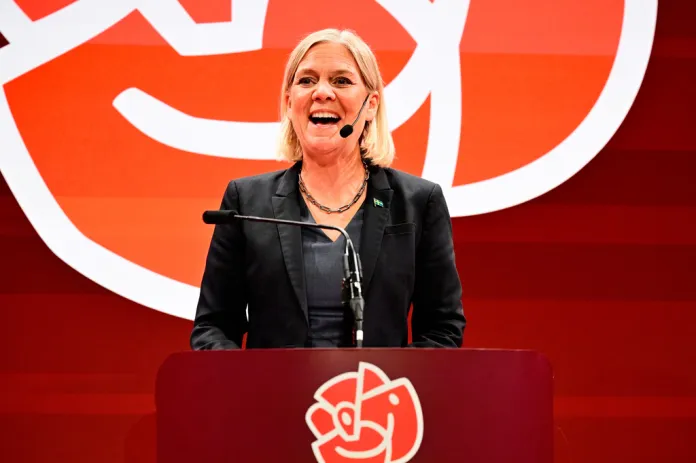
<p> ” data-large-file=”https://conservativemodern.com/wp-content/uploads/2026/09/swedish-left-projected-for-narrow-victory-in-national-elections-but-pathway-to-governing-coalition-unclear.webp” src=”https://conservativemodern.com/wp-content/uploads/2026/09/swedish-left-projected-for-narrow-victory-in-national-elections-but-pathway-to-governing-coalition-unclear.webp” alt=”Magdalena Andersson” class=”wp-image-4725994″ srcset=”https://conservativemodern.com/wp-content/uploads/2026/09/swedish-left-projected-for-narrow-victory-in-national-elections-but-pathway-to-governing-coalition-unclear-3.webp 1024w, https://conservativemodern.com/wp-content/uploads/2026/09/swedish-left-projected-for-narrow-victory-in-national-elections-but-pathway-to-governing-coalition-unclear-3.webp?resize=300,200 300w, https://conservativemodern.com/wp-content/uploads/2026/09/swedish-left-projected-for-narrow-victory-in-national-elections-but-pathway-to-governing-coalition-unclear-3.webp?resize=768,512 768w, https://conservativemodern.com/wp-content/uploads/2026/09/swedish-left-projected-for-narrow-victory-in-national-elections-but-pathway-to-governing-coalition-unclear-3.webp?resize=150,100 150w, https://conservativemodern.com/wp-content/uploads/2026/09/swedish-left-projected-for-narrow-victory-in-national-elections-but-pathway-to-governing-coalition-unclear-3.webp?resize=696,464 696w” sizes=”(max-width: 1024px) 100vw, 1024px”><figcaption class=) Social Democrats party leader Magdalena Andersson speaks during the Social Democrats’ election night watch party on Sunday, Sept. 13, 2026, in Stockholm. (Jonas Ekströmer/TT News Agency via AP)
Social Democrats party leader Magdalena Andersson speaks during the Social Democrats’ election night watch party on Sunday, Sept. 13, 2026, in Stockholm. (Jonas Ekströmer/TT News Agency via AP)If predictions hold, the Social Democrats’ left-wing bloc will walk away with 176 seats, compared to 173 held by the Moderates’ right-wing bloc.
Social Democrats press secretary Tobias Baudin told the media that he has already tapped counterparts across the coalition to prepare to remove Kristersson.
“Now the voters have had their say, and they have given him a failing grade for himself and his government,” Baudin told Swedish outlet SVT. “He should resign himself. In fact, it doesn’t matter. If he doesn’t resign, he will be removed. How he does it is up to him.”
The Sweden Democrats seem to have suffered the most notable losses of the election, giving up 11 seats and slipping behind the mainstream Moderates. It’s the first time the party has shrunken since its genesis in 1988. The outsider right-wing party grew slowly for decades before exploding into the mainstream ahead of the 2022 election.
Heading into the Sunday election, the Sweden Democrats were even larger than Kristersson’s mainstream Moderate Party. Their popularity was charged by a stiff opposition to immigration, dedication to recentering Swedish language and culture, and a platform advocating harsh crackdowns on gangs and organized crime. Kristersson promised to hand party leaders ministerial positions if they helped carry his coalition, which also includes the Christian Democrats and the Liberals, across the finish line.
Right-wing commentators have expressed frustration with the breakdown of voting tendencies across demographics, citing exit poll data showing immigrants of “non-European background” voted overwhelmingly for the left-wing parties. Critics attacking the governing coalition from the right accused them of sowing their own defeat by continuing to grant citizenship to non-European immigrants.
</p>
<p> ” data-large-file=”https://conservativemodern.com/wp-content/uploads/2026/09/swedish-left-projected-for-narrow-victory-in-national-elections-but-pathway-to-governing-coalition-unclear-1.webp” src=”https://conservativemodern.com/wp-content/uploads/2026/09/swedish-left-projected-for-narrow-victory-in-national-elections-but-pathway-to-governing-coalition-unclear-1.webp” alt=”Jimmie Åkesson” class=”wp-image-4725995″ srcset=”https://conservativemodern.com/wp-content/uploads/2026/09/swedish-left-projected-for-narrow-victory-in-national-elections-but-pathway-to-governing-coalition-unclear-5.webp 1024w, https://conservativemodern.com/wp-content/uploads/2026/09/swedish-left-projected-for-narrow-victory-in-national-elections-but-pathway-to-governing-coalition-unclear-5.webp?resize=300,200 300w, https://conservativemodern.com/wp-content/uploads/2026/09/swedish-left-projected-for-narrow-victory-in-national-elections-but-pathway-to-governing-coalition-unclear-5.webp?resize=768,512 768w, https://conservativemodern.com/wp-content/uploads/2026/09/swedish-left-projected-for-narrow-victory-in-national-elections-but-pathway-to-governing-coalition-unclear-5.webp?resize=150,100 150w, https://conservativemodern.com/wp-content/uploads/2026/09/swedish-left-projected-for-narrow-victory-in-national-elections-but-pathway-to-governing-coalition-unclear-5.webp?resize=696,464 696w” sizes=”auto, (max-width: 1024px) 100vw, 1024px”><figcaption class=) Leader of the Sweden Democrats party Jimmie Akesson speaks during the Sweden Democrats election night watch party on Sunday, Sept. 13, 2026, in Stockholm. (Pontus Lundahl/TT News Agency via AP)
Leader of the Sweden Democrats party Jimmie Akesson speaks during the Sweden Democrats election night watch party on Sunday, Sept. 13, 2026, in Stockholm. (Pontus Lundahl/TT News Agency via AP)“During the right-wing government, they handed out ~200k citizenships, predominantly to Middle Eastern and African immigrants who almost exclusively vote for the left,” wrote Evelina Hahne, a campaigner for fringe party Alternative for Sweden. “If they hadn’t done that, they would have won. There is a lesson to be learned here.”
If the left-wing parties’ lead holds, it will be a tough road to forming a governing coalition due to deep conflicts between Social Democrats and the other constituent parties on issues such as immigration and the economy.
“The Center Party backs Andersson as the most likely candidate for prime minister, opening a path for cooperation across Sweden’s traditional blocs,” according to a report released last week by the Atlantic Council. “However, it rules out a government that includes the Left Party and opposes giving either the Left Party or the Sweden Democrats decisive influence over key policy areas. The Left Party, in turn, has declared that it will vote against any government in which it is not represented.”
If the various parties cannot negotiate a mutually acceptable arrangement, a slew of possibilities open up. A German-style “Grand Coalition” is highly unlikely, having happened only once during World War II.
And if the Moderates’ coalition indeed suffers a three-seat deficit, that does not mean Kristersson will give up. He said Sunday that the election results might cause a “complicated government formation,” but “where it ends remains to be seen.”
</p>
<p> ” data-large-file=”https://conservativemodern.com/wp-content/uploads/2026/09/swedish-left-projected-for-narrow-victory-in-national-elections-but-pathway-to-governing-coalition-unclear-2.webp” src=”https://conservativemodern.com/wp-content/uploads/2026/09/swedish-left-projected-for-narrow-victory-in-national-elections-but-pathway-to-governing-coalition-unclear-2.webp” alt=”Ulf Kristersson” class=”wp-image-4725996″ srcset=”https://conservativemodern.com/wp-content/uploads/2026/09/swedish-left-projected-for-narrow-victory-in-national-elections-but-pathway-to-governing-coalition-unclear-7.webp 1024w, https://conservativemodern.com/wp-content/uploads/2026/09/swedish-left-projected-for-narrow-victory-in-national-elections-but-pathway-to-governing-coalition-unclear-7.webp?resize=300,200 300w, https://conservativemodern.com/wp-content/uploads/2026/09/swedish-left-projected-for-narrow-victory-in-national-elections-but-pathway-to-governing-coalition-unclear-7.webp?resize=768,512 768w, https://conservativemodern.com/wp-content/uploads/2026/09/swedish-left-projected-for-narrow-victory-in-national-elections-but-pathway-to-governing-coalition-unclear-7.webp?resize=150,100 150w, https://conservativemodern.com/wp-content/uploads/2026/09/swedish-left-projected-for-narrow-victory-in-national-elections-but-pathway-to-governing-coalition-unclear-7.webp?resize=696,464 696w” sizes=”auto, (max-width: 1024px) 100vw, 1024px”><figcaption class=) Swedish Prime Minister Ulf Kristersson leaves Sager House on Monday, Sept. 14, 2026, in Stockholm, a day after the general election. (Claudio Bresciani/TT News Agency via AP)
Swedish Prime Minister Ulf Kristersson leaves Sager House on Monday, Sept. 14, 2026, in Stockholm, a day after the general election. (Claudio Bresciani/TT News Agency via AP)“If all the red lines remain, then Sweden won’t have a government at all,” the prime minister added on Monday ahead of a meeting with coalition partners. “I plan to pursue a number of possibilities that may exist.”
The parliament is set to meet on Sept. 28, and the speaker will be able to nominate a new prime minister beginning on Sept. 29. Such nominations must be approved through a simple majority.
If four consecutive votes for prime minister fail, a new election is immediately triggered.


