







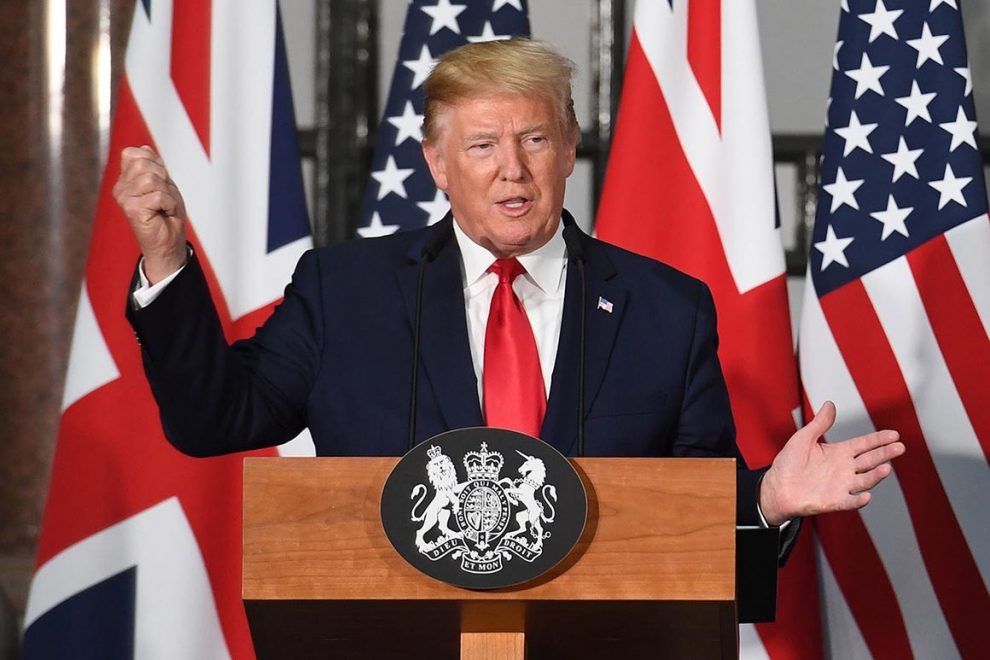
Can people please stop talking complete, unmitigated claptrap on the subject of President Donald Trump, Mexican tariffs, and the U.S. economy? Is it really too much to ask?
The panic over the last few days about possible Mexican tariffs is even more ridiculous than the panic we had last month about the China tariffs — and that was bad enough.
Trump’s new tariff threat will send prices soaring for U.S. households, say the doomsayers. They’ll cost hundreds of thousands of jobs. They’ll crash the stock market. They’ll crash the economy.
Really? No doubt this is why the Dow Jones Industrial Average DJIA, +0.60% plunged 350 points in a panic on Friday. And the Dow’s performance since then through Wednesday? Up around 600 points.
Watch: Outrageous Pro-El-Sayed Ad Blames Jewish State for Raising Price of Bananas, Eggs in Michigan
Haitian illegal immigrant charged in Walmart killing entered US via Biden parole program: DHS
Flavio Bolsonaro to be issued visa by State Department after fleeing Brazil
Right-Wing Presidential Candidate Flavio Bolsonaro Secretly Flees Brazil for US After Disputed Election: Report
Luxury real estate brothers sentenced to 30 years in prison for yearslong sex-trafficking scheme
Judge who apologized to accused would-be Trump assassin lights up DOJ in Hunter Biden FBI case
Jordanian Military Goes After Targets in Syria in Response to Terrorists Killing Christians
‘Beloved’ daredevils who scaled Empire State Building inching toward deal after proposal stunt: attorney
Judge slams federal prosecutors over new charges against ex-FBI officials
DHS Shuts Down Major Chinese Birth Tourism Loophole in US Pacific Territory
175 Democrats demand Trump admin stop Ilhan Omar investigation, warn it could hurt her re-election bid
Shouting match erupts at UN as Cuban foreign minister moves toward US ambassador’s podium: ‘Back up!’
Trump administration ‘monitoring’ leftist organizers ignoring new terrorism sanctions: State Department official
90 Percent of Largest United Methodist Church Congregation Votes to Leave Denomination – But It Won’t Be Easy
Hundreds of staged armed robberies helped thousands pose as crime victims in US immigration scam: DOJ
The Standard & Poor’s 500 SPX, +0.54% is now higher than it was last Thursday, just before Trump shook his little fist at the Mexicans. And it’s not just the popular stocks such as Apple AAPL, +1.09% Netflix NFLX, +0.13% , and TSLA, +4.54% U.S. industrial stocks — as measured by the S&P 1500 Industrials index — are up 3%. The stocks of automobile components companies are up almost 5%. Small company stocks, often a useful barometer for the domestic, Main Street economy, are up about 1.5%, whether measured by the broad Russell 2000 RUT, -0.49% or the narrower, higher-quality S&P 600 index SML, -0.63% .
Sure, a few days’ stock market action doesn’t mean much long term. And the stock market isn’t America. But then again, apparently it was an Infallible Omen of Doom when the stock market fell on Friday. You see how that works?
Whether or not these tariffs are a sensible policy is another matter. But anyone claiming they will cost households a small fortune and wipe out vast numbers of jobs is relying on some heroic assumptions. Or, as non-economists call them: guesses.
U.S. imports from Mexico came to $372 billion last year, according to the federal government. So slapping a 5% tariff on them amounts to a federal tax hike of… er… $19 billion. Total federal taxes last year: $3.3 trillion. So we’re talking about a 0.6% tax hike.
But the Mexican peso USDMXN, +0.4490% has already reacted. It has weakened by 2.7% against the U.S. dollar DXY, -0.30% in a few days — wiping out more than half of that cost increase.
Watch: Outrageous Pro-El-Sayed Ad Blames Jewish State for Raising Price of Bananas, Eggs in Michigan
Haitian illegal immigrant charged in Walmart killing entered US via Biden parole program: DHS
Flavio Bolsonaro to be issued visa by State Department after fleeing Brazil
Right-Wing Presidential Candidate Flavio Bolsonaro Secretly Flees Brazil for US After Disputed Election: Report
Luxury real estate brothers sentenced to 30 years in prison for yearslong sex-trafficking scheme
Judge who apologized to accused would-be Trump assassin lights up DOJ in Hunter Biden FBI case
Jordanian Military Goes After Targets in Syria in Response to Terrorists Killing Christians
‘Beloved’ daredevils who scaled Empire State Building inching toward deal after proposal stunt: attorney
Judge slams federal prosecutors over new charges against ex-FBI officials
DHS Shuts Down Major Chinese Birth Tourism Loophole in US Pacific Territory
175 Democrats demand Trump admin stop Ilhan Omar investigation, warn it could hurt her re-election bid
Shouting match erupts at UN as Cuban foreign minister moves toward US ambassador’s podium: ‘Back up!’
Trump administration ‘monitoring’ leftist organizers ignoring new terrorism sanctions: State Department official
90 Percent of Largest United Methodist Church Congregation Votes to Leave Denomination – But It Won’t Be Easy
Hundreds of staged armed robberies helped thousands pose as crime victims in US immigration scam: DOJ
Meanwhile, anyone hoping to buy a home, or refinance their home loan, also just got a nice cost saving. The trade tensions have sent long-term interest rates tumbling. Average 30-year mortgage rates have declined to 3.89% from 4.01% in just a few days, according to Mortgage News Daily. The interest savings from that move alone on an average new home loan comes to about $300 a year. According to Bankrate, 30-year mortgage rates are now about their lowest since the summer of 2017.
Oh, and then there’s the matter of that $19 billion in tariff revenues. To hear some people, you’d think it just vanishes. Maybe it gets trucked to a Great Secret Money Bonfire — possibly in Area 51 — where it gets torched. (Along with the money raised from the China tariffs, money spent by companies on stock buybacks, and so on).
Actually, if Uncle Sam levies $19 billion in extra taxes on imports from Mexico, then he has extra money that he can recycle back into the U.S. economy through spending, or tax cuts. How much? Try $19 billion.
Story cited here.


