







The End of Oak Street may seem like a harmless, companionable, feel-good potpourri made up of parts from E.T. the Extra-Terrestrial (1982), Jurassic Park (1993), and Jumanji (1995), but it is, without question, one of the most cynical movies of the year.
The movie tells of a time warp that admits dinosaurs to a suburban enclave in the early 1980s, and writer-director David Robert Mitchell means to lure audiences into the theater with the promise that it will traffic in nostalgia for that terrific time and milieu. After all, the popularity of 1980s-set movies and shows proves that a significant portion of the population wishes to live in a world in which Walkman cassette players were in wide use and Pizza Hut restaurants everywhere were outfitted with buffets.
The End of Oak Street wants to capture this demographic. But recreating an era, as the movie does reasonably well, is not the same thing as expressing real affection for it. Despite embellishing his movie with period-accurate clothes, decor, and music, Mitchell has no deep attachment to the period at all. He means to sell tickets by putting Pat Benatar’s “Hit Me With Your Best Shot” on the soundtrack, but he has no intention of ratifying the actual manners and mores that governed the 1980s, which was, after all, “morning in America” — not the sort of era likely to be commemorated by Hollywood, and it isn’t here.
</p>
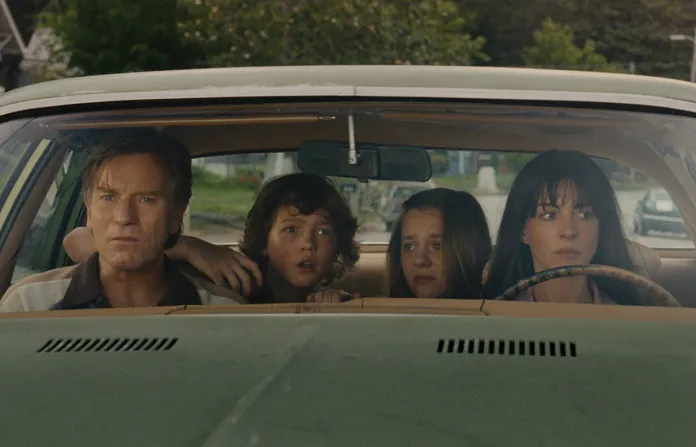
<p> ” data-large-file=”https://conservativemodern.com/wp-content/uploads/2026/08/skip-the-summers-woke-dinosaur-movie-the-end-of-oak-street.webp” height=”658″ width=”1024″ src=”https://conservativemodern.com/wp-content/uploads/2026/08/skip-the-summers-woke-dinosaur-movie-the-end-of-oak-street.webp” alt=”Ewan McGregor, Christian Convery, Maisy Stella, and Anne Hathaway in The End of Oak Street. (Courtesy of Warner Bros.)” class=”wp-image-4695813″ style=”width:880px;height:auto” srcset=”https://conservativemodern.com/wp-content/uploads/2026/08/skip-the-summers-woke-dinosaur-movie-the-end-of-oak-street-1.webp 1400w, https://conservativemodern.com/wp-content/uploads/2026/08/skip-the-summers-woke-dinosaur-movie-the-end-of-oak-street-1.webp?resize=300,193 300w, https://conservativemodern.com/wp-content/uploads/2026/08/skip-the-summers-woke-dinosaur-movie-the-end-of-oak-street-1.webp?resize=768,494 768w, https://conservativemodern.com/wp-content/uploads/2026/08/skip-the-summers-woke-dinosaur-movie-the-end-of-oak-street-1.webp?resize=1024,658 1024w, https://conservativemodern.com/wp-content/uploads/2026/08/skip-the-summers-woke-dinosaur-movie-the-end-of-oak-street-1.webp?resize=150,96 150w, https://conservativemodern.com/wp-content/uploads/2026/08/skip-the-summers-woke-dinosaur-movie-the-end-of-oak-street-1.webp?resize=696,447 696w, https://conservativemodern.com/wp-content/uploads/2026/08/skip-the-summers-woke-dinosaur-movie-the-end-of-oak-street-1.webp?resize=1068,687 1068w” sizes=”auto, (max-width: 1024px) 100vw, 1024px”><figcaption class=) Ewan McGregor, Christian Convery, Maisy Stella, and Anne Hathaway in “The End of Oak Street.” (Courtesy of Warner Bros.)
Ewan McGregor, Christian Convery, Maisy Stella, and Anne Hathaway in “The End of Oak Street.” (Courtesy of Warner Bros.)The film stars Ewan McGregor and Anne Hathaway as Greg and Denise Platt, who, along with their children Audrey (Maisy Stella) and Brian (Christian Convery), are among the inhabitants of Oak Street. One thing the film cannot be faulted for is its picture-perfect evocation of the ranch and split-level houses whose low rooflines remain an ideal visual signifier of the time. Equally resonant is the end-of-summer neighborhood block party that kicks off the movie: potato sack races, Formica tables with food spreads, the constant din of rock music and locusts — it feels downright cozy, as well it should.
Yet, having lulled us into a state of reminiscence, Mitchell — best known for the faddish, overpraised genre movies It Follows (2014) and Under the Silver Lake (2018) — wants to complicate, if not annihilate, our yearning. He accomplishes this not by dinosaurs, though, but by wokeness. For starters, Greg and Denise are discontent in their marriage — or, to put it more sharply, Denise is discontent in her marriage. McGregor plays Greg — a laid-off, evidently middle-class worker who has turned to pizza delivery driving — as a human doormat who absorbs his wife’s frequent, feminist-tinged expressions of annoyance and dissatisfaction. Thoroughly unimpressed by her suburban idyll, and evidently unmoved by her responsibilities as wife and mother, Denise labors in her basement on a novel whose protagonist wishes to forsake her family for a life in New York. (These were the days when New York was a publishing capital, not the chief example of electoral success by a member of the Democratic Socialists of America.)
What is objectionable is not that the film portrays a strained family unit — after all, the mother in E.T. had been through a divorce, though she was plainly the victim in the split — but that it presents Denise’s frustrations through a kind of “women’s lib” lens as completely at odds with the family values ethos of the era. One might assume that once the dinosaurs make their presence known, the family unit would reset along traditional lines, but no: in the film’s woke terms, Denise, not Greg, is the one who takes command of the brood and does most of the battling with the dinos.
Admittedly, Mitchell is fairly creative in sketching the run-up to the dinosaur takeover, which includes ominous signs such as long-extinct plant life taking root overnight. And the filmmaker wrings some genuine thrills when he deposits the creatures among fenced, Radio Flyer-strewn backyards and such. Although when seen up close or for prolonged periods, the digital dinos are remarkably bland and unimpressive — I was reminded of the notoriously bad CGI in the woeful Ray Bradbury movie A Sound of Thunder (2005).
Yet, in contending with the invading species, Denise is fashioned into a female action hero more in keeping with the epoch of director Quentin Tarantino than with that of President Ronald Reagan. “I can handle anything you can handle — maybe more,” she tells her husband, pointedly. Note that Denise is the parent who arms herself with a rifle and first shoots a dinosaur while Greg ambles around with a baseball bat. Note, too, that Denise is the parent behind the wheel of their car as the family fruitlessly tries to flee their street. And further note (spoiler alert) that Greg is the parent who is apparently maimed and killed. This is Jurassic Park gone woke.
Speaking as someone born in 1983 — the year after the film is set — I simply do not believe that a majority of American fathers at the time were as feeble as Greg, nor that a majority of American mothers were itching to become reptile-slaying mercenaries like Denise. To top it off, Mitchell is not content to let the defeat of the dinosaurs close the film but must also show the fulfillment of Denise’s writerly ambitions: she has managed to get a book about the experience published. Greg, presumably, is living off the royalties. This is not a story about vanquishing the T. Rex; it’s a study in how Denise became a girl boss.
REVIEW — ‘SPIDER-MAN: BRAND NEW DAY’ IS A SLOG FOR THE UNINITIATED
Because the film is so anachronistic on a deep level, its surface anachronisms start to merit attention. For example, my ears hurt when Greg’s pizza delivery job was referred to as a “side gig,” a term I am certain I never heard during my six years of living in the 1980s. Speaking of which: When Greg is seen delivering a pizza in the pouring rain (a portent of the dinosaurs’ arrival), why is he not wearing a jacket? And why is the pie he is delivering not being kept in one of those insulated pizza delivery bags? Is he really that dumb? When the power goes out at night, why does Denise emerge from the basement (where, of course, she has been typing) with a gigantic lit candle? Is it her practice to keep candles and matches with her in the basement — you know, in the event of a mass, dinosaur-induced power failure? But as far as inexplicable character behavior, this has nothing on the scene in which Denise cajoles Greg into letting her take his picture in front of mating dinosaurs. It is difficult to know whether the movie is meant to be scary (which it sometimes is) or is intended as camp (at which it fails).
The real end of Oak Street comes not from the feet and chompers of the dinosaurs but from a moviemaker who revives the idyllic 1980s only to desecrate them with wokeness.
Peter Tonguette is the Life & Arts editor of the Washington Examiner magazine.


