





Captured former Venezuelan dictator Nicolas Maduro and his wife, Cilia Flores, appeared in Manhattan federal court on Monday after their dramatic capture by U.S. forces, opening one of the most consequential criminal prosecutions ever brought against a foreign head of state and his spouse.
The couple was seized in Caracas during a surprise U.S. military operation over the weekend and transferred to federal custody in New York. They were being held in Brooklyn ahead of proceedings in the Southern District of New York before U.S. District Judge Alvin K. Hellerstein.
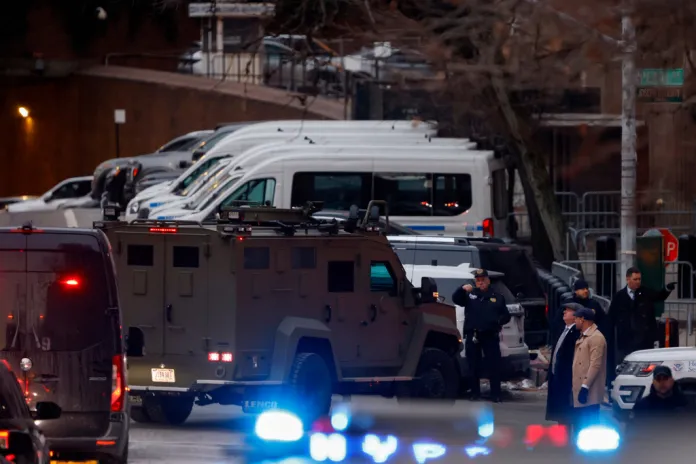
Maduro, 63, appeared in court wearing a blue prison shirt and listening through Spanish-language interpretation headphones, flanked by U.S. marshals. Flores, 69, appeared beside him, each represented by separate counsel.
Hellerstein briefly summarized the charges, saying Maduro faces narco-terrorism counts, while both Maduro and Flores are charged with cocaine importation conspiracy and firearms offenses involving machine guns and destructive devices.
Maduro and his wife plead not guilty
When asked to confirm his identity, Maduro, wearing translating headphones, initially said in Spanish that he considered himself the president of Venezuela and a “prisoner of war” who had been captured at his home in Caracas, according to a local reporter’s account of the arrangement. Hellerstein quickly cut him off, telling him there would be time later for such statements, and Maduro then confirmed his identity.
Maduro pleaded not guilty to all counts, with his attorney entering the plea after Maduro declared through an interpreter that he was innocent. Defense counsel waived a public reading of the indictment, though Maduro said he had only just received it and had not yet read it in full. Cilia also entered a not guilty plea.
Court filings that appeared on the docket ahead of the arrangement showed Maduro is represented by Barry Pollack, a veteran U.S. trial attorney who represents WikiLeaks founder Julian Assange and negotiated Assange’s plea deal last year. For his initial appearance, Maduro was also assisted by court-appointed counsel David Wikstrom. Flores is being represented by Mark E. Donnelly, a Texas-based attorney, according to court records.
The case targets both Maduro and his wife
The Justice Department over the weekend charged Maduro and Flores together in a sweeping superseding indictment that alleges they jointly participated in a decadeslong narco-terrorism conspiracy.
According to prosecutors, the couple used Venezuela’s political institutions, military, and diplomatic corps to traffic massive quantities of cocaine into the United States, partnering with U.S.-designated terrorist organizations and violent transnational cartels. Those groups include the Revolutionary Armed Forces of Colombia and the National Liberation Army, also in Colombia; Mexico’s Sinaloa Cartel and Los Zetas; and the Venezuelan gang Tren de Aragua.
The indictment alleges the conspiracy enriched Maduro’s inner circle and family members while providing protection and logistical support to narco-terrorist groups operating across the Western Hemisphere.
Why Flores is charged alongside Maduro
Flores is not charged as a peripheral figure. Prosecutors allege she played an active role in the cocaine importation conspiracy and related firearms offenses.
The indictment accuses Flores of accepting bribes from drug traffickers, brokering protection arrangements with Venezuelan officials, and working with Maduro to traffic cocaine that had previously been seized by Venezuelan authorities. Prosecutors further allege that Maduro and Flores relied on state-sponsored criminal gangs, known as colectivos, to protect drug shipments and enforce debts through kidnappings and killings.
Flores faces the same core conspiracy charges as Maduro, along with forfeiture allegations tied to drug proceeds and firearms.
The other defendants named in the case
The case extends beyond the couple. The indictment names several high-ranking Venezuelan officials and cartel figures as codefendants, including Interior Minister Diosdado Cabello Rondón, former interior minister Ramón Rodríguez Chacín, Maduro’s son Nicolás Maduro Guerra, and Tren de Aragua leader Héctor Rusthenford Guerrero Flores, better known as Niño Guerrero.
Each defendant will have separate proceedings, including individual arraignments and detention hearings, though the charges stem from what prosecutors describe as a single, integrated conspiracy spanning Venezuela, Colombia, Central America, Mexico, and the United States.
A judge familiar with high-stakes political disputes
The case is assigned to Hellerstein, 92, a senior federal judge in Manhattan with a long record of handling politically sensitive matters.
Hellerstein previously rejected President Donald Trump’s effort to move his New York hush-money prosecution into federal court and ruled last year against Trump’s invocation of the Alien Enemies Act in a separate national security dispute.
Former federal prosecutor Jonathan Fahey told the Washington Examiner the judge is likely to handle the case deliberately and issue detailed rulings on major motions rather than disposing of arguments summarily.
“In a case like this, every significant motion is going to receive careful, reasoned consideration,” said Fahey, who was also previously the acting director of Immigration and Customs Enforcement from 2020 to 2021.
Pretrial detention is all but certain
Maduro and Flores are expected to remain in custody throughout the proceedings.
Under federal law, narco-terrorism, large-scale drug trafficking, and machine gun offenses carry a presumption of detention. Courts must also weigh flight risk and danger to the community.
“I would be shocked if he were released,” said former federal prosecutor Neama Rahmani, pointing to the severity of the charges. “This is effectively a life case.”
Rahmani noted that narco-terrorism carries a mandatory minimum of 20 years and that the machine gun and destructive device charges carry a 30-year consecutive mandatory minimum, making pretrial release virtually impossible. The same presumption is expected to apply to Flores.
Noriega precedent and how long the case could last
Defense attorneys are expected to challenge the legality of Maduro’s capture, but legal experts say those arguments face steep odds under long-standing precedent, including the prosecution of former Panamanian dictator Manuel Noriega in 1988.
Rahmani said U.S. courts have repeatedly held that even an arrest carried out abroad in violation of international law does not bar prosecution in American courts, so long as the indictment itself is valid.
“If the State Department does not recognize you as the legitimate leader of a foreign country, you can be prosecuted, and that decision is not reviewable by the courts,” Rahmani said, noting that the indictment explicitly characterizes Maduro as an illegitimate ruler.
As for timing, experts offered slightly different projections. Fahey said the Southern District of New York is accustomed to managing complex, document-heavy prosecutions and could move the case toward trial within roughly a year.
“This will clearly qualify as a complex case under the Speedy Trial Act,” Fahey said. “I think it will be at least a year, but I don’t think it will be years plural.”
Rahmani, by contrast, said the scope of discovery, immunity litigation, and witness preparation could push a trial into late 2026 or early 2027, particularly if the defense waives speedy trial rights to prepare motions.
VENEZUELA LIVE UPDATES: MADURO TO APPEAR IN COURT AS TRUMP ADMINISTRATION BRIEFS CONGRESS ON STRIKES
Both experts agreed the case will likely hinge on cooperating witnesses, recordings, wiretaps, and surveillance rather than direct evidence of Maduro personally handling drugs.
Maduro’s capture has already triggered international backlash, including condemnation from Russia and China, as well as an emergency United Nations Security Council meeting. But the legal fate of Venezuela’s former ruling couple now rests in a Manhattan courtroom, where one of the most consequential criminal cases in modern U.S. history is just beginning.


