




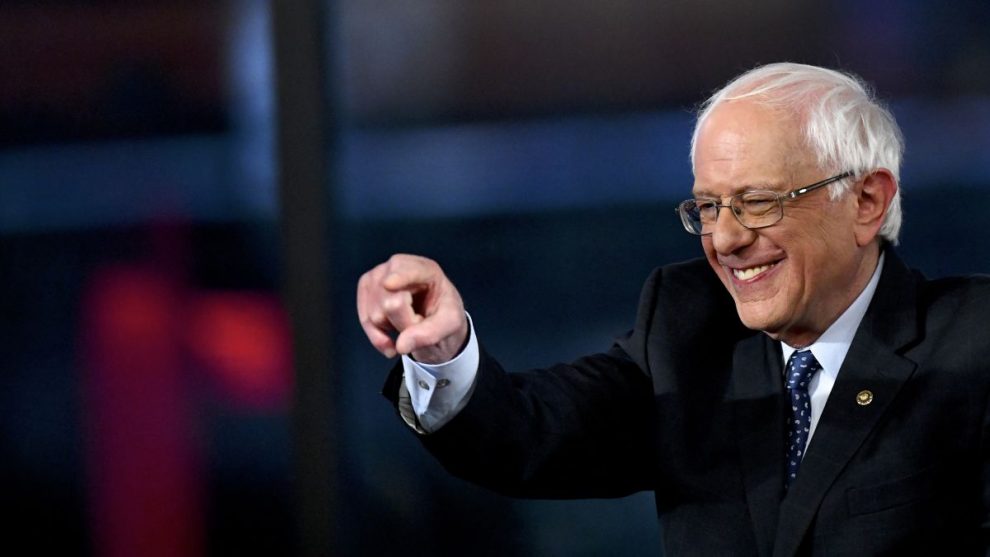
Sen. Bernie Sanders, challenged at Thursday night’s Democratic presidential debate on how he would pay for universal health care and his other proposed programs, admitted income taxes on the middle class would have to go up — but maintained that the savings in medical expenses would more than offset the tax hike.
Sanders, who took the first question from NBC correspondent Savannah Guthrie, talked about his Medicare for All proposal for his allotted minute. But when Guthrie followed up and pressed him about taxes on the middle class, he conceded, “Yes, they will pay more in taxes.”
“We have a new vision for America,” Sanders began. “And at a time when we have three people in this country owning more wealth than the bottom half of America while 500,000 people are sleeping out on the streets today, we think it is time for change, real change. And by that, I mean that health care in my view is a human right and we have got to pass a Medicare for All single-payer system.
“Under that system, by the way, [the] vast majority of the people in this country will be paying significantly less for health care than they are right now.”
“I believe that education is the future for this country and that is why I believe we must make public colleges and universities tuition-free and eliminate student debt, and we do that by placing a tax on Wall Street.”
He continued: “Every proposal that I have brought forth is fully paid for.”
Luxury real estate brothers sentenced to 30 years in prison for yearslong sex-trafficking scheme
Jordanian Military Goes After Targets in Syria in Response to Terrorists Killing Christians
‘Beloved’ daredevils who scaled Empire State Building inching toward deal after proposal stunt: attorney
DHS Shuts Down Major Chinese Birth Tourism Loophole in US Pacific Territory
175 Democrats demand Trump admin stop Ilhan Omar investigation, warn it could hurt her re-election bid
Shouting match erupts at UN as Cuban foreign minister moves toward US ambassador’s podium: ‘Back up!’
Trump administration ‘monitoring’ leftist organizers ignoring new terrorism sanctions: State Department official
90 Percent of Largest United Methodist Church Congregation Votes to Leave Denomination – But It Won’t Be Easy
Hundreds of staged armed robberies helped thousands pose as crime victims in US immigration scam: DOJ
The Thing That Never Happens: DOJ Says Hundreds of Foreigners Voted in Multiple US Elections
House report says NYC prosecutors tailored plea deals to shield illegal immigrants from deportation
Norway and Finland break norms by phoning Putin directly to urge breakthroughs at trilateral talks
Multi-state manhunt underway as murder victim’s close friend fears escaped killer could strike again
FBI raids Beverly Hills mansion as part of Eric Swalwell investigation
WNBA Players Run Off the Court Again Before National Anthem Ahead of Monday Finals Game
Guthrie said she would give Sanders “10 seconds just to answer the very direct question: Will you raise taxes for the middle class in a Sanders administration.”
“People who have health care under Medicare for All will have no premiums, no deductibles, no copayments, no out of pocket expenses. Yes, they will pay more in taxes, but less in health care for what they get.”
Still, taxes would significantly increase as “the government takes on trillions of dollars in health care costs now covered by employers and individuals,” the Associated Press fact checked. “Independent studies estimate the government would be spending an additional $28 trillion to $36 trillion over 10 years, although Medicare for All supporters say that’s overstating it. How those tax increases would be divvied up remains to be seen, as Sanders has not released a blueprint for how to finance his plan.”
Health care, a contentious topic among candidates in the first debate night, was expected to be an explosive talking point during the second debate with top-polling candidates like Sanders and Joe Biden.
But lower-profile candidates also dove into the health care debate.
Luxury real estate brothers sentenced to 30 years in prison for yearslong sex-trafficking scheme
Jordanian Military Goes After Targets in Syria in Response to Terrorists Killing Christians
‘Beloved’ daredevils who scaled Empire State Building inching toward deal after proposal stunt: attorney
DHS Shuts Down Major Chinese Birth Tourism Loophole in US Pacific Territory
175 Democrats demand Trump admin stop Ilhan Omar investigation, warn it could hurt her re-election bid
Shouting match erupts at UN as Cuban foreign minister moves toward US ambassador’s podium: ‘Back up!’
Trump administration ‘monitoring’ leftist organizers ignoring new terrorism sanctions: State Department official
90 Percent of Largest United Methodist Church Congregation Votes to Leave Denomination – But It Won’t Be Easy
Hundreds of staged armed robberies helped thousands pose as crime victims in US immigration scam: DOJ
The Thing That Never Happens: DOJ Says Hundreds of Foreigners Voted in Multiple US Elections
House report says NYC prosecutors tailored plea deals to shield illegal immigrants from deportation
Norway and Finland break norms by phoning Putin directly to urge breakthroughs at trilateral talks
Multi-state manhunt underway as murder victim’s close friend fears escaped killer could strike again
FBI raids Beverly Hills mansion as part of Eric Swalwell investigation
WNBA Players Run Off the Court Again Before National Anthem Ahead of Monday Finals Game
Sen. Michael Bennet, who was the last candidate to earn a spot on the debate stage, took a shot at Sanders on taxes.
Bennet said he believed in getting to universal health care. “I believe the way to do that is by finishing the work we started with Obamacare and creating a public option that every family and every person in America can make a choice for their family about whether they want a public option which for them would be like having Medicare for All or whether they want to keep their private insurance. I believe we will get there much more quickly if we do that.”
“Bernie mentioned the taxes that we would have to pay, because of those taxes, Vermont rejected Medicare for All,” he added. Sanders shook his head in response.
When asked which candidates would abolish private health insurance in favor of a government-run plan, only Sanders and Harris raised their hands.
Supporters of a single-payer plan like Medicare for All say that a “public option” to buy insurance, the competing approach, is just another incremental step, like Obamacare, that perpetuates the power and profits of the private insurance industry while failing to achieve universal coverage.
Luxury real estate brothers sentenced to 30 years in prison for yearslong sex-trafficking scheme
Jordanian Military Goes After Targets in Syria in Response to Terrorists Killing Christians
‘Beloved’ daredevils who scaled Empire State Building inching toward deal after proposal stunt: attorney
DHS Shuts Down Major Chinese Birth Tourism Loophole in US Pacific Territory
175 Democrats demand Trump admin stop Ilhan Omar investigation, warn it could hurt her re-election bid
Shouting match erupts at UN as Cuban foreign minister moves toward US ambassador’s podium: ‘Back up!’
Trump administration ‘monitoring’ leftist organizers ignoring new terrorism sanctions: State Department official
90 Percent of Largest United Methodist Church Congregation Votes to Leave Denomination – But It Won’t Be Easy
Hundreds of staged armed robberies helped thousands pose as crime victims in US immigration scam: DOJ
The Thing That Never Happens: DOJ Says Hundreds of Foreigners Voted in Multiple US Elections
House report says NYC prosecutors tailored plea deals to shield illegal immigrants from deportation
Norway and Finland break norms by phoning Putin directly to urge breakthroughs at trilateral talks
Multi-state manhunt underway as murder victim’s close friend fears escaped killer could strike again
FBI raids Beverly Hills mansion as part of Eric Swalwell investigation
WNBA Players Run Off the Court Again Before National Anthem Ahead of Monday Finals Game
Those against Medicare for All say it would be too hard to implement, resulting in underfunded hospitals due to lower Medicare-rate payments, and not provide enough options for consumers.
“Everybody who says Medicare for All, every person in politics who allows that phrase to escape their lips has a responsibility to explain how you’re actually supposed to get from here to there,” said South Bend, Ind., Mayor Pete Buttigieg. “I would call it Medicare for All Who Want It.”
Buttigieg said he would take parts of Medicare and give people an option to buy into it, providing “a very natural glide path to the single-payer environment.”
Story cited here.


