




Russia’s anticipated air campaign targeting Ukrainian energy infrastructure began Tuesday night into Wednesday, with drones and ballistic missiles hitting power plants and other energy infrastructure in and around Kyiv and across the rest of the country.
Mass missile and drone strikes on Ukraine have become routine, but the night was unique in the choice of targets. Instead of previous months’ focus on warehouses, logistics centers, supermarkets, industrial centers, and, more recently, telecommunications and data centers, Moscow focused its barrage almost entirely on power plants, substations, and other energy infrastructure.
Among the targets hit were the Trypilska thermal power plant, the largest in Kyiv oblast, the Kyiv CHP-5 Combined Heat and Power Plant, and the Kyiv Hydroelectric Power Plant. Russia used Iskander-M and RM-48U S-400 ballistic missiles, Tsirkon hypersonic missiles, Onyx supersonic missiles, and Geran-4 and Geran-5 jet-powered drones. Overall, 11 oblasts across Ukraine came under attack, but hits were concentrated in Kyiv.
</p>
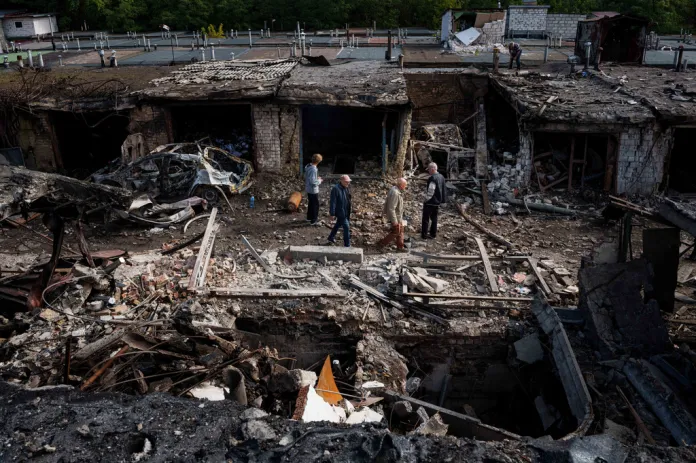
<p> ” data-large-file=”https://conservativemodern.com/wp-content/uploads/2026/09/russia-begins-air-campaign-targeting-ukrainian-energy-grid-with-barrage-against-kyiv-power-plants.webp” src=”https://conservativemodern.com/wp-content/uploads/2026/09/russia-begins-air-campaign-targeting-ukrainian-energy-grid-with-barrage-against-kyiv-power-plants.webp” alt=”Ukraine” class=”wp-image-4748391″ srcset=”https://conservativemodern.com/wp-content/uploads/2026/09/russia-begins-air-campaign-targeting-ukrainian-energy-grid-with-barrage-against-kyiv-power-plants-1.webp 1024w, https://conservativemodern.com/wp-content/uploads/2026/09/russia-begins-air-campaign-targeting-ukrainian-energy-grid-with-barrage-against-kyiv-power-plants-1.webp?resize=300,200 300w, https://conservativemodern.com/wp-content/uploads/2026/09/russia-begins-air-campaign-targeting-ukrainian-energy-grid-with-barrage-against-kyiv-power-plants-1.webp?resize=768,512 768w, https://conservativemodern.com/wp-content/uploads/2026/09/russia-begins-air-campaign-targeting-ukrainian-energy-grid-with-barrage-against-kyiv-power-plants-1.webp?resize=150,100 150w, https://conservativemodern.com/wp-content/uploads/2026/09/russia-begins-air-campaign-targeting-ukrainian-energy-grid-with-barrage-against-kyiv-power-plants-1.webp?resize=696,464 696w” sizes=”(max-width: 1024px) 100vw, 1024px”><figcaption class=) People walk in front of garages destroyed in a Russian missile strike on Vyshhorod, Kyiv region, Ukraine, on Wednesday, Sept. 30, 2026. (AP Photo/Evgeniy Maloletka)
People walk in front of garages destroyed in a Russian missile strike on Vyshhorod, Kyiv region, Ukraine, on Wednesday, Sept. 30, 2026. (AP Photo/Evgeniy Maloletka)The Trypilska TPP had been a previous target of Russian barrages, suffering a particularly serious attack in April 2024. It was still under repair when it was hit on Tuesday night, and assessments of damage are ongoing, Centrenergo CEO Serhiy Isachenko said.
“The enemy is deliberately striking the energy sector ahead of the heating season, hoping to leave Ukrainians without electricity and heat,” he said. “But we will stand firm.”
Videos also showed hits against high-voltage power lines near Kyiv. Power was briefly knocked offline for sizable swaths of Kyiv, but it was quickly restored.
Russia has targeted Ukraine’s energy grid every winter since October 2022 as a way to exert pressure on Ukraine’s government, economy, and populace, but this damage was kept in check by Ukraine’s capable air defense network. Advances in Russian technology and production, and the parallel critical degradation of Ukraine’s air defense network, have led to near-apocalyptic fears from Ukrainian officials about this winter being the worst yet.
Ukrainian Prime Minister Serhii Koretskyi confirmed analysts’ assessment that the Tuesday night strikes marked the start of Russia’s anticipated energy campaign, right as the weather has started to cool.
“Russia has escalated to massive strikes on energy infrastructure,” he said on Wednesday. “Since summer, there’s barely been a day without an attack on our energy infrastructure. But a combined strike of this scale hasn’t happened since the end of last heating season.”
Russia also hit “residential buildings, social infrastructure, civilian businesses, and railways,” he said, with the latter a staple of recent rounds of attacks.
Notably, the Ukrainian Air Force claimed it intercepted five Russian ballistic, supersonic, or hypersonic missiles. If true, it would show that Ukraine still has a handful of Patriot interceptors, rather than being out completely. Given that Russia has hit Kyiv numerous times since July without a single interception, Ukraine either received a handful of new Patriots or preserved some in anticipation of the fall-winter energy campaign.
Ukraine also reported that Russia launched 188 drones, 86 of which were jet-powered.
Kyiv residents woke up Wednesday coated in a thick blanket of smoke from the strikes, which emergency services attributed to a lack of wind.
“As soon as the wind picks up and the sun comes out, everything will gradually dissipate,” emergency services told residents, urging them to keep their windows closed and stay inside until this happens.
The increasingly massed use of Geran jet drones was one of the turning points this summer, giving Russia the advantage as its strike drone production outpaced Ukraine’s ability to acquire interceptors. The older propeller-powered Geran drones have a low success rate due to Ukraine’s adoption of interceptor drones, but the new Geran-4 and Geran-5s are too fast for the interceptor drones.
Aviation expert Bohdan Dolyntse said Ukraine still has another two months before jet-powered interceptors will be ready to deploy and engage jet-powered Gerans, with mass production needing several more months, Strana reported. Overall, he estimated that Geran-4 and Geran-5 jets cannot be intercepted en masse for another six months, giving Russia dominance of the skies for nearly the entire winter.
Russia’s mass production of Geran-4s and Geran-5s has continued to climb rapidly. On Tuesday, Ukrainian Air Force spokesman Yurii Ihnat said Russia fired 2,850 jet-powered drones in August, and 3,177 in September so far.
Russia began mass production of the jet-powered models in May, producing around 500 units per month. By August, it had reached 3,000 per month. It took nearly three years to have a comparable increase in the propeller-powered Geran-2 drone production. In August, the jet models overtook the Geran-2 in production, and Russia halted its first jet-powered model, the Geran-3.
With the odds of the air war increasingly in Russia’s favor, Ukrainian officials have begun to panic over what winter could bring. Some have openly warned that entire cities may become unlivable and empty out.
“We could have humanitarian disasters of the magnitude that nobody has seen,” former Ukrainian member of Parliament Ivanna Klympush-Tsintsadze warned last week.
HOW RUSSIA TURNED THE TIDE OF THE SUMMER AIR WAR IN UKRAINE
Rybar, a leading Russian analyst channel with connections to the Russian Ministry of Defense, cautioned against this apocalyptic assessment, saying it was “worth remembering that Kyiv has not frozen over in any of the previous winters.”
“Several years of attacks … have allowed the enemy to adapt,” the analyst wrote. “Of course, in 2026, Russian units are demonstrating much greater systematicity in terms of striking, but the enemy has also not been idle in terms of increasing the resilience of infrastructure.”


