






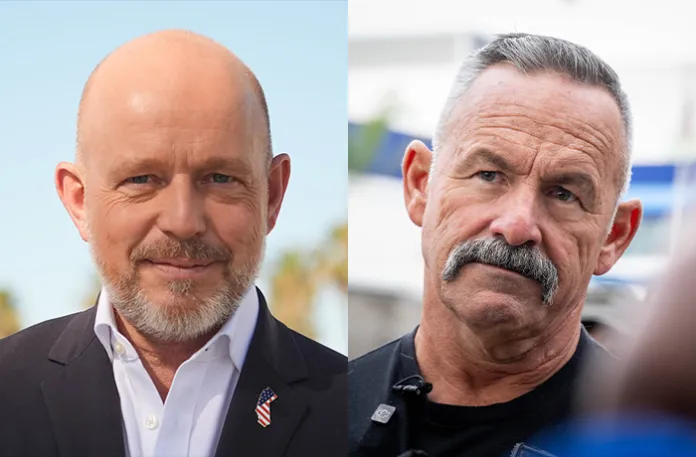
RIVERSIDE, Calif. — Heading into the 2026 election cycle, predicting a Republican candidate winning the California governorship would have seemed like a sucker’s bet in the heavily Democratic state. Now it’s more of a long shot — still unlikely but increasingly plausible.
It’s not that the deep blue bastion has embraced conservative politics and policy proposals offered by the top-polling Republican gubernatorial candidates, Riverside County Sheriff Chad Bianco and Silicon Valley tech entrepreneur Steve Hilton, who moved to California from his native Great Britain in 2012. But California has a top-two primary system in which all candidates run against each other regardless of party, advancing to the November general election if no candidate reaches 50% of the vote.
So many Democratic candidates are seeking the soon-to-be-open governorship that they could divvy up the June 2 primary vote, which would allow Bianco and Hilton to reach the November ballot and shut out the crowded field of Democrats aiming to succeed term-limited Gov. Gavin Newsom (D-CA). That would prove a major political embarrassment in a state — the nation’s most populous with nearly 40 million people — where Democratic activists consider themselves a “Resistance” tip-of-the-spear against President Donald Trump in his second nonconsecutive term.
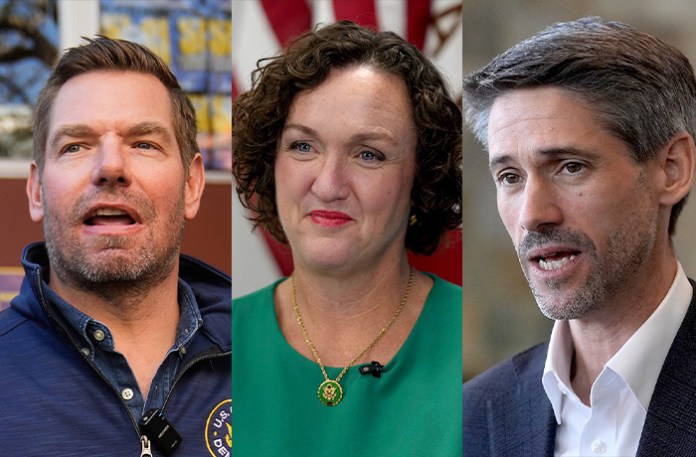
Most major 2026 Democratic gubernatorial candidates are sharpening their anti-Trump rhetoric. That includes former Health and Human Services Secretary Xavier Becerra, who was a House member representing Los Angeles for nearly 24 years and then California attorney general before serving in the Biden administration.
There’s also former state Assemblyman Ian Calderon, former Rep. Katie Porter, billionaire investor Tom Steyer, Rep. Eric Swalwell (D-CA), California Superintendent of Public Instruction Tony Thurmond, former state Assembly speaker and Los Angeles Mayor Antonio Villaraigosa, and former state Controller Betty Yee.
San Jose Mayor Matt Mahan also recently entered the race. Mahan has broken with Democratic orthodoxies by pushing a crackdown on homeless encampments and criticizing Newsom, a likely 2028 Democratic presidential candidate, for trolling the Trump administration on social media. Mahan argues Team Newsom’s social media antics targeting Trump do little to solve California’s myriad of problems.
There is no clear frontrunner in the gubernatorial field. Late February polling averages, though, consistently point to a fractured Democratic vote, which has allowed the two most prominent Republican candidates to top the pack in some surveys. No Republican has been elected to statewide office in California since 2006, when Arnold Schwarzenegger won a full term as governor.
One recent polling aggregation had Bianco at 14.7%, with Hilton narrowly behind at 14.1%. After that came Swalwell at 13%, Porter at 12.9%, Steyer at 6.2%, and Becerra at 5.9%. The poll showed the undecided vote stood at 33%, leaving the race up for grabs.
To be sure, polls are only a snapshot in time. Four months out from the all-party primary, there’s still time for one of the Democratic candidates to surge into a top-two spot, or for Bianco or Hilton to lose steam. Either trend would mean a Democratic candidate on the November ballot, and that person would be virtually assured of winning the governorship in a Democratic-dominated general election environment.
Yet the crowded Democratic field and the possibility that it could help ensure the first Republican governor since Schwarzenegger left office in early 2011 have caught the attention of party operatives. A leading Democratic data expert, Paul Mitchell, recently issued a statistical warning. Mitchell launched TWINS, a top-two primary simulator that shows the chance of any candidate combination winning the governor’s race primary.
Mitchell’s voter simulation puts the possibility of two Republicans facing off in November, and shutting out Democratic gubernatorial candidates, at 12%. Mitchell’s call-them-like-he-sees-them numbers have real credibility with the political class, since a Republican governor likely isn’t his preferred electoral outcome. After all, Mitchell helped draw pro-Democratic congressional redistricting lines for Proposition 50, which California voters approved last year. In what’s shaping up as a strong Democratic year amid Trump’s rising unpopularity, the new House map could effectively reduce Republican members of California’s 52-strong House delegation from its current eight lawmakers to only four.
Only room for two
California voters approved the top-two voting system ahead of the 2012 elections. Since it came into effect, the voting system has occasionally burned Democrats.
Rep. Pete Aguilar (D-CA), the House Democratic Caucus chairman, saw the start of his congressional career delayed due to the top-two voting system. In 2012, Aguilar, then mayor of Redlands, an Inland Empire city about 63 miles east of Los Angeles, ran for a newly revamped House district. Aguilar was the highest-finishing Democrat at 23%, but two Republicans were higher vote-getters, at 27% and 25%, including Republican Rep. Gary Miller, who had first been elected to the House in 1998. Miller retired ahead of the 2014 midterm elections, and Aguilar easily nabbed the seat.
Aguilar, 46, has since risen to the fourth-ranking spot in House Democratic leadership. Yet, the saga remains a cautionary tale for Democrats about what can happen if too many of their candidates bunch up on the ballot under the top-two election system.
That area of California is also home to Riverside County Sheriff Bianco, one of the two leading Republicans in the 2026 gubernatorial race. Bianco, 59, has spent more than three decades in law enforcement. In 2018, he was first elected sheriff of Riverside County, which stretches from the eastern Los Angeles exurbs to the Arizona state line.
Riverside County’s economic and population boom gives Bianco a real political base from which to run statewide. With a population of nearly 2.5 million, Riverside is the fourth-most populous county in California and the tenth-most populous nationwide. Its county seat, the city of Riverside, is California’s 12th-most populous city with about 315,000 people, and it is home to a University of California campus.
Running statewide, Bianco’s priorities include toughening public safety laws and addressing homelessness through law enforcement involvement. Bianco is also pushing to cut taxes for families and businesses.
Hilton, 56, was born in London. His parents were Hungarian refugees who worked in catering at Heathrow airport. Their original surname was Hircksac, which they anglicized.
Hilton attended Oxford and rose in the British Conservative Party, becoming a top advisor to then-Prime Minister David Cameron in the early 2010s. Once ensconced in California after establishing himself as a Silicon Valley tech executive, Hilton hosted the Fox News Sunday night show, The Next Revolution.
Hilton’s gubernatorial campaign centers on ending “16 years of Democrat one-party rule.” He has authored a book titled Califailure: Reversing the Ruin of America’s Worst-Run State. His platform focuses on the skyrocketing housing prices in California, lowering high taxes, addressing homelessness, and reducing government waste.
Game theory of sorts from California’s top-two primary system pits Bianco and Hilton as opposing Republicans running for governor, but they still need each other, at least until the all-party primary is done. The pair would have then five months to fight it out ahead of the Nov. 3 general election.
On the Democratic side, Porter seemed to be the leading gubernatorial candidate last summer. The former congresswoman had some residual name recognition from losing a 2024 Senate bid and previously gained notice for her pointed questioning of public officials and business leaders during congressional hearings, where she often used visual aids such as whiteboards.
But Porter’s gubernatorial chances took a hit in late 2025 after an interview with a local television reporter in Sacramento went seriously awry. Porter, 52, threatened to walk out when questioned about appealing to Republican voters. The Yale- and Harvard Law-educated former congresswoman came across to many as a smug, superior academic. Simultaneously, a 2021 video surfaced of Porter yelling at a staffer.
Lately, Swalwell, 45, has picked up some momentum in the governor’s race. The staunch anti-Trump cable news fixture earned the endorsement of Sen. Adam Schiff (D-CA), himself a leading “Resistance” figure. Swalwell is positioning himself as a “fighter and protector” focused on reducing the state’s cost of living and opposing the Trump administration.
A Democratic gubernatorial race wild card is Mahan, the San Jose mayor and most recent entrant. Mahan, 43, is drawing an ideological contrast between himself and a crop of Democrats who have expressed few differences of opinion. Mahan is setting up a test of whether Californians are willing to choose a tech-aligned centrist who deemphasizes national politics over more than half a dozen “Resistance” Democrats.
That is, of course, assuming Mahan can build enough statewide name identification in four months that voters outside the greater Bay Area will even consider him. It’s a version of the harsh political reality that any viable gubernatorial candidate faces. They must also raise vast amounts of money to win in a sprawling state with some of the nation’s most expensive media markets.
An escape hatch for Democrats?
Should Democrats’ worst electoral fears be realized by Republicans Bianco and Hilton advancing to the general election, they wouldn’t necessarily have to live through four years of a GOP governor in Sacramento. Another peculiarity of California election law, the recall, would give Democrats the chance to end a Republican governorship almost before it got off the ground.
Democratic strategists already are whispering about that possibility amid the party’s fractured gubernatorial field. Since the recall became part of the California Constitution in 1911, there have been 55 attempts to recall a governor, but only two have ever qualified for the ballot.
California’s only successful gubernatorial recall, in 2003, saw voters oust Democrat Gray Davis and replace him with Schwarzenegger. Newsom successfully defeated the most recent recall attempt in 2021.
The recall process allows any registered voter to initiate a recall for any reason, or none at all. Proponents must gather signatures equal to 12% of the votes cast in the last election for that office.
HOMELESSNESS, TAXES, AND AFFORDABILITY TAKE CENTER STAGE IN CALIFORNIA GUBERNATORIAL DEBATE
That wouldn’t be a particularly high threshold to clear in the nation’s preeminent blue state. And while Democrats have expressed scorn and heaped criticism of recall efforts against sitting governors of their party, there’s every reason to think that, with the political tables turned, the process could be used to dislodge a Republican state chief executive from office. The process would likely take about six months, starting with the inauguration of California’s next governor in early January 2027.
For now, that’s all theoretical, as California Democrats scramble to avoid their party from getting boxed out of the November gubernatorial ballot. But should the polls in the late spring still resemble those from mid-winter, powerful Democrats may pressure some of the candidates who have struggled to raise money or secure much support in the polls to drop out.
David Mark (@DavidMarkDC) is the managing editor of the Washington Examiner magazine.


