




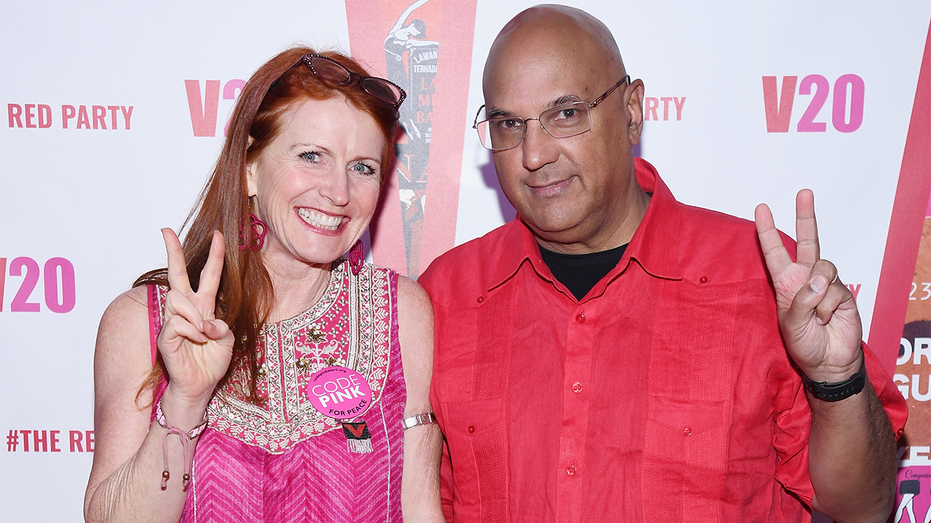
On Sunday, CodePink, a far-left, pro-China, pro-communism nonprofit activist group, published a video on Instagram attacking a proposed data center project in Utah backed by investor Kevin O’Leary.
According to a new report, obtained by Fox News Digital, that wasn’t a coincidence.
The report, “Foreign Influence in the Campaign against American AI,” by the Bitcoin Policy Institute, alleges that there are “three vectors of foreign influence converging on the push to block U.S. AI data center construction.”
They include a nonprofit network funded by tech tycoon Neville Roy Singham, a U.S. expatriate living in Shanghai promoting Chinese propaganda; Chinese Communist Party state media; and dark money funding tied to foreign billionaires including Swiss billionaire Hansjörg Wyss and British billionaire Alan Parker.
The report alleges nonprofits funded by Singham — including CodePink — have spent years fueling opposition to U.S. AI infrastructure and data center expansion in coordination with Chinese propaganda narratives and foreign-funded activist networks. As reported, in February 2017, Singham married Jodie Evans, the co-founder of CodePink in a lavish wedding in Jamaica, and, according to a Fox News Digital investigation, Singham pumped $285 million into six nonprofits over the next several years, using a series of shell companies and a donor-advised fund established at a philanthropy arm of Goldman Sachs. A spokesman for Goldman Sachs told Fox News Digital that the company “terminated” Singham’s donor-advised fund in early 2024.
Still, the network of organizations that Singham has funded have continued to act as proxies for the propaganda of the Chinese Communist Party.
On March 25, amid campaigns by Singham organizations against U.S. technology firms, Sen. Bernie Sanders and Rep. Alexandria Ocasio-Cortez introduced the “AI Data Center Moratorium Act.” Weeks later, on April 29, Sanders hosted a Capitol Hill event titled “The Existential Threat of AI.”
According to the report, two of the four panelists at that event were affiliated with the Chinese government: Zeng Yi, founding dean of the Beijing Institute of AI Safety and Governance, and Xue Lan, a counselor of China’s State Council and chair of China’s National AI Governance Committee.
Singham, Evans, Wyss, Parker Sanders, Ocasio-Cortez didn’t respond to requests for comment. The organizations named in the report didn’t respond to requests for comment.
BERNIE SANDERS’ PLANS TO SCHMOOZE WITH TOP BEIJING AI EXPERTS IGNITES BACKLASH: ‘HOLY SH–‘
The report states that, using a U.S. Senate platform, Xue argued that the U.S.-China AI race was “an inaccurate narrative” and promoted “safe zones” of cooperation on AI governance, messaging the report says paralleled years of Chinese state media narratives surrounding AI policy and American technological development.
Sam Lyman, head of research at the Bitcoin Policy Institute and a former senior speechwriter for Treasury Secretary Scott Bessent, said, “Ensuring that AI is safe and empowers American workers must be a top priority for US policymakers. But the discussion about AI safety should not be influenced by geopolitical rivals, especially China, whose leaders have publicly stated their intentions to accelerate AI development to ‘gain the initiative in global science and technology competition.’”
“Depending on advances in this field, there may come a time when the United States and China must engage in bilateral negotiations to ensure the safe development of AI,” Lyman said. “But until then, an honest conversation about AI safety requires filtering any foreign influence. This report provides the transparency citizens and lawmakers need to see who is funding and influencing the campaigns shaping the AI policy debate.”
STEVE FORBES: THE AI COLD WAR HAS BEGUN AND AMERICA CANNOT AFFORD TO LOSE
The convergence of interest groups opposing data centers isn’t a coincidence, the report alleges.
“These events did not take place in isolation,” says the report. “They were the culmination of a multi-year influence campaign against American AI conducted across three vectors of foreign influence.”
The report specifically alleges that Beijing’s state-run media outlets — including CGTN, China Daily and Global Times — have pushed anti-data-center narratives inside the United States while China simultaneously subsidizes domestic AI infrastructure development.
“The asymmetry is what gives the operation away,” the report argues. “While Beijing’s state media warns American audiences that data centers are environmentally and economically dangerous, the Chinese state subsidizes up to half of the energy costs of its own AI data center operators.”
The report further alleges that the Singham network “has spent nearly five years producing parallel domestic content opposing U.S. AI infrastructure, AI labs, and AI export controls.”
It points to multiple examples involving organizations linked to the network.
GORDON CHANG: A LOT OF OUR ANTI-AMERICAN PROTESTS ARE MADE IN CHINA
In January 2026, CodePink published an article titled “The War Intervention: AI, Data Centers, and the Environment,” directly targeting U.S. AI data centers, including Meta’s Hyperion project in Louisiana and Meta Cheyenne in Wyoming, while framing the fight as opposition to “the new Cold War on China.”
The report also cites Tricontinental: Institute for Social Research, a Singham-funded think tank, for repeatedly opposing U.S. semiconductor export controls and criticizing efforts to limit China’s AI development.
On March 27, Tricontinental published an article, “Breaking the Stranglehold: How China Is Shattering US Technological Hegemony,” arguing against U.S. AI chip restrictions and portraying American export controls as an attempt to suppress China’s rise.
That same day, Peoples Dispatch — which is also part of the Singham ecosystem — published “Kill Chain: Silicon Valley, AI, and the war on Iran,” attacking AI companies including Anthropic and Palantir Technologies. The report describes the same-day publication pattern across affiliated outlets as evidence of coordinated messaging operations.
By May 1, CodePink published an article, “The Dark Side of the Data Center Boom,” adding to the cacophony of coordinated protests against U.S. data centers.
The House Ways and Means Committee, House Oversight Committee and the House Select Committee on the Chinese Communist Party are investigating whether some of the nonprofits should register under the Foreign Agents Registration Act, or FARA. The House Ways and Means Committee has issued letters to Singham-funded organizations, seeking internal documents related to their funding, operations and connections to Singham and the Chinese Communist Party.
On foreign funding, the report alleges that charitable organizations tied to Wyss and Parker have routed billions of dollars into U.S.-based advocacy infrastructure now aligned against AI infrastructure projects and data centers.
It specifically highlights a Dec. 8, 2025, letter organized by Food & Water Watch, a nonprofit, calling for a national moratorium on new AI data centers. According to the report, about 230 organizations signed the letter, including groups receiving funding from networks linked to Wyss and Parker.
The report notes that the Sanders-Ocasio-Cortez moratorium legislation was introduced 107 days after the coalition letter was circulated.
“That kind of efficiency typically distinguishes coordinated advocacy infrastructure from spontaneous grassroots opposition,” the AI Policy Institute states.
The report argues that “ensuring that AI is safe and empowers American workers must be a top priority for U.S. policymakers,” but says the debate over AI safety and data centers “should not be influenced by a geopolitical rival.”
In its conclusion, the report frames the debate in stark geopolitical terms, arguing that “the choice facing policymakers is not between AI or no AI but between American AI or Chinese AI.”
By early afternoon on Monday, the CodePink video opposing the Utah data center project had acquired 356 likes, many of them from the pro-China, pro-communist activist ecosystem.


