




Two groups with ties to the Left are engaged in coordinated campaigns to promote artificial intelligence regulation in three Republican-controlled states, public records show.
While President Donald Trump, himself generously supported by many tech interests, has voiced opposition to state-level AI regulation, some red-state leaders have nonetheless proposed laws to rein in the emerging technology. Nebraska, Tennessee, and Utah have attempted to buck the White House on this front. Encode AI and the Secure AI Project, nonprofit groups with staffing and financial ties to the Left, have had a hand in driving this divide between the Trump administration and each of these states.
Encode AI was founded by activist Sneha Revanur in 2020, who continues to lead the organization. In a 2023 interview with Politico, which described Revanur as the “Greta Thunberg of AI,” she disclosed that her organization was primarily funded by the philanthropies of liberal billionaire Pierre Omidyar. Recent tax filings show that liberal grantmakers, such as those linked to Omidyar and major Democratic donors, are still cutting checks to Encode AI.
Among Encode AI’s relatively short list of staffers, several have worked for Democratic lawmakers or left-of-center activist organizations. Revanur interned for former Rep. Cori Bush (D-MO), according to a previous version of her LinkedIn page. Her group previously criticized Immigration and Customs Enforcement, though the blog post containing their critiques has since been scrubbed.
Despite its links to the Left, Encode AI is officially nonpartisan and promotes Democrats and Republicans whom it believes are aligned with its goals, such as Pete Buttigieg and Sen. Marsha Blackburn (R-TN).
“Encode is a nonpartisan nonprofit working to advance the responsible development of AI for the benefit of all,” Adam Billen, the group’s co-executive director, told the Washington Examiner. “We partner with policymakers at every level of government, across both parties, to promote smart, effective legislation that protects the public and supports innovation.”
SAIP, meanwhile, is led by Nick Beckstead, a seven-year veteran of Dustin Moskovitz’s Open Philanthropy. Moskovitz, a Facebook co-founder, is a major Democratic donor. The organization’s policy director is also an alumnus of Open Philanthropy, which has since rebranded as Coefficient Giving. SAIP does not publicly disclose its donors.
“The Secure AI Project continues to be proud to support both Republican and Democratic legislators in protecting children and the public from risks of severe harm from advanced AI,” a spokesman for the group told the Washington Examiner. “In all the states where we work, the public overwhelmingly supports responsible guardrails on AI. This likely underpins much of the inbound interest we have from elected officials to support AI safety legislation.”
To advance their preferred policies in GOP-led states, the duo of groups relies on a combination of political donations, lobbying, and public advocacy campaigns.
In Nebraska, for instance, Encode AI and SAIP retained lobbyists within days of each other in early January. Further entangling the two groups is the fact that they retained the same law firm, Radcliffe, Gilbertson & Brady, to provide them with lobbying services.
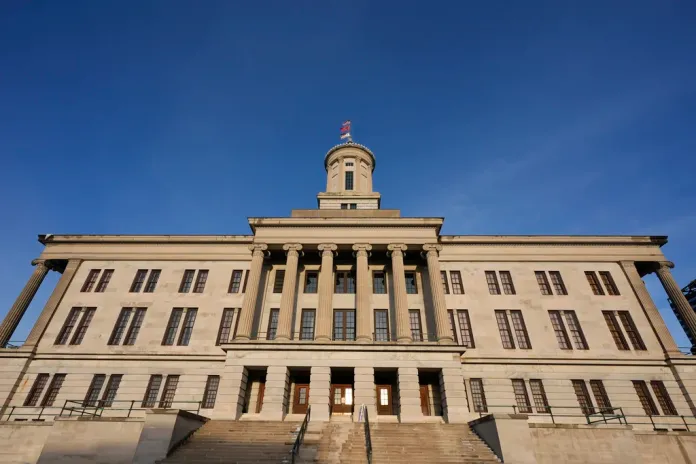
These aren’t lightweight operations. Combined, the duo of organizations spent nearly $50,000, in addition to staff time, on lobbying efforts in Nebraska between January and mid-March, records show. That is a considerable sum for a state-level lobbying effort.
Through this spending, the duo of groups is seeking to advance the Transparency in Artificial Intelligence Risk Management Act, a piece of legislation that would require firms operating AI chatbots to submit safety plans, implement a formal risk mitigation system, and make such materials publicly available.
Interestingly, the bill was introduced by a Republican lawmaker on Jan. 15, just days after Encode AI and SAIP registered lobbyists in Nebraska.
Everything happening in Nebraska follows a familiar pattern.
Also in January of this year, Encode AI cut a $10,000 check to State Rep. Doug Fiefia’s (R-UT) campaign account. Once again, the GOP lawmaker introduced AI safety legislation supported by Encode AI and SAIP just days later. The two groups also registered lobbyists in Utah in the months leading up to the bill’s introduction.
The bill introduced in Utah is strikingly similar to the one being pushed in Nebraska. Both require AI companies to promulgate public safety plans and impose consequences if they fail to do so.
In Tennessee, Encode AI and SAIP once again registered lobbyists before a pair of Republican state lawmakers introduced legislation that, like in Utah and Nebraska, requires AI companies to publish detailed safety plans. Once again, Encode AI and SAIP appear to be working with the same law firm to aid in their lobbying efforts, suggesting coordination.
The effort to get these laws across the finish line does not stop at lobbying and political contributions. In Tennessee and Utah, Encode AI and SAIP have launched public advocacy campaigns seeking to win over voters.
In Utah, Encode AI commissioned a poll that found broad support for the AI safety legislation it was backing. It then used that polling data in a mass texting campaign to convince voters that they should pressure their representatives to support the bill.
The groups — which are based out of Washington, D.C., and San Francisco — are employing a similar playbook in Tennessee, where they run a group called Tennesseans for AI Safety. One of the talking points this group has pushed most aggressively is a commissioned poll showing overwhelming support for the AI safety bill working its way through the state’s legislature.
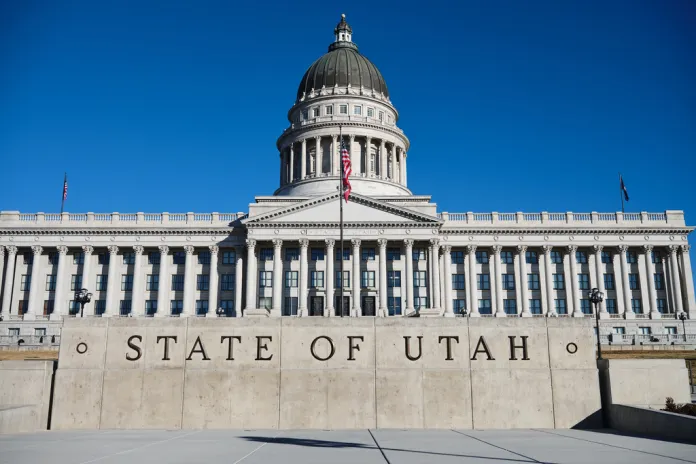
Critics of laws such as those proposed in Nebraska, Utah, and Tennessee argue that rigid safety plans could impose technical burdens that hamper technological innovation and that a patchwork of state regulations, rather than uniform federal policies, could create an uncertain business environment. Proponents, meanwhile, claim that the federal government is moving too slowly and that safety regulations are needed as soon as possible to prevent the new technologies from harming people.
ORGANIZATIONS WITH STRONG TIES TO THE LEFT INFLUENCED AI POLICY IN A DEEP RED STATE
Some have encouraged conservatives to be wary of other conservatives who take certain policy positions after brushes with liberal money.
“There is nothing inherently wrong with a conservative organization taking funds from liberal entities or with a conservative organization dissenting from some conservative orthodoxy,” Capital Research Center director of research Mike Watson wrote in 2021. “But when nominal conservatives start rushing to the left as left-wing dollars flow into their institutions, skepticism is warranted.”
Indeed, the Trump administration has attempted to clamp down on state-level AI regulation efforts in Utah, Nebraska, and Tennessee.


