



A Democratic-sponsored California ballot measure aims to salve a long-festering political wound for Team Blue.
Voters in the Nov. 3 midterm elections will decide whether to significantly alter California’s recall election law, a statute that’s been on the books since 1911 but wasn’t deployed successfully in a governor’s race until 2003. When voters chose to replace Democratic Gov. Gray Davis — less than a year after winning reelection — with Republican movie star Arnold Schwarzenegger. And though Gov. Gavin Newsom (D-CA) beat back a GOP-initiated recall attempt in 2021, Democrats say it’s time to change the current system.
It’s one they call a distortion of democracy, in which a noisy political minority can effectively overthrow a duly elected statewide official. While defenders of the current recall law, often Republicans, say the ballot measure is a thinly veiled lawmaker incumbent protection racket for rogue politicians defying the public’s anger over rising crime, high taxes, rampant homelessness, and onerous environmental standards. With these and other policy sins by Democrats in this deeply blue state.
The debate over Proposition 5 is likely to intensify as Election Day nears. One that will miss the dispassionate yet deeply knowledgeable voice of the nation’s widely acknowledged recall expert — Berkeley, California-based Joshua Spivak, who died peacefully in his sleep on July 12, 2025, at age 51.
</p>
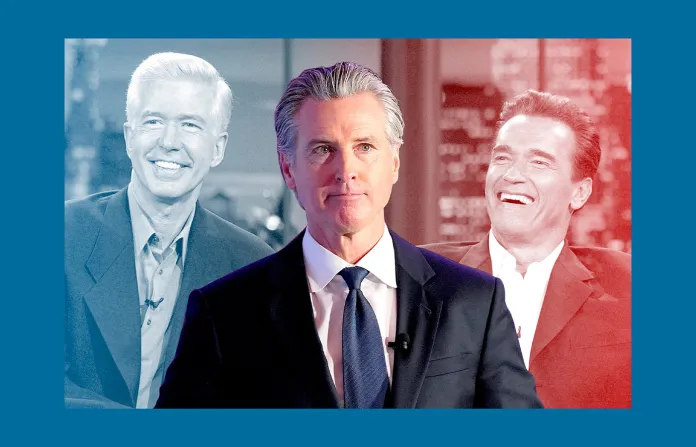
<p> ” data-large-file=”https://conservativemodern.com/wp-content/uploads/2026/08/recalling-a-political-analyst-whose-insight-would-have-risen-above-the-midterm-elections-din.webp” height=”658″ width=”1024″ src=”https://conservativemodern.com/wp-content/uploads/2026/08/recalling-a-political-analyst-whose-insight-would-have-risen-above-the-midterm-elections-din.webp” alt=”In October 2003, under the California recall law in place since 1911, voters removed Democratic Gov. Gray Davis from office and replaced him with Republican movie star Arnold Schwarzenegger. State Democrats now aim to alter the recall law through Proposition 5, which California voters will consider in the Nov. 3 midterm elections. (Examiner illustration; Jae C. Hong/AP; Nam Y. Huh/AP)” class=”wp-image-4695689″ style=”width:878px;height:auto” srcset=”https://conservativemodern.com/wp-content/uploads/2026/08/recalling-a-political-analyst-whose-insight-would-have-risen-above-the-midterm-elections-din-2.webp 1400w, https://conservativemodern.com/wp-content/uploads/2026/08/recalling-a-political-analyst-whose-insight-would-have-risen-above-the-midterm-elections-din-2.webp?resize=300,193 300w, https://conservativemodern.com/wp-content/uploads/2026/08/recalling-a-political-analyst-whose-insight-would-have-risen-above-the-midterm-elections-din-2.webp?resize=768,494 768w, https://conservativemodern.com/wp-content/uploads/2026/08/recalling-a-political-analyst-whose-insight-would-have-risen-above-the-midterm-elections-din-2.webp?resize=1024,658 1024w, https://conservativemodern.com/wp-content/uploads/2026/08/recalling-a-political-analyst-whose-insight-would-have-risen-above-the-midterm-elections-din-2.webp?resize=150,96 150w, https://conservativemodern.com/wp-content/uploads/2026/08/recalling-a-political-analyst-whose-insight-would-have-risen-above-the-midterm-elections-din-2.webp?resize=696,447 696w, https://conservativemodern.com/wp-content/uploads/2026/08/recalling-a-political-analyst-whose-insight-would-have-risen-above-the-midterm-elections-din-2.webp?resize=1068,687 1068w” sizes=”(max-width: 1024px) 100vw, 1024px”><figcaption class=) In October 2003, under the California recall law in place since 1911, voters removed Democratic Gov. Gray Davis from office and replaced him with Republican movie star Arnold Schwarzenegger. State Democrats now aim to alter the recall law through Proposition 5, which California voters will consider in the Nov. 3 midterm elections. (Examiner illustration; Jae C. Hong/AP; Nam Y. Huh/AP)
In October 2003, under the California recall law in place since 1911, voters removed Democratic Gov. Gray Davis from office and replaced him with Republican movie star Arnold Schwarzenegger. State Democrats now aim to alter the recall law through Proposition 5, which California voters will consider in the Nov. 3 midterm elections. (Examiner illustration; Jae C. Hong/AP; Nam Y. Huh/AP)Spivak was a senior research fellow at UC Berkeley Law’s California Constitution Center, among other academic affiliations. Spivak, a Columbia Law School alum, was also a longtime West Coast anchor for Ripp Media/Public Relations, a top communications firm, based in New York City.
“Josh was a perfect fit for my media relations practice focused on law firms and legal affairs,” eponymous firm founder and Spivak’s boss for more than 20 years, Allan Ripp, wrote in an Aug. 5, 2025 remembrance. Ripp added that Spivak was a hot media commodity himself if a recall election qualified for the ballot somewhere.
“Whenever an elected official anywhere faced a recall,” Ripp wrote about the father of two young men, in college and high school, who first moved west from his native Brooklyn when his wife Amelia was starting a Ph.D. in mathematics at UC Berkeley. “Josh was sought out by news outlets around the country for perspective and legal analysis.”
</p>
<p> ” data-large-file=”https://conservativemodern.com/wp-content/uploads/2026/08/recalling-a-political-analyst-whose-insight-would-have-risen-above-the-midterm-elections-din-1.webp” height=”1024″ width=”819″ src=”https://conservativemodern.com/wp-content/uploads/2026/08/recalling-a-political-analyst-whose-insight-would-have-risen-above-the-midterm-elections-din-1.webp” alt=”Joshua Spivak. (AP Photo)” class=”wp-image-4695691″ style=”width:194px;height:auto” srcset=”https://conservativemodern.com/wp-content/uploads/2026/08/recalling-a-political-analyst-whose-insight-would-have-risen-above-the-midterm-elections-din-4.jpg 1080w, https://conservativemodern.com/wp-content/uploads/2026/08/recalling-a-political-analyst-whose-insight-would-have-risen-above-the-midterm-elections-din-4.jpg?resize=240,300 240w, https://conservativemodern.com/wp-content/uploads/2026/08/recalling-a-political-analyst-whose-insight-would-have-risen-above-the-midterm-elections-din-4.jpg?resize=768,960 768w, https://conservativemodern.com/wp-content/uploads/2026/08/recalling-a-political-analyst-whose-insight-would-have-risen-above-the-midterm-elections-din-4.jpg?resize=819,1024 819w, https://conservativemodern.com/wp-content/uploads/2026/08/recalling-a-political-analyst-whose-insight-would-have-risen-above-the-midterm-elections-din-4.jpg?resize=150,188 150w, https://conservativemodern.com/wp-content/uploads/2026/08/recalling-a-political-analyst-whose-insight-would-have-risen-above-the-midterm-elections-din-4.jpg?resize=300,375 300w, https://conservativemodern.com/wp-content/uploads/2026/08/recalling-a-political-analyst-whose-insight-would-have-risen-above-the-midterm-elections-din-4.jpg?resize=696,870 696w, https://conservativemodern.com/wp-content/uploads/2026/08/recalling-a-political-analyst-whose-insight-would-have-risen-above-the-midterm-elections-din-4.jpg?resize=1068,1335 1068w” sizes=”(max-width: 819px) 100vw, 819px”><figcaption class=) Joshua Spivak. (AP Photo)
Joshua Spivak. (AP Photo)Spivak was routinely interviewed about and quoted in The New York Times, the San Francisco Chronicle, and KQED (the San Francisco-based Bay Area NPR affiliate). Plus a range of other news outlets in the United States and abroad.
There was no shortage of subject matter fodder. In 39 states, local officials can be subject to recall elections. California is among 19 states that permit recalls of state-level officials.
Spivak was, as UC Berkeley Law noted in an Aug. 5, 2025, remembrance, “the nation’s foremost — nay, only — expert on recall elections. He was a thinker and scholar who published many works to define the field he pioneered: books, academic journal articles, and hundreds of public commentary pieces.”
That included six pieces for this magazine in the first half of 2025. Among the highlights: “The end of the founders’ presidency” (Jan. 31); “Campaigns for new statewide jobs in 2026 likely mean foregoing 2028 presidential runs” (March 7); and “Senators make a beeline for open governorships” (June 20).
Each column brought a unique analytic take to the political news of the day. With a thematic throughline emphasizing that members of Congress in both parties have, in recent decades, ceded constitutionally granted powers to the executive branch. A turn of events that has distorted the careful checks and balances envisioned by the Founding Fathers. And this ongoing lapse in respect for constitutional structures made the type of daily executive branch power grabs by President Donald Trump during his second, nonconsecutive term almost inevitable.
Reforming the recall?
Spivak, no doubt, would have been busy with analysis about the California recall statewide ballot measure. The proposal’s central change to current law is a provision that applies to each recall attempt of a state-level official. It consists of two separate ballot questions. Voters are first asked a “yes” or “no” question about whether they want to remove the incumbent.
The state-level official recall ballot’s next part has voters pick among the candidates vying to replace them. The incumbent can’t run in that replacement “election,” which denies them two bites of the political apple.
The rub is that the replacement results only matter if a majority votes “yes” on the first question. If a majority of voters reject recalling the incumbent, nothing happens. That was the situation in 2021 when the question before voters, “Shall Gavin Newsom be recalled (removed) from the office of Governor?” received a nearly 62% “no” vote and only a 38% “yes” vote.
That proved a starkly different result from the 2003 California gubernatorial recall, when voters chose to recall Davis, a Sacramento political veteran who was chief of staff to a prior governor, a state assemblyman, a state controller, and California’s lieutenant governor, before he won the governorship in 1998.
In 2023, a “yes” recall of Davis earned 55.39% to 44.61% for the “no” side. Schwarzenegger, a first-time candidate, finished first in the gubernatorial replacement race that included 135 candidates. Schwarzenegger earned 48.6%, to 31.5% for his closest Democratic rival, then-Lt. Gov. Cruz Bustamante. Rep. Tom McClintock (R-CA), then a state legislator, drew 13.5%.
The successful recall effort was, in hindsight, an early sign of populist anger at the political status quo, which manifested nationally 13 years later with the election of Trump, a real estate developer and celebrity game show host. Even as their styles differed greatly, with Schwarzenegger offering a sunny, California can-do optimism about free markets and Trump emphasizing an angry, often gloomy, populist-nationalist vision.
And while Schwarzenegger won by playing by the rules — and then capturing a full, four-year gubernatorial term in the 2006 elections — California Democrats have long been angry about that 23-year-old turn of events because California is such a Democratic state, and a Republican still won on their political turf.
Democrats and “good government” critics contend this system is fundamentally undemocratic. If a “yes” vote prevails, the successor can get elected with less than a majority of the vote, as Schwarzenegger did. That’s because all the candidates from all parties run on a single ballot without any primary or runoff to winnow the field.
So, Proposition 5, which the state’s Democratic-led legislature voted to place on this year’s ballot back in 2024, would amend the state constitution to change the process. Under the proposed amendment, voters would simply be asked whether or not they want to recall the incumbent. If the governor is ousted, the lieutenant governor would automatically take over.
DARLINE GRAHAM NORDONE, RALPH NORMAN ADVANCE TO RUNOFF IN SENATE RACE TO REPLACE LINDSEY GRAHAM
Ballot measure opponents argue that the proposal would limit voter power and serve as a shield for incumbent politicians. The ballot measure, these critics say, runs counter to the recall law’s spirit and intent. Voters approved it in 1911 as a way to check corrupt state officials beholden to deep-pocketed railroad titans and other entrenched special interests, they note.
There have been 56 attempts to recall a governor since California adopted the process in the early 20th century. The Schwarzenegger “Total Recall” election was the only one to work. That’s the kind of fact Spivak would have had ready to recite in any waking moment — and the type of context about a proposed major change to California campaigns and elections for which he’ll be so missed.
David Mark (@DavidMarkDC) is the managing editor of the Washington Examiner magazine.


