




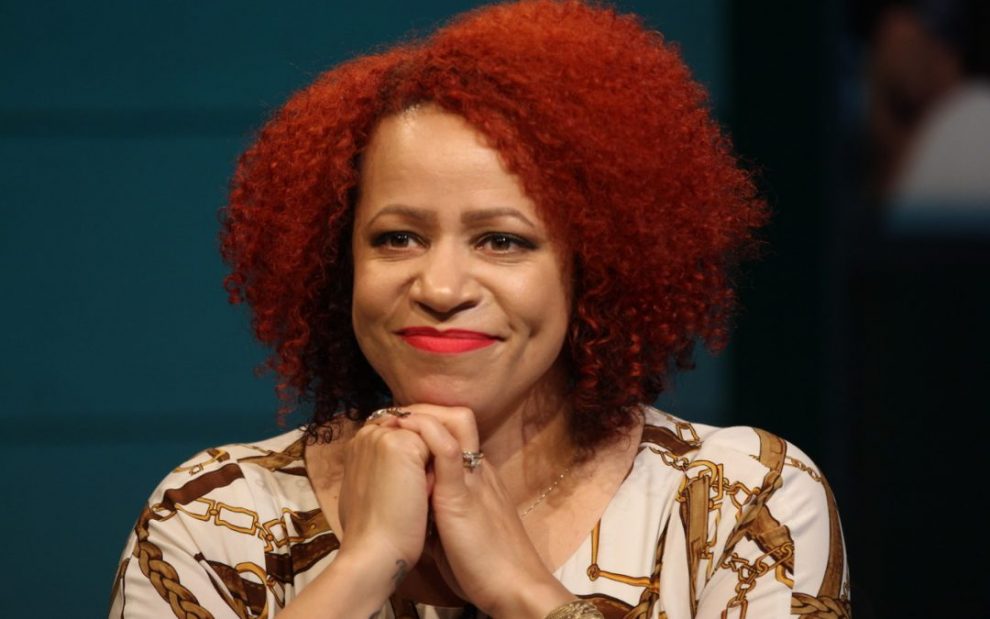
The 2020 Pulitzer Prize for commentary was awarded Monday to Nikole Hannah-Jones for an essay in the New York Times that falsely claimed the American Revolution was fought primarily to protect slavery.
The essay, titled “Our democracy’s founding ideals were false when they were written. Black Americans have fought to make them true,” launched the Times‘ controversial 1619 project.
The essay incorrectly claimed that the Declaration of Independence was signed on July 4, 1776 (signing began weeks later, on August 2).
However, the far more egregious error was Hannah-Jones’s claim about the cause for which the Revolution was fought. She wrote: “Conveniently left out of our founding mythology is the fact that one of the primary reasons the colonists decided to declare their independence from Britain was because they wanted to protect the institution of slavery.”
That passage, which appeared in the original text, has since been updated to include the word “some” (emphasis added): “Conveniently left out of our founding mythology is the fact that one of the primary reasons some of the colonists decided to declare their independence from Britain was because they wanted to protect the institution of slavery.”
Historians were outraged by Hannah-Jones’s false claim. One of them, Northwestern University Professor Leslie Harris, was enthusiastic about the 1619 Project, but furious about the inaccurate claim. Harris recalled in Politico:
Watch: Ilhan Omar, AOC Unexpectedly Show up on Football Fans’ TVs, Making Racist, Anti-White Comments Many Voters Had Never Heard
Watch: Ilhan Omar, AOC Unexpectedly Show up on Football Fans’ TVs, Making Racist, Anti-White Comments Many Voters Had Never Heard
Watch: Ilhan Omar, AOC Unexpectedly Show up on Football Fans’ TVs, Making Racist, Anti-White Comments Many Voters Had Never Heard
Alaska Dem Senate candidate suffers minor injuries in car crash, forcing her to skip campaign events
Obama’s Saddam Hussein Jab at Trump’s Ornate WH Backfires as Critics Point Out He Built a ‘Wizard Prison’
Obama’s Saddam Hussein Jab at Trump’s Ornate WH Backfires as Critics Point Out He Built a ‘Wizard Prison’
Obama’s Saddam Hussein Jab at Trump’s Ornate WH Backfires as Critics Point Out He Built a ‘Wizard Prison’
Dem Senate hopeful rejects Schumer but benefits from millions in spending by his allies
What are the most expensive midterm races?
Trump’s fingerprints seen on Latin America’s rightward shift as Brazil becomes next test
Nicki Minaj pledges to support Donald Trump again during Michigan Republican campaign rally
El Sayed mocks Rogers’s ‘earpiece’ and Trump’s ‘a**’ remarks in Grand Rapids rally
Sanders calls Michigan Senate race a test of Trump, accuses president of using racism to divide voters
Bruce Blakeman calls Kathy Hochul Zohran Mamdani’s ‘puppet’ during New York campaign rally
College homecoming party turns to chaos as deck collapses, leaving at least 28 people injured
On August 19 of last year I listened in stunned silence as Nikole Hannah-Jones, a reporter for the New York Times, repeated an idea that I had vigorously argued against with her fact-checker: that the patriots fought the American Revolution in large part to preserve slavery in North America.
…
I vigorously disputed the claim. Although slavery was certainly an issue in the American Revolution, the protection of slavery was not one of the main reasons the 13 Colonies went to war.
…
Overall, the 1619 Project is a much-needed corrective to the blindly celebratory histories that once dominated our understanding of the past—histories that wrongly suggested racism and slavery were not a central part of U.S. history. I was concerned that critics would use the overstated claim to discredit the entire undertaking. So far, that’s exactly what has happened.
The current version of Hannah-Jones’s essay preserves other controversial statements, such as the claim that “Anti-black racism runs in the very DNA of this country,” which repeats (almost verbatim) a claim then-President Barack Obama made in 2015 to National Public Radio that racism is “still part of our DNA.”
Watch: Ilhan Omar, AOC Unexpectedly Show up on Football Fans’ TVs, Making Racist, Anti-White Comments Many Voters Had Never Heard
Watch: Ilhan Omar, AOC Unexpectedly Show up on Football Fans’ TVs, Making Racist, Anti-White Comments Many Voters Had Never Heard
Watch: Ilhan Omar, AOC Unexpectedly Show up on Football Fans’ TVs, Making Racist, Anti-White Comments Many Voters Had Never Heard
Alaska Dem Senate candidate suffers minor injuries in car crash, forcing her to skip campaign events
Obama’s Saddam Hussein Jab at Trump’s Ornate WH Backfires as Critics Point Out He Built a ‘Wizard Prison’
Obama’s Saddam Hussein Jab at Trump’s Ornate WH Backfires as Critics Point Out He Built a ‘Wizard Prison’
Obama’s Saddam Hussein Jab at Trump’s Ornate WH Backfires as Critics Point Out He Built a ‘Wizard Prison’
Dem Senate hopeful rejects Schumer but benefits from millions in spending by his allies
What are the most expensive midterm races?
Trump’s fingerprints seen on Latin America’s rightward shift as Brazil becomes next test
Nicki Minaj pledges to support Donald Trump again during Michigan Republican campaign rally
El Sayed mocks Rogers’s ‘earpiece’ and Trump’s ‘a**’ remarks in Grand Rapids rally
Sanders calls Michigan Senate race a test of Trump, accuses president of using racism to divide voters
Bruce Blakeman calls Kathy Hochul Zohran Mamdani’s ‘puppet’ during New York campaign rally
College homecoming party turns to chaos as deck collapses, leaving at least 28 people injured
How many Pulitzer prizes have gone to essays that have had to subsequently publicly correct one of their core claims? Or been challenged by every major historian in the field, right and center and left?
— Andrew Sullivan (@sullydish) May 4, 2020
The Times also shared a Pulitzer Prize in 2018 for its reporting on the “Russia collusion” narrative, which was later disproven (albeit reluctantly) by Special Counsel Robert Mueller’s investigation into the 2016 election.
In August 2019, Times editor Dean Baquet told the newsroom that the newspaper intended to shift its coverage from Russia to race. With the collapse of Russia conspiracy theories, which the Times had used to attack President Donald Trump from the day of his inauguration, the paper needed a new narrative. The 1619 Project is the centerpiece of that new narrative — with Trump, implicitly, the inheritor of America’s racist past.
The Pulitzer Prize committee described Hannah-Jones’s essay as “sweeping, deeply reported and personal.” The Poynter Institute, which lists George Soros’s Open Society Foundations as a major funder, also gushed over Hannah-Jones’s essay, calling it “nearly impossible, and almost insulting, to try and describe in a handful of words or even sentences.”
Yet two corrections — technically, one “correction” and one “editors’ note” — below the essay suggest that while perhaps heartfelt, the prize-winning piece is also, fundamentally, wrong about American history.
Story cited here.


