






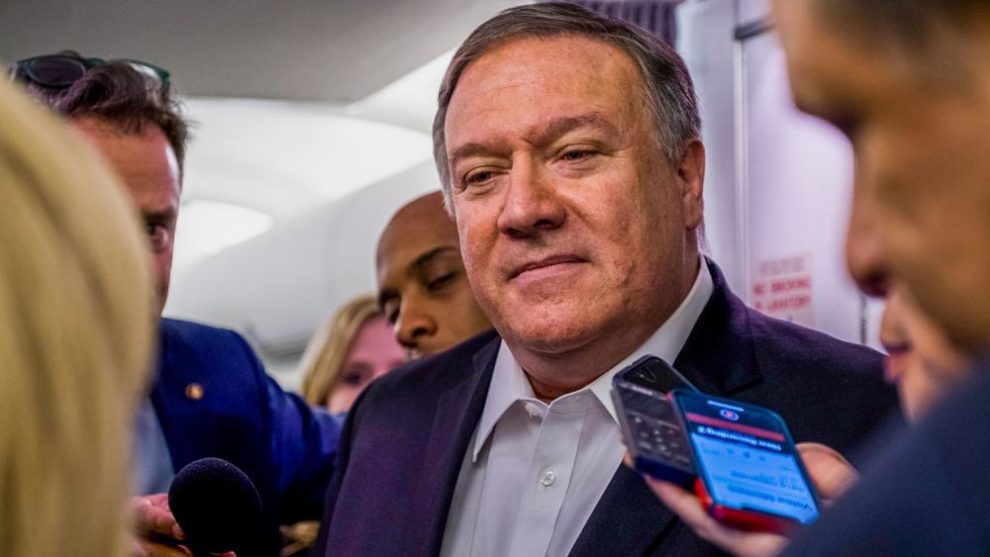
U.S. Secretary of State Mike Pompeo is in the Middle East this week to build a “global coalition” against Iran amid intensified tensions between Washington and Tehran.
The likelihood of a military confrontation between Iran and the United States has increased in recent days, notably after Iranian troops shot down an American drone last week.
U.S. President Donald Trump’s administration has also accused Iran of sabotaging oil tankers in the Persian Gulf.
In response, President Trump has slapped additional punishing economic restrictions on Iran as part of his administration’s maximum pressure campaign that is choking the Islamic Republic’s economy.
The United States retaliated by launching a cyber attack on Iranian weapons systems last Thursday.
On Monday, Tehran dismissed the cyber attacks as unsuccessful.
Watch: Outrageous Pro-El-Sayed Ad Blames Jewish State for Raising Price of Bananas, Eggs in Michigan
Haitian illegal immigrant charged in Walmart killing entered US via Biden parole program: DHS
Flavio Bolsonaro to be issued visa by State Department after fleeing Brazil
Right-Wing Presidential Candidate Flavio Bolsonaro Secretly Flees Brazil for US After Disputed Election: Report
Luxury real estate brothers sentenced to 30 years in prison for yearslong sex-trafficking scheme
Judge who apologized to accused would-be Trump assassin lights up DOJ in Hunter Biden FBI case
Jordanian Military Goes After Targets in Syria in Response to Terrorists Killing Christians
‘Beloved’ daredevils who scaled Empire State Building inching toward deal after proposal stunt: attorney
Judge slams federal prosecutors over new charges against ex-FBI officials
DHS Shuts Down Major Chinese Birth Tourism Loophole in US Pacific Territory
175 Democrats demand Trump admin stop Ilhan Omar investigation, warn it could hurt her re-election bid
Shouting match erupts at UN as Cuban foreign minister moves toward US ambassador’s podium: ‘Back up!’
Trump administration ‘monitoring’ leftist organizers ignoring new terrorism sanctions: State Department official
90 Percent of Largest United Methodist Church Congregation Votes to Leave Denomination – But It Won’t Be Easy
Hundreds of staged armed robberies helped thousands pose as crime victims in US immigration scam: DOJ
The Trump administration has also ordered the deployment of an additional 2,500 American troops into the Middle East since May.
Pompeo arrived in Shiite Iran’s regional rival Sunni Saudi Arabia on Monday as part of a trip that will include the United Arab Emirates (UAE).
The two Sunni kingdoms are leading a coalition fighting Iran-allied Shiite Houthi rebels in war in Yemen that has killed tens of thousands.
In recent days, the Houthis have launched attacks against targets inside Yemen’s neighbor Saudi Arabia.
Before leaving the U.S. capital for the Middle East, Pompeo told reporters that he would talk with the two U.S. Sunni Arab allies Saudi Arabia and the UAE:
[A]bout how to make sure that we are all strategically aligned and how we can build out a global coalition, a coalition not only throughout the Gulf states but in Asia and in Europe that…is prepared to push back against the world’s largest state sponsor of terror.
Echoing President Trump, Pompeo noted that the United States is willing to negotiate with Iran without preconditions to ease tensions between the two longtime rivals. Iran, however, has indicated it is not interested in dialogue.
On Sunday, Pompeo also told reporters that with the new sanctions the Trump administration aims to deny Iran further the resources “to foment terror, to build out their nuclear weapons system, [and] to build out their missile program.”
Watch: Outrageous Pro-El-Sayed Ad Blames Jewish State for Raising Price of Bananas, Eggs in Michigan
Haitian illegal immigrant charged in Walmart killing entered US via Biden parole program: DHS
Flavio Bolsonaro to be issued visa by State Department after fleeing Brazil
Right-Wing Presidential Candidate Flavio Bolsonaro Secretly Flees Brazil for US After Disputed Election: Report
Luxury real estate brothers sentenced to 30 years in prison for yearslong sex-trafficking scheme
Judge who apologized to accused would-be Trump assassin lights up DOJ in Hunter Biden FBI case
Jordanian Military Goes After Targets in Syria in Response to Terrorists Killing Christians
‘Beloved’ daredevils who scaled Empire State Building inching toward deal after proposal stunt: attorney
Judge slams federal prosecutors over new charges against ex-FBI officials
DHS Shuts Down Major Chinese Birth Tourism Loophole in US Pacific Territory
175 Democrats demand Trump admin stop Ilhan Omar investigation, warn it could hurt her re-election bid
Shouting match erupts at UN as Cuban foreign minister moves toward US ambassador’s podium: ‘Back up!’
Trump administration ‘monitoring’ leftist organizers ignoring new terrorism sanctions: State Department official
90 Percent of Largest United Methodist Church Congregation Votes to Leave Denomination – But It Won’t Be Easy
Hundreds of staged armed robberies helped thousands pose as crime victims in US immigration scam: DOJ
“We’re prepared to negotiate with no preconditions. They know precisely how to find us,” he added.
In recent days, the Trump administration added the Saudi city of Jeddah and the U.A.E. capital of Abu Dhabi to Pompeo’s trip to India from where America’s top diplomat is expected to join Trump in Japan and South Korea.
U.S. national security advisers, namely John Bolton, are expected to begin a two-day summit in Jerusalem on Monday along with Russia and Israel to focus on Iran and other issues in the Middle East.
The meetings are “a very important summit for ensuring stability in the Middle East during turbulent times,” Israeli Prime Minister Benjamin Netanyahu declared, according to Radio Farda, a component of Radio Free Europe/Radio Liberty (RFE/RL).
Nikolai Patrushev, the secretary of Russian President Vladimir Putin’s Security Council, added that “Russia will take Iran’s interests into account [during the summit], making them known to the Israelis and the Americans,” the state-run TASS news agency revealed.
During a joint press conference with Netanyahu in Jerusalem on Sunday, Bolton cautioned Iran that it should not “mistake U.S. prudence and discretion for weakness.”
No one has granted Iran a “hunting license in the Middle East,” he proclaimed.
Watch: Outrageous Pro-El-Sayed Ad Blames Jewish State for Raising Price of Bananas, Eggs in Michigan
Haitian illegal immigrant charged in Walmart killing entered US via Biden parole program: DHS
Flavio Bolsonaro to be issued visa by State Department after fleeing Brazil
Right-Wing Presidential Candidate Flavio Bolsonaro Secretly Flees Brazil for US After Disputed Election: Report
Luxury real estate brothers sentenced to 30 years in prison for yearslong sex-trafficking scheme
Judge who apologized to accused would-be Trump assassin lights up DOJ in Hunter Biden FBI case
Jordanian Military Goes After Targets in Syria in Response to Terrorists Killing Christians
‘Beloved’ daredevils who scaled Empire State Building inching toward deal after proposal stunt: attorney
Judge slams federal prosecutors over new charges against ex-FBI officials
DHS Shuts Down Major Chinese Birth Tourism Loophole in US Pacific Territory
175 Democrats demand Trump admin stop Ilhan Omar investigation, warn it could hurt her re-election bid
Shouting match erupts at UN as Cuban foreign minister moves toward US ambassador’s podium: ‘Back up!’
Trump administration ‘monitoring’ leftist organizers ignoring new terrorism sanctions: State Department official
90 Percent of Largest United Methodist Church Congregation Votes to Leave Denomination – But It Won’t Be Easy
Hundreds of staged armed robberies helped thousands pose as crime victims in US immigration scam: DOJ
The president of Iran, which denies supporting terrorism and argues that its nuclear program is peaceful, blamed the United States for fueling the ongoing tensions.
America’s “interventionist military presence” is fanning the flames, Iranian President Hassan Rouhani said on Sunday, the Associated Press (AP) noted.
U.S.-Iran tensions have intensified since President Trump decided to pull the United States out of the controversial 2015 nuclear deal between Tehran and American-led world powers, arguing that it was not severe enough.
After withdrawing from the accord, the Trump administration moved to reimpose sanctions suspended under the deal as part of an unprecedented wave of economic restrictions that have crippled the Iranian economy.
Both Iran and the Trump administration have acknowledged that Tehran is feeling the pressure from the sanctions, forcing the Islamic Republic to act out against the United States.
The Trump administration hopes that the sanctions will ultimately force Iran into a more robust nuclear deal.
Story cited here.


