






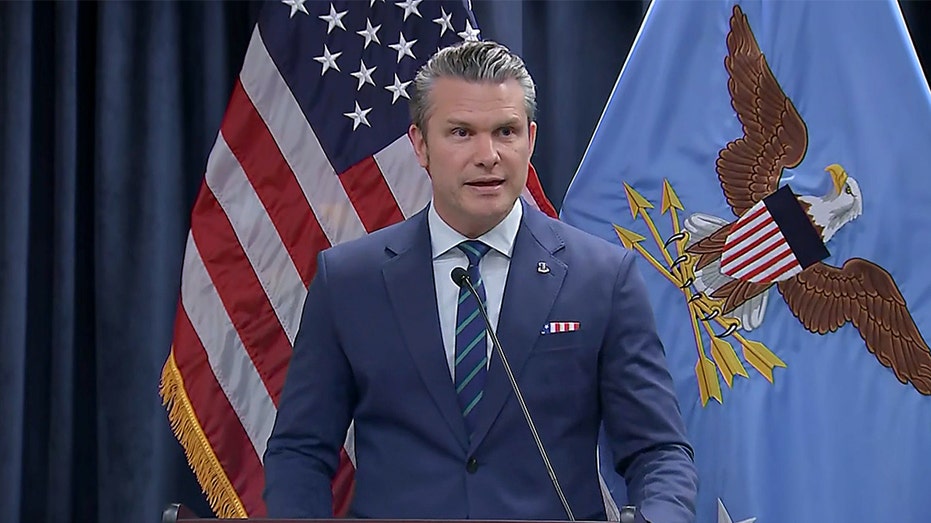
Secretary of War Pete Hegseth said Thursday that U.S. forces have delivered devastating blows to Iran’s military in the opening days of Operation Epic Fury, crippling key naval and missile capabilities while signaling that a larger and more sustained campaign is underway.
Speaking alongside U.S. Central Command (CENTCOM) Commander Adm. Brad Cooper at CENTCOM headquarters at MacDill Air Force Base in Tampa, Florida, Hegseth described a fast-moving operation that has significantly degraded Iran’s ability to threaten U.S. forces and regional partners as officials shift toward preventing Tehran from rebuilding its military strength.
“In just days of Operation Epic Fury, you and your team have delivered nothing short of devastating, precise strikes taking out the better part of Iran’s navy, making it combat ineffective, neutralizing missile sites and launchers and establishing total dominance over the skies,” Hegseth told Cooper.
REP BRIAN MAST: DEMOCRATS DON’T WANT WAR POWERS, THEY WANT TO WAVE A WHITE FLAG
“Our forces are executing with unmatched skill, and the mission is advancing decisively.”
Cooper detailed the expanding maritime campaign, saying U.S. forces have intensified strikes against Iranian vessels in recent hours, surpassing previously disclosed totals and further weakening Tehran’s ability to project power at sea.
“You may have heard the president say just a little while ago that we have sunk or destroyed 24 ships. That was true. At the moment, we’re now up over 30 ships,” Cooper said. “In just the last few hours, we hit an Iranian drone carrier ship roughly the size of a World War II aircraft carrier. And, as we speak, it’s on fire.”
Beyond naval losses, sustained air operations have sharply reduced Iran’s ability to launch retaliatory attacks. U.S. bombers have targeted launchers, command infrastructure and air defenses deep inside the country in an effort to limit both immediate threats and future strike capacity.
“Ballistic missile attacks have decreased by 90% since day one. Drone attacks have decreased by 83% since day one,” Cooper said.
The sharp decline in launches, officials indicated, reflects both the destruction of key systems and the disruption of Iran’s command-and-control networks, forcing Tehran onto the defensive as U.S. aircraft continue operating over the country.
Hegseth made clear the operation is not slowing down, warning that significantly more firepower is moving into the region as additional forces and assets come online.
“We have only just begun to fight and fight decisively,” Hegseth said. “The amount of combat power that’s still flowing, that’s still coming, that we’ll be able to project over Iran is multiples of what it currently is right now.”
PENTAGON POLICY CHIEF GRILLED AS DEM CLAIMS TRUMP BROKE PROMISE ABOUT GOING TO WAR WITH IRAN
He also sought to counter any suggestion that the U.S. could face supply constraints as the campaign continues, emphasizing both capacity and staying power.
“Our capabilities are overwhelming and gathering still, as are those of our Israeli partners,” Hegseth said. “Our munitions are full up and our will is ironclad, which means our timeline is ours and ours alone to control as long as it takes to ensure the United States of America achieves these objectives.”
Cooper confirmed the mission is entering a new phase aimed at Iran’s long-term missile production capacity, shifting from degrading existing stockpiles to preventing their regeneration.
“We’re not just hitting what they have. We’re destroying their ability to rebuild,” Cooper said. “As we transition to the next phase of this operation, we will systemically dismantle Iran’s missile production capability for the future.”
Together, the remarks underscored both the scale of the battlefield damage already inflicted and the administration’s message that the campaign — bolstered by additional forces and sustained munitions capacity — is positioned to intensify in the days ahead.


