







One year after the initialing of the peace agreement between Armenia and Azerbaijan, the United States has cemented its lasting influence in the South Caucasus.
On Aug. 8, 2025, longtime enemies Armenian Prime Minister Nikol Pashinyan and Azerbaijani President Ilham Aliyev met alongside President Donald Trump as newly christened friends, ready to put aside decades of enmity between their nations. A central appeal of this peace deal was the promise of a new dawn of relations with the U.S., which has been realized over the past year.
The U.S. and Armenia have struck new deals opening up cooperation regarding artificial intelligence, critical minerals, and nuclear power, while the U.S.-Azerbaijani relationship has expanded to new partnerships across the board.
The Washington Examiner interviewed Armenian Ambassador Narek Mkrtchyan and Azerbaijani Ambassador Khazar Ibrahim just ahead of the anniversary of the historic peace agreement, where each outlined how relations between their countries and the U.S. have grown over the past year.
</p>
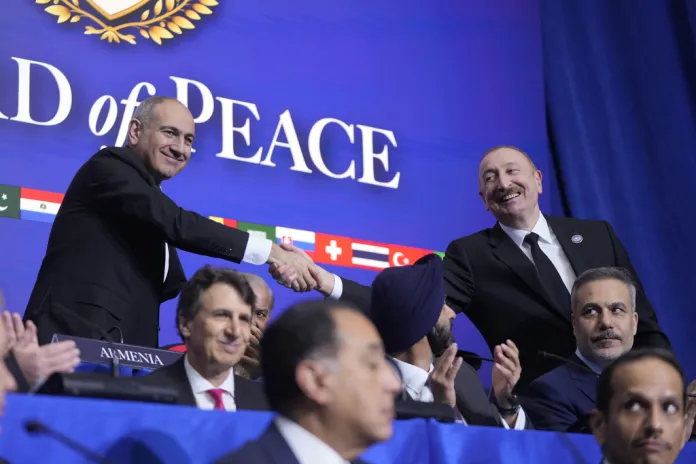
<p> ” data-large-file=”https://conservativemodern.com/wp-content/uploads/2026/08/one-year-on-us-brokered-peace-between-armenia-and-azerbaijan-cements-us-foothold-in-the-caucasus.webp” src=”https://conservativemodern.com/wp-content/uploads/2026/08/one-year-on-us-brokered-peace-between-armenia-and-azerbaijan-cements-us-foothold-in-the-caucasus.webp” alt=”Armenia Azerbaijan” class=”wp-image-4680169″ srcset=”https://conservativemodern.com/wp-content/uploads/2026/08/one-year-on-us-brokered-peace-between-armenia-and-azerbaijan-cements-us-foothold-in-the-caucasus-1.webp 1024w, https://conservativemodern.com/wp-content/uploads/2026/08/one-year-on-us-brokered-peace-between-armenia-and-azerbaijan-cements-us-foothold-in-the-caucasus-1.webp?resize=300,200 300w, https://conservativemodern.com/wp-content/uploads/2026/08/one-year-on-us-brokered-peace-between-armenia-and-azerbaijan-cements-us-foothold-in-the-caucasus-1.webp?resize=768,512 768w, https://conservativemodern.com/wp-content/uploads/2026/08/one-year-on-us-brokered-peace-between-armenia-and-azerbaijan-cements-us-foothold-in-the-caucasus-1.webp?resize=150,100 150w, https://conservativemodern.com/wp-content/uploads/2026/08/one-year-on-us-brokered-peace-between-armenia-and-azerbaijan-cements-us-foothold-in-the-caucasus-1.webp?resize=696,464 696w” sizes=”(max-width: 1024px) 100vw, 1024px”><figcaption class=) Armenia’s Prime Minister Nikol Pashinyan, left, and President of Azerbaijan, Ilham Aliyev, right, shake hands during a Board of Peace meeting at the U.S. Institute of Peace, Thursday, Feb. 19, 2026, in Washington. (AP Photo/Mark Schiefelbein)
Armenia’s Prime Minister Nikol Pashinyan, left, and President of Azerbaijan, Ilham Aliyev, right, shake hands during a Board of Peace meeting at the U.S. Institute of Peace, Thursday, Feb. 19, 2026, in Washington. (AP Photo/Mark Schiefelbein)Different starting points
Historically, the Caucasus was largely understood to be Russia’s wheelhouse, so U.S. influence in the region was limited, though far from nonexistent. Following the collapse of the Soviet Union, U.S. relations with Azerbaijan were stronger than with Armenia, mostly due to Azerbaijan’s wealth in natural resources. The U.S. was a central party in the 1994 “Contract of the Century,” a deal signed with Azerbaijan by 11 international oil companies representing seven countries to develop Azerbaijan’s energy infrastructure.
Despite the already existing relations between the U.S. and Azerbaijan, few imagined that relations would bloom to the extent it has over the past year.
The 2025 treaty, Ibrahim said, “brought a very different level of relations between Azerbaijan and the United States. To the highest level, I think, of the last 34 years.”
With the vigorous work of both parties, he believes the deal has met all expectations on the current timeline.
Given the previous lack of significant U.S. interest in Armenia before last year’s deal, the advancement in U.S.-Armenian relations has been little short of revolutionary.
“The Washington Peace Declaration created a process which is leading our countries and our region into a new phenomenon, into a new reality — or as our prime minister would phrase it: into a ‘crossroads of peace,’” Mkrtchyan said.
“The Washington Declaration also became decisive for bilateral relations,” he added. “Because if we look into the history of bilateral relations between the U.S. and Armenia, you can see that the Washington Declaration … and the following months … really brought a breakthrough in bilateral relations.”
In previous years, relations between the U.S. and Armenia were largely defined by U.S. support for civil society and humanitarian issues, Mkrtchyan explained. It has shifted over the past year into a focus on economic cooperation. Armenia has appealed to the Trump administration’s priorities by pursuing cooperation in artificial intelligence and critical minerals.
A few weeks after the Washington peace accord was initialed, the U.S. and Armenia signed a Memorandum of Understanding on AI and semiconductor development. After Vice President JD Vance visited the country earlier this year, they signed another MOU on nuclear cooperation.
Just two months after the AI development MOU, Mkrtchyan said, “We got approval from the Department of Commerce for one of the biggest AI factories in the region, which is not only a U.S. investment. It’s also a project which will contribute to U.S. AI systems and the U.S. economy, because the intelligence that will be computed in Armenia, it will be delivered to the U.S., and it will be used by different American companies, and of course it will also generate a lot of revenue.”
“I think there is no future without AI systems, and Armenia is becoming a partner of the U.S. in providing sustainability of supply chains for AI systems,” he said.
The AI project was just one example of how “mutually beneficial projects can change the nature of bilateral relations,” Mkrtchyan added, contrasting it with one-sided aid relationships that characterized much of the U.S.-Armenia relationship before. These mutually beneficial projects help create the trust on which the growing U.S.-Armenia relationship must be based, the Armenian ambassador argued.
Armenia’s choice to lean in on AI and technology development is a telling sign of its awareness of one of its main resources — human capital. Though small in population, around 3-4 million, the Caucasian nation and its diaspora are known for punching above their weight in intelligence and competence.
“With this partnership, we want to be active creators of the future with the United States of America, because we have that potential,” Mkrtchyan said. “We have resources. We have human capital. We have knowledge. We have technologies, and we have a trust-based partnership, which really can transform the region.”
Azerbaijan is less focused on AI and technology in its cooperation with the U.S., content with deepening its relationship through other sectors.
“Our situation is a bit different than that of Armenia,” Ibrahim said, noting the longstanding U.S.-Azerbaijani cooperation in the areas of energy and counterterrorism.
“We already had two big chunks, and we already had this experience of working strategically and very actively with the United States. Armenia started right now, and yes, AI is priority for Armenia, so that’s why it immediately came to the future. For us, again, energy and security cooperation is already huge,” he continued.
With the Washington agreement, energy and counterterrorism became just “one of several” areas of close cooperation with the U.S. Ibrahim was particularly happy about the signing of the strategic partnership between the U.S. and Azerbaijan, solidifying a state of affairs that had already begun to exist in practice.
“In every direction, we are having development. The strategic partnership envisaged cooperation on energy, economy, defense, AI, you name it,” he said. “In general, economy, everything is happening in a very fast way.”
The philosophy of the TRIPP
A central aspect of the U.S.-brokered peace deal was the establishment of the “Trump Route for International Peace and Prosperity,” a U.S.-developed land corridor linking Azerbaijan with its Nakhchivan exclave. According to the plan, U.S. companies would develop rail, oil, gas, and fiber optic lines through the 27-mile-long corridor. The U.S. will hold a 74% stake in the project, with the Armenian government holding the rest. The route will be officially under Armenian control.
To Mkrtchyan, however, the TRIPP is more than just a physical land corridor. He laid out a utopian vision in which the TRIPP would be expanded throughout the Caucasus to bring forth a new era of interconnectivity, peace, and prosperity.
“This is an important platform for people-to-people contact. An important platform to break the stereotypes and to break the psychological difficulties to use each other’s territories, respecting each other’s territorial integrity, sovereignty, and jurisdiction, and live peacefully together. The philosophy of TRIPP is to build peace,” he said.
Mkrtchyan envisions the TRIPP expanding beyond just the land corridor connecting Nakhchivan and Azerbaijan, floating future projects connecting Georgia with northern Armenia, connecting the Caucasus with parts of Central Asia, and ultimately giving Armenia easy access to Turkey and the Mediterranean.
“So the TRIPP has a potential to connect with existing infrastructure, both road and possible new railroad projects in Armenia,” he said.
Before that happens, however, the first step of the TRIPP must be completed. Mkrtchyan said Armenia is working closely with the U.S. International Development Finance Corporation to “set up the financial component,” and the project is currently in the feasibility study process.
“Once we assess a feasibility study, we will create a more practical project of the construction of the TRIPP,” he said, outlining the hundreds of millions of dollars in investments the State Department has pledged.
As the physical TRIPP will be entirely located within Armenian territory, Azerbaijan has no involvement in the project. Azerbaijan appears to be getting impatient with the lack of progress on the physical route.
“It should largely have already happened; we think it’s a little bit slow, for whatever reason,” Ibrahim said, adding that Azerbaijan has already completed most of its part of infrastructure development, and is just waiting to connect to the “small chunk” that will complete a larger route through the Caucasus.
If Azerbaijan is asked to be a direct party in developing the TRIPP in the future, he said it would “think about it,” but in such an early stage of development, “it’s too early to say.” The ambassador also noted that Azerbaijan has been kept in the loop on developments regarding the TRIPP.
The Bear in the room
Prior to the U.S.’s increased involvement in the Caucasus, the dynamic between Armenia and Azerbaijan was largely defined by Armenia’s alignment with Russia and Iran against Azerbaijan’s alignment with Turkey and Israel. The sudden boost of the U.S.’s role predictably made Russia and Iran uneasy, with each denouncing the deal as an encroachment in the region.
Russia has been especially skeptical, viewing the peace deal as a brazen attempt to wean its longtime ally Armenia away from it. Armenia has gone to significant lengths to soothe Moscow’s fears and assure it that its growing relationship with the U.S. isn’t coming at the Kremlin’s expense.
“This is a bilateral project with a huge potential to bring benefit to others as well. But it’s not a project against other countries, including Russia,” Mkrtchyan said.
The ambassador even welcomed future Russian involvement in the TRIPP.
“We’ve said many times that the TRIPP will set up certain rules … and if any country will be ready to play with these certain rules of the game, we would be happy to engage them as well,” he added.
Ibrahim was also quick to stress that Azerbaijan doesn’t view its international relationships as a zero-sum game.
“It has been always very clear from the first days after our independence, not only in terms of our relations with the United States, with anybody else, our position has always been: our relations with somebody else can never be to the detriment of our relations with somebody else,” he said.
“We never try to put any relations against each other because we believe it can be myopic for any other country as well,” Ibrahim added. “Tactically, maybe you can gain something, but strategically you’re losing, because what you lose is your reliability.”
The U.S. war with Iran brought new anxieties to the region, including some fears that it could distract Washington from its new commitments to the region. Even before the war, Armenia had to tread carefully, as it long enjoyed positive relations with Iran.
“When we are building our relations with foreign countries, first of all, we are taking into consideration our national interest, with respect to all the neighbors, this is our decision, and we decided … the U.S. should be one of our key partners, and we communicated with Iran, mentioning that this is our decision, this is our sovereign decision, this is our strategic choice, and it is nothing against you. And I think they comprehended it,” Mkrtchyan said.
After fears arose that the U.S. would shift away from Armenia over the war with Iran, the ambassador said that it received a reassuring message from the U.S. that it wasn’t leaving.
“We got a very clear message from the State Department that the strategic partnership with Armenia and trade project is still the priority of the United States of America, and we are continuing to progress with this agenda,” he said.
AZERBAIJANI AMBASSADOR PRAISES TRUMP AS ‘TRUE PEACEMAKER’ AFTER HISTORIC AZERBAIJAN-ARMENIA DEAL
The State Department sent a similar message to Azerbaijan.
“Of course, we were worried when there was a war anywhere in the neighborhood, regardless,” Ibrahim said. “But the U.S. administration was very clear that they will continue their efforts, and we really appreciate that in terms of helping the region to be more developed and more peaceful. And I don’t think I see any specific impact on that.”


