







Autumn marks the return of cooler weather and cozy, short days. It also means nearly all Americans will soon shift their clocks back an hour in November, marking the months of early sunsets.
The debate over daylight saving time has taken on a new dimension in recent years, with lawmakers in Washington and state capitals weighing whether to keep the current system, adopt permanent daylight saving time, or stick with standard time year-round.
But there is one key sticking point in the debate: states can choose permanent standard time on their own, but they cannot choose permanent daylight saving time without Congress changing federal law.
The DST vs. standard time divide
Under the current system, most of the country moves its clocks forward one hour in March and back one hour in November. The period of daylight saving time begins on the second Sunday in March and ends on the first Sunday in November.
Two states, most notably Arizona and Hawaii, do not make the seasonal switch. They remain on standard time throughout the year, although most of the Navajo Nation in Arizona observes daylight saving time.
The distinction is important because federal law treats the two alternatives differently. The Uniform Time Act of 1966 established the current nationwide framework for observing standard time and daylight saving time. The law allows states to exempt themselves from daylight saving time and remain on standard time year-round. It does not, however, give states the same unilateral authority to make daylight saving time permanent.
That means a state such as Connecticut can pass a law saying it wants permanent daylight saving time, but the change cannot actually take effect unless Congress first gives states that authority.
Congress is the roadblock
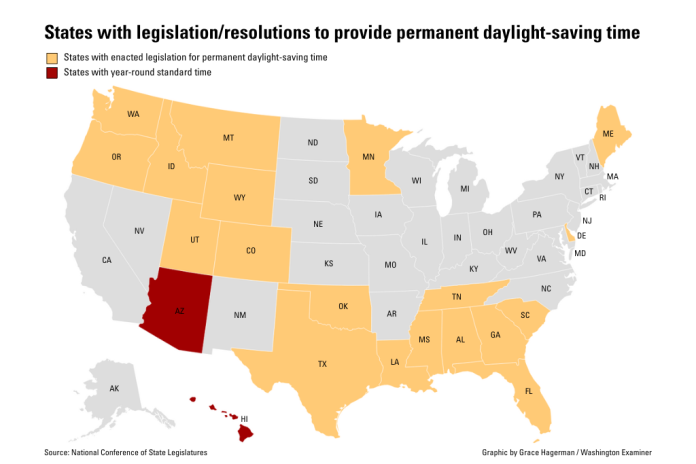
That federal hurdle has left a growing number of states in limbo. At least 19 states have enacted laws or resolutions providing for year-round daylight saving time if federal law changes, with Texas becoming the most recent state to do so in 2025. But those laws do not currently change the clocks under current federal law.
Congress is considering changing that rule, allowing states to decide whether to enact permanent daylight saving time laws. The Sunshine Protection Act, introduced in January 2025, passed the House of Representatives on July 14, but it is held up in the Senate committee without a scheduled debate.
 100vw, 1024px”><figcaption class=) States with legislation or resolutions to provide permanent daylight saving time. (Grace Hagerman/Washington Examiner)
States with legislation or resolutions to provide permanent daylight saving time. (Grace Hagerman/Washington Examiner)The clock is ticking for the upper chamber because the time is scheduled to fall back on Nov. 1. The Senate is unlikely to move on the legislation before the time change, meaning states will continue to follow the federal schedule.
Why states keep trying
The state-level push reflects a broader dissatisfaction with changing the clocks twice a year.
Since 2015, virtually every state has considered legislation related to time changes, according to the National Conference of State Legislatures. More than 800 bills and resolutions have been considered in recent years involving year-round daylight saving time.
But lawmakers have not reached a consensus over which system should replace the current one. Some proposals call for permanent daylight saving time, effectively keeping the clocks in their summer setting year-round. Others would eliminate daylight saving time and keep states on standard time.
Arizona and Hawaii took the other path
Arizona and Hawaii provide the clearest examples of what states can already do without waiting for Congress. Both states observe standard time year-round and therefore do not participate in daylight saving time. U.S. territories including Puerto Rico, Guam, American Samoa, the Northern Mariana Islands, and the U.S. Virgin Islands also remain on standard time year-round.
Arizona’s decision dates back decades. The state opted out of daylight saving time in 1968 and has remained on standard time since then, citing its hot, sunny climate as the reason against the time change. The traditional argument for daylight saving time has emphasized extending evening daylight, while Arizona lawmakers argue that the state’s sweltering heat could prevent residents from enjoying activities until after the sun sets.
Hawaii, meanwhile, sits far enough west-to-east within its time zone that the seasonal clock change provides less practical benefit than it does in many mainland states.
The debate isn’t only about convenience
Supporters of permanent daylight saving time have emphasized the additional daylight in the evening and the inconvenience of changing clocks twice a year.
President Donald Trump, who has thrown his support behind the Sunshine Act, has previously argued that a permanent shift would eliminate the disruption of changing clocks and said it could reduce violent crime, car crashes, and some health risks.
 100vw, 1024px”><figcaption class=) Source: Department of Transportation, Washington Post; Graphic: Grace Hagerman/Washington Examiner
Source: Department of Transportation, Washington Post; Graphic: Grace Hagerman/Washington ExaminerWHAT TO KNOW ABOUT THE 2026 UN GENERAL ASSEMBLY
But the scientific evidence remains part of the debate. The American Academy of Sleep Medicine supports eliminating the seasonal clock change in favor of permanent standard time, arguing that it better aligns with humans’ natural sleep rhythms. The group warns that the switch from standard time to daylight saving time can cause significant safety risks, including increased risk of adverse cardiovascular events, mood disorders, and motor vehicle crashes.
A permanent daylight saving time, while providing more daylight in winter evenings, would push sunrises back much later across the country. The trade-off would be particularly noticeable across the Midwest. In Chicago, for example, the sun rises at about 7:14 a.m. on the winter solstice under standard time. If daylight saving time were observed year-round, that sunrise would shift to roughly 8:13 a.m.


