

Gov. Gavin Newsom (D-CA) has made one of the most consequential declarations in the early 2028 Democratic presidential race, saying that if former Vice President Kamala Harris runs, he won’t.
Newsom made the declaration to CNN’s Jake Tapper in an interview filmed while the two men fly-fished in a Montana river and discussed the outgoing governor’s presidential ambitions.
Newsom said he would not challenge his fellow Californian, describing a Newsom-Harris primary as “mutual assured destruction” because their political networks, donors, and supporters overlap so heavily. He said a showdown would be “a gift from God” to the rest of the Democratic field.
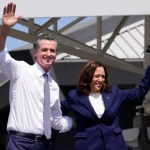
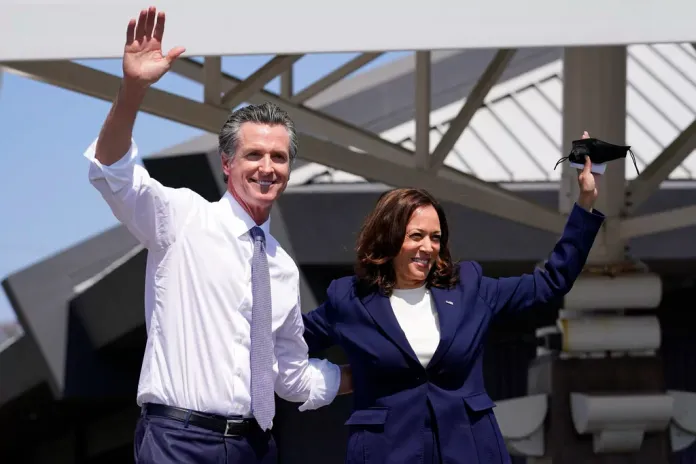
 Newsom and Harris wave during a campaign event at the IBEW-NECA Joint Apprenticeship Training Center in San Leandro, Calif., Wednesday, Sept. 8, 2021. (AP Photo/Carolyn Kaster)
Newsom’s waiting game
For more than a year, Newsom has steadily built the profile of a possible 2028 candidate, from his near-constant attacks on President Donald Trump to his outreach to conservatives and repeated trips to early-primary states such as South Carolina, where he was two weeks ago.
His decision to publicly subordinate his presidential ambitions to Harris could be an act of loyalty or a calculated maneuver based on the possibility that Harris ultimately will not run.
Harris has not announced a 2028 campaign, but she has made clear that she is considering one. In April, she said, “I might, I might. I’m thinking about it.” Her decision not to run for California governor this year further fueled speculation that she is keeping the option of another presidential bid open.
Newsom, meanwhile, is leaving office at the end of the year because of California’s term limits and has increasingly spoken publicly about what a presidential campaign would require.
His pledge could reflect a desire to avoid a bruising California-versus-California primary that could damage both candidates and hand the rest of the Democratic field an advantage — even if he ultimately believes he could have the stronger campaign.
The pledge also gives Newsom a politically useful hedge. If Harris runs, he can say he kept his word. If she doesn’t, he can move forward without having appeared to challenge her.
California-based political strategist Matt Klink sees that flexibility as central to Newsom’s strategy.
“That’s the whole play,” Klink told the Washington Examiner. “Newsom banks credit for loyalty now and keeps a clean runway if Harris takes herself out. Deference is cheap when you don’t actually expect to have to honor it.”
Political strategist Michael Fahey said the pledge “feels less like Gavin Newsom clearing the field for Kamala Harris and more like him betting that the field eventually clears itself.”
Newsom, he told the Washington Examiner, understands what a California-on-California primary could look like: the same donors, consultants, and political relationships competing against each other while other Democrats watch from the sidelines.
“His mutual assured destruction description is probably the clearest explanation of why he wants to avoid that scenario,” Fahey said.
But Fahey sees another calculation beneath the public deference.
“Harris has the name recognition and the national resume, but she would also have to make the case for another presidential campaign after losing in 2024,” he said. “Newsom does not have to force that conversation today. He can keep building his national profile and political relationships while allowing Harris to make the first move.”
The possibility raises another question: Newsom could be betting that Harris will struggle to turn her national profile into the fundraising operation and political infrastructure required for another presidential campaign.
Money moves
Indications already suggest that Harris’s donor base may not automatically follow her into another race.
A Los Angeles Times report in May found uncertainty among some of Harris’s major 2024 backers about financing another presidential campaign, even as her decision not to run for California governor was viewed as leaving the presidential option open.
California-based veteran political strategist Garry South said Harris would face an uphill fundraising environment if she sought the nomination again.
“It would be unusual and perhaps problematic for two major candidates from the same state, both with national profiles, to be running for the Democratic nomination,” South told the Washington Examiner.
South also argued that Democrats have historically been reluctant to renominate presidential nominees who have already lost, saying Harris would face a difficult political environment if she sought the nomination again.
“If Harris did run again, she would struggle to raise money,” South said, adding that he believes California voters would resist another Harris presidential bid.
South’s broader argument has historical precedent, though it is not absolute. The last Democratic presidential nominee to lose and then receive the party’s nomination again was Adlai Stevenson, who lost to Dwight Eisenhower in 1952 and was renominated in 1956 — and lost again.
Whether that history applies to Harris remains an open question. She would enter a 2028 race with an unusually large national profile and an existing donor and campaign network from 2024.
Newsom gives Harris the first move
Harris’s political standing remains uneven. Early polling has her up or down, depending on the survey, making it difficult to draw an accurate picture so far in advance.
That makes Newsom’s proclamation he will step aside particularly notable.
He is not simply deferring to a candidate who has clearly established herself as the Democratic front-runner. He is making his own possible candidacy contingent on hers.
“In some ways, Newsom just turned Harris’s decision into the starting gun for his own,” Fahey said.
If Harris runs, Newsom has publicly promised to stay out. If she does not, he can enter the race saying he kept his word rather than appearing to have pushed the nation’s first black female vice president aside.
A gamble with a downside
There is a downside for Newsom.
Presidential politics rewards candidates who build donor networks, endorsements, and campaign infrastructure well before voters begin casting ballots. If Harris runs and begins consolidating support, Newsom will have voluntarily removed himself from a contest he has spent considerable time positioning himself to potentially enter.
“That is why I would not look at this simply as political humility,” Fahey said. “It is a calculated gamble.”
James Christopher, a political analyst, similarly described Newsom’s pledge as a hedge.
“Newsom isn’t clearing the field for Harris as much as he’s keeping his own lane open,” Christopher told the Washington Examiner. “By pledging not to run against her, he avoids a costly California civil war while preserving the option to step forward if she bows out. It reads as loyalty — but it also functions as a very smart political hedge.”
The risk is that Harris could take advantage of the opening Newsom has given her.
If she announces early, demonstrates strong fundraising, assembles a national organization, and begins consolidating Democratic support, Newsom would have little room to change course without breaking a highly public promise.
Do Democrats even want Newsom?
Not everyone sees the Newsom-Harris contest as the most important question facing Democrats.
Democratic strategist Jay Satterfield said the bigger issue is whether Newsom represents the kind of candidate Democrats need.
“Democrats have spent years talking about rebuilding trust with working-class voters, rural communities, and people who feel like neither party understands what it means to struggle,” Satterfield told the Washington Examiner. “From my perspective, Newsom is not the answer to that problem.”
Satterfield said the party’s 2028 debate should extend beyond which familiar national figure gets the next opportunity.
For Newsom, however, the immediate question is less about whether he can win a hypothetical primary than whether he has just tied his political future to a decision Harris has not made.
Newsom has previously signaled that Harris would get the first move. Now he has gone further, publicly promising not to challenge her.
The gamble is straightforward: Newsom is betting that preserving his relationship with Harris and avoiding a mutually destructive primary is worth surrendering the ability to compete if she enters the race.
But another bet is embedded in that decision.
He may also be betting that Harris will ultimately decide that another presidential campaign is not viable or that she will be unable to assemble the money, organization, and coalition required to make it competitive.
If that calculation is wrong, Newsom could find himself having voluntarily stepped aside from the race he has spent his entire career preparing for.
But if it is right, his pledge could look less like a surrender and more like a carefully constructed waiting game.
Newsom spokesman Bob Salladay said he could not immediately clarify what the governor meant.
NEWSOM SAYS HE WON’T RUN FOR PRESIDENT IN 2028 IF KAMALA HARRIS DOES
“They’ve been friends long enough that they wouldn’t play cat-and-mouse games on something this important,” Salladay told the New York Times.
A Harris spokeswoman did not respond to a request for comment.


