





Following the United States’s dramatic capture of former Venezuelan dictator Nicolás Maduro earlier this month, New York City, where authorities are holding the autocrat, emerged as an epicenter of pro-Maduro sentiment in America. Such a development is unsurprising given the New York labor movement’s long-standing alignment with Caracas.
Maduro’s regime, for instance, has used New York labor leaders in an attempt to launder its international image, and union officials were all too happy to assist.
Ahead of Venezuela’s 2017 elections, called by Maduro amid mass protests to elect an assembly tasked with drafting a new constitution, the regime invited a delegation of American union leaders to observe the voting and praise the country’s electoral process.
The election was roundly condemned by international observers who characterized it as an attempt by Maduro to erode Venezuela’s remaining democratic institutions. Maduro’s opposition boycotted the election, leading to independent estimates placing voter turnout between 11.3% and 21%. During the election, allies of Maduro reportedly used force to compel voting and asserted that turnout was overwhelming. Ultimately, the government claimed that 41.53% of voters participated in the election.
Smartmatic, the company that provided the voting machines for the election, reported that Venezuelan election officials tampered with the machines to inflate turnout figures. The vast majority of Venezuelans polled by independent sources characterized the government as a dictatorship and voiced opposition to drafting a new constitution.
Despite all this, the New York labor leaders invited by the regime to monitor the elections were quick to endorse them, giving positive interviews to the Venezuelan state-sponsored media outlet Telesur, according to an archived webpage reviewed by the Washington Examiner.
Estela Vazquez, who was serving as the executive vice president of the 1199 SEIU at the time, ironically, said that “99% of the Venezuelans support the process,” contradicting the findings of independent observers but mirroring the rhetoric of the Venezuelan regime.
“The participation was impressive,” said Vazquez, who was taken to select polling stations by officials. “So I found [it] surprising when I saw headlines the next day talking of high absenteeism in Venezuela, and that is not the truth.” Venezuela’s own statistics ultimately showed that the majority of the country did not participate in the elections.
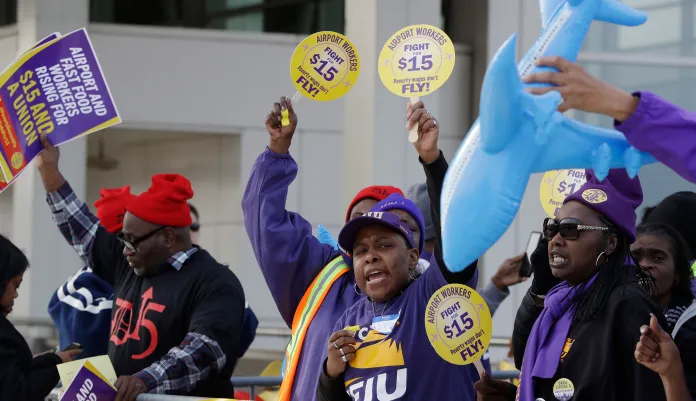
Judy Gonzalez, a registered nurse who was the president of the New York State Nurses Association at the time of the elections, praised Venezuelan officials for the allegedly incredible transparency with which they were administering the election.
“I’ve been through a lot of union elections, I know what to look for when there’s cheating. I didn’t see any cheating,” John Patafio, who was vice president of the Transport Workers Union at the time, said, echoing Gonzalez’s claim. “I saw a very open process; I saw the people [who] were controlling it were people from the community, earnest. So, I thought it was fine.”
The trio accused independent observers of engaging in “propaganda” by criticizing the elections.
Representatives for the 1199 SEIU, NYSNA, and TWA did not respond to requests for comment.
“All credibility goes out the window when you beat the drum for workers’ rights in the U.S. while simultaneously applauding an oppressive leader in Caracas,” Charlyce Bozzello, communications director at the Center for Union Facts, told the Washington Examiner. “These ‘useful idiots’ should remember that workers everywhere have the right to fair elections and free speech without the risk of imprisonment.”
Following the widely criticized 2017 Venezuelan elections, the United States imposed sanctions on the country. A number of labor union leaders joined the Alliance for Global Justice — a left-wing nonprofit group that has since faced scrutiny for sponsoring Samidoun, an organization deemed by the Treasury Department to be a Hamas fundraising front — in opposing the sanctions through a petition.
Among the signatories were Vazquez, the president of the National Lawyers Guild; the general president of the United Electrical Workers; counsel for the United Steelworkers Union; and scores of local union leaders.
Ties between American labor organizers and the Maduro regime go back even further.
An online photo album posted by an account apparently belonging to the Venezuelan Embassy in September 2015 shows the now former dictator meeting with a large group of New York City union leaders in Harlem. An image of a document resurfaced by the anonymous X account “L” appears to show that the 1199 SEIU held a “People of African Descent Leadership Summit” on the same date the embassy’s album says Maduro met with U.S. labor leaders. The document, which is likely legitimate as it was also posted by the Venezuelan Embassy, describes Maduro as “his excellency.”
Fast-forwarding to the present day, New York City unions, such as the 1199 SEIU, have aligned themselves with organizations like Indivisible, one of the primary groups rallying against American intervention in Venezuela. Meanwhile, New York-based leadership at the United Autoworkers, such as its counsel and the union’s regional director, have criticized the United States for removing Maduro.
Even the AFL-CIO, the nation’s largest labor union, has condemned the United States for removing Maduro from power.
“We join the international labor community in condemning President Trump’s unconstitutional actions in Venezuela,” a statement from the union reads.


