





Utah‘s Republican-led legislature is set to convene a special session on Dec. 9 to review a judge’s ruling on congressional maps. The state’s congressional districts have been in legal limbo since 2018, when voters approved Proposition 4, which created an independent redistricting commission.
The move comes amid a redistricting feud that has exploded into a cross-country battle involving more than a dozen states. Republicans will have a 220-215 majority when current House vacancies are filled by special elections for two safely Democratic seats in the coming months.
So, in a political game of inches, President Donald Trump‘s political operation this spring successfully leaned on Texas Republicans to redraw the Lone Star State’s 38-seat House map in a way that could net a five-seat GOP pickup. California Democrats retaliated by leading a successful state ballot initiative to boost their ranks in the Golden State’s 52-member House delegation by up to five seats. Several more states, on both sides of the political aisle, are now in the process of, or considering, redrawing their maps for partisan advantage.
In Utah, the House redistricting fight goes back much further. In 2021, state lawmakers rejected the independent redistricting commission’s recommendations for Utah’s four House seats and adopted their own set of maps. Each strongly favors Republicans, with district lines stretching from Salt Lake County, enveloping the state capital of Salt Lake City, to conservative exurban and rural environs.
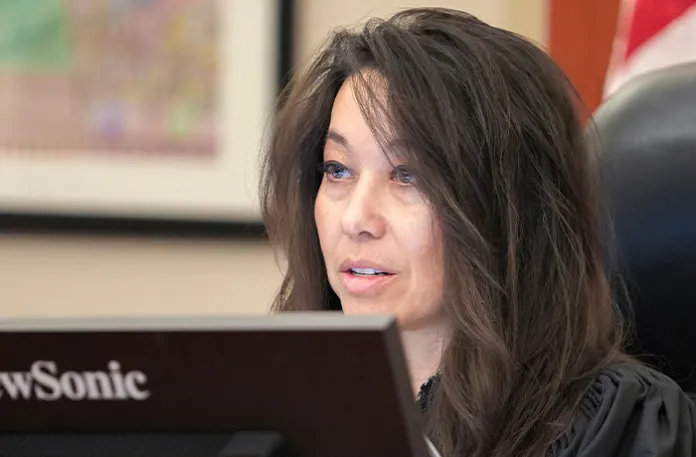
The League of Women Voters of Utah and Mormon Women for Ethical Government sued in 2022, arguing the legislature ignored the will of the people. A unanimous Utah Supreme Court agreed and sent the case to Judge Dianna Gibson’s courtroom.
Gibson, appointed to the state’s 3rd District Court in October 2018 by former Republican Gov. Gary Herbert, ruled in August that the maps violated the commission’s mandate of crafting House districts broadly representative of constituent demographics.
“To permit the 2021 Congressional Plan to remain in place would reward the very constitutional violation this Court has already identified,” she wrote.
The state legislature approved a third set of maps in October. They included two districts that legislative Republicans portrayed as more competitive for the Democratic Party. However, the pair of proposed districts favored Republicans, and President Donald Trump won them both in 2024.
Meanwhile, the League of Women Voters of Utah and Mormon Women for Ethical Government drew up a fourth set of maps that gave the GOP three majority districts. While Democrats got one majority district, it’s concentrated around Salt Lake County, which has long been much more liberal than the rest of Utah.
Statewide in Utah, Trump beat former Vice President Kamala Harris 59% to 38% in 2024. But in Salt Lake — the most populous of Utah’s 29 counties at more than 1.2 million people — Harris prevailed easily over Trump, 54% to 44%. Under the new House map, Utah’s newly configured 1st Congressional District would have gone for Harris over Trump by a whopping 24 points.
Gibson accepted the League of Women Voters of Utah and Mormon Women for Ethical Government maps last month because they were “configured by a reliable computer algorithm” that did not involve partisan data.
“It falls comfortably in the distribution of expected partisan outcomes under that ensemble of Proposition 4-compliant maps,” Gibson ruled.
She did not have kind words for the legislative-drawn maps, observing that they were drawn to unfairly benefit Republicans over Democrats. Gibson criticized them for having “partisan political data on display.”
Utah Republicans want the state Supreme Court to overturn the maps and reinstate the legislature’s proposed districts. Gov. Spencer Cox (R-UT) accused Gibson of overstepping her authority, saying it was only the legislature that could create new maps.
Crowded primaries for both parties
Utah Republicans are appealing Gibson’s decision to the state Supreme Court. But unless that is successful, the current boundaries will stay in place. Leah A. Murray, director of the Olene S. Walker Institute of Politics & Policy at Weber State University in Ogden, Utah, said there is no way the redistricting battle will be sorted out by next year’s midterm elections.
“I think the judiciary boxed the legislature in, and given the timeline, there’s really not enough time to make changes,” Murray said.
State Democrats are acting as if Gibson’s maps will stand. Five Democratic candidates have announced their runs in the 1st District, with a win in the June 23, 2026, primary being tantamount to a general election victory in November.
The most prominent is former Rep. Ben McAdams, who represented a Salt Lake City-area district from 2019 to 2021. He is known as a centrist who broke with his party in 2019 by voting against Rep. Nancy Pelosi (D-CA) for speaker in her successful quest for the chamber’s top job a second time.
But McAdams has faced criticism from other Democrats for supporting Evan McMullin’s failed 2022 independent bid against Sen. Mike Lee (R-UT). He was part of a group that convinced Democratic Party delegates to forgo nominating their own Senate candidates. McMullin lost by 10 points, six years after a quixotic independent presidential bid when he earned 0.54% of the popular vote (though he garnered 21.4% of the vote in Utah while Trump won the state).
In the 2026 1st District Democratic primary, McAdams will face opposition from, among others, state Sen. Kathleen Riebe. A schoolteacher, Riebe was chosen by Democratic legislative colleagues to serve as the state Senate minority whip in 2023. She is seen as a centrist on fiscal policy but supports expanded Medicare, Medicaid, and abortion service access.
In her campaign announcement, Riebe emphasized that she is a Democrat and a fighter, promising to stand up for her beliefs, even if it leaves her politically isolated. She has also criticized Washington Democrats for agreeing to reopen the government without securing expanded Obamacare subsidies.
The other three candidates are appealing to the party’s progressive wing.
One of the most outspoken is state Sen. Nate Blouin. He was elected to the Senate in 2022 after defeating longtime Democratic incumbent Gene Davis in a primary fight after legislative redistricting altered the district’s contours. Since taking office, Blouin has pushed for progressive policies, including a millionaire’s tax.
A green energy activist, Blouin recently received Sen. Bernie Sanders’s (I-VT) endorsement, which cited the state senator’s support of Medicare for All and affordable housing. Blouin has repeatedly criticized the Trump administration on Bluesky, even suggesting Cabinet members and Congress invoke the 25th Amendment to remove the president from office. Blouin is giving up his state Senate seat to run for Congress.
Another prominent progressive seeking the seat is former state Sen. Derek Kitchen, owner of Laziz Kitchen, a Lebanese restaurant in downtown Salt Lake City, which was featured in a February 2019 episode of Diners, Drive-Ins, & Dives. Kitchen was a plaintiff in the 2013 federal lawsuit that struck down Utah’s ban on gay marriage.
Kitchen was a member of the Salt Lake City Council before being elected to the state Senate in 2018. While in office, he proposed a carbon tax and sponsored a bill expanding family-planning services. He lost his 2022 Democratic primary bid to current state Sen. Jen Plumb. Kitchen has said he will fight for progressive causes in Congress, even if it means being at odds with Democratic leadership.
The third progressive is Luis Villarreal, a software engineer with no previous government experience. Villarreal supports Medicare for All, affordable housing, and “working-class power.”
Republican incumbents are also jostling for position.
Reps. Blake Moore (R-UT), Burgess Owens (R-UT), Celeste Maloy (R-UT), and Mike Kennedy (R-UT) are all up for reelection in 2026. The quartet has promised to seek new two-year House terms. That sets up a political version of musical chairs, with the four incumbent lawmakers vying for three strongly Republican seats.
The new boundaries mean Moore, whose current district covers northern Utah and eastern Salt Lake City, may have to run elsewhere. Under the Constitution, House members can live outside district boundaries if they are residents of the same state.
Murray said that this possibly sets up a clash between two GOP incumbents. Maloy could be an inviting target within the GOP in a deep-red seat. Maloy won a November 2023 special election in the current 2nd Congressional District, covering central and western Salt Lake City and southwestern Utah. But defending the seat in the June 25, 2024, Republican primary, Maloy barely staved off opponent Colby Jenkins, 50.1% to 49.9%.
“Blake Moore is known to be more moderate and was on the board of the group that brought Prop. 4 forward in 2018,” Murray said. She added that more right-leaning candidates could choose to challenge the GOP incumbents.
With state Republicans vowing to fight the new districts ahead, and in this view having maps in flux, no other GOP candidate has yet filed papers to run for Congress.
Murray said the redistricting fight will continue to weaken the independent commission’s mandate.
WHERE REDISTRICTING STANDS A YEAR OUT FROM THE MIDTERM ELECTIONS
The ultimate loser, however, may be Utah voters. Murray said the redistricting fight will continue, too.
“The legislature is going to look for its own language to say the only people who get to draw maps are them, either through a new initiative or a constitutional amendment,” she observed.
Taylor Millard is a freelance journalist who lives in Virginia.


