




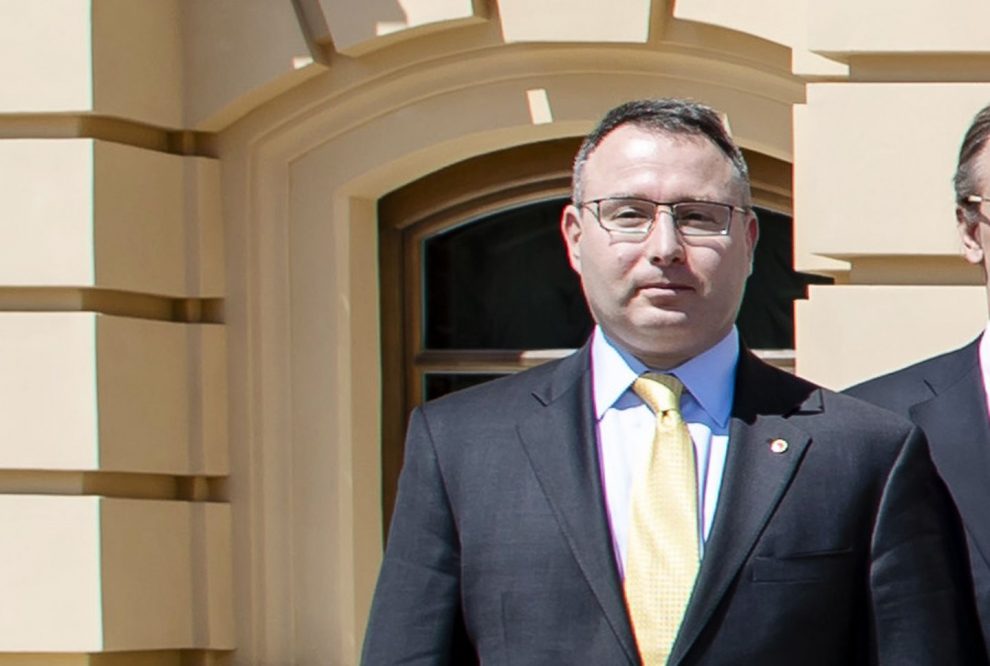
The New York Times has obtained the opening statement of Lieutenant Colonel Alexander S. Vindman, the top White House expert on Ukraine, who will testify to the House Intelligence Committee on Tuesday about his concerns about President Donald Trump’s telephone call with Ukrainian President Volodymyr Zelensky in July.
The statement, leaked to the Times — though committee chair Rep. Adam Schiff (D-CA) has likened impeachment to a “grand jury” proceeding, which is typically conducted in secrecy — is described by the Times as the first account of someone who actually listened in on the telephone call, as opposed to hearing about it second- or third-hand.
In his statement, Vindman — a Ukrainian-American and decorated Army officer who was awarded the Purple Heart after being wounded by a roadside bomb in Iraq — outlines his own views on “The Geopolitical Importance of Ukraine.” He adds: “The U.S. government policy community’ s view is that the election of President Volodymyr Zelenskyy and the promise of reforms to eliminate corruption will lock in Ukraine’ s Western-leaning trajectory.”
Vindman says that he became concerned in the spring of 2019 about “outside influencers promoting a false narrative of Ukraine inconsistent with the consensus views of the interagency.”
That concern for the fate of the “consensus views of the interagency” informed Vindman’s approach to the president’s contacts with Zelensky.
Harley-Davidson’s Decade-Long Electric Motorcycle Initiative Has Turned Disastrous
Rock Legend Donnie Iris Dies Less Than Three Weeks After Retiring from Performing
Federal officials identify 400 noncitizens registered to vote in Washington state: ‘Tip of the iceberg’
Cassidy Hutchinson avoids indictment after DOJ effort to charge her over Jan 6 testimony fails: sources
Watch: Outrageous Pro-El-Sayed Ad Blames Jewish State for Raising Price of Bananas, Eggs in Michigan
Haitian illegal immigrant charged in Walmart killing entered US via Biden parole program: DHS
Flavio Bolsonaro to be issued visa by State Department after fleeing Brazil
Right-Wing Presidential Candidate Flavio Bolsonaro Secretly Flees Brazil for US After Disputed Election: Report
Luxury real estate brothers sentenced to 30 years in prison for yearslong sex-trafficking scheme
Judge who apologized to accused would-be Trump assassin lights up DOJ in Hunter Biden FBI case
Jordanian Military Goes After Targets in Syria in Response to Terrorists Killing Christians
‘Beloved’ daredevils who scaled Empire State Building inching toward deal after proposal stunt: attorney
Judge slams federal prosecutors over new charges against ex-FBI officials
DHS Shuts Down Major Chinese Birth Tourism Loophole in US Pacific Territory
175 Democrats demand Trump admin stop Ilhan Omar investigation, warn it could hurt her re-election bid
He was pleased with Trump’s first congratulatory call to Zelensky in April 2019, but became alarmed in early July when the U.S. Ambassador to the European Union, Gordon Sondland, “started to speak about Ukraine delivering specific investigations in order to secure [a] meeting with the President.” Vindman does not identify those investigations.
Later, during a debriefing with American officials, Sondland “emphasized the importance that Ukraine deliver the investigations into the 2016 election , the Bidens, and Burisma,” Vindman recalls. That is when Vindman pushed back, saying Sondland’s statements were “inappropriate” and the National Security Council would not be involved.
On July 25, when the president called Zelensky to congratulate him on his party’s parliamentary victory, Vindman listened in on the call. He says: “I was concerned by the call. I did not think it was proper to demand that a foreign government investigate a U.S. citizen, and I was worried about the implications for the U.S. government’ s support of Ukraine.” Notably, the transcript of the call suggests that Trump did not “demand” an investigation of the Bidens.
Vindman goes on to say that he concluded that if Ukraine was seen as a partisan player in U.S. politics, that could undermine “bipartisan support” for better relations with Ukraine. “This would all undermine U.S. national security,” Vindman argues, substituting his views — or those of the “interagency” — for those of the president himself.
Harley-Davidson’s Decade-Long Electric Motorcycle Initiative Has Turned Disastrous
Rock Legend Donnie Iris Dies Less Than Three Weeks After Retiring from Performing
Federal officials identify 400 noncitizens registered to vote in Washington state: ‘Tip of the iceberg’
Cassidy Hutchinson avoids indictment after DOJ effort to charge her over Jan 6 testimony fails: sources
Watch: Outrageous Pro-El-Sayed Ad Blames Jewish State for Raising Price of Bananas, Eggs in Michigan
Haitian illegal immigrant charged in Walmart killing entered US via Biden parole program: DHS
Flavio Bolsonaro to be issued visa by State Department after fleeing Brazil
Right-Wing Presidential Candidate Flavio Bolsonaro Secretly Flees Brazil for US After Disputed Election: Report
Luxury real estate brothers sentenced to 30 years in prison for yearslong sex-trafficking scheme
Judge who apologized to accused would-be Trump assassin lights up DOJ in Hunter Biden FBI case
Jordanian Military Goes After Targets in Syria in Response to Terrorists Killing Christians
‘Beloved’ daredevils who scaled Empire State Building inching toward deal after proposal stunt: attorney
Judge slams federal prosecutors over new charges against ex-FBI officials
DHS Shuts Down Major Chinese Birth Tourism Loophole in US Pacific Territory
175 Democrats demand Trump admin stop Ilhan Omar investigation, warn it could hurt her re-election bid
Vindman says that he reported his concerns to the National Security Council’s lead counsel. He denies being the so-called “whistleblower” or knowing the identity of the “whistleblower,” or wishing to speculate about such. He concludes with another policy view: “The United States and Ukraine are and must remain strategic partners.”
At no point does Vindman accuse the president of breaking the law, but of doing what he thought “inappropriate.”
The public will not see Vindman face questions from the committee, because it is being held behind closed doors and “in defiance of a White House edict not to cooperate with the impeachment inquiry,” the Times reports, though it does not explain that the reason for the White House stance is that the House has not yet authorized the inquiry.
Only one copy of the transcript of Vindman’s testimony will be provided to Republican members of the committee, who will only be allowed to review the transcript with a Democratic staffer present to observe them at all times.
Story cited here.


