





Abdul el Sayed is contending with the fact that the Democratic Party’s most reliable voters could cost him the election in the high-stakes matchup with former Rep. Mike Rogers for Michigan’s Senate race.
Black voters have helped propel his party to statewide victories for years, but they were significantly less enthusiastic about his candidacy than other parts of the Democratic coalition.
El Sayed’s weakness was particularly evident in Wayne County, the state’s most populous county, home to Detroit, nearly 40% black, and a critical Democratic stronghold. Despite having served as the county’s health director, el Sayed lost the county to Rep. Haley Stevens (D-MI), 51.3% to 45.4%, a deficit of roughly 17,300 votes.
That result leaves el Sayed with an immediate challenge: winning back voters who could have supported him in the primary but chose someone else.
He has seemingly yet to develop an answer to his problem. When asked how he would respond to black voters who do not support him, el Sayed pointed to his own African identity rather than directly addressing why those voters might be skeptical of his candidacy.
Irina Tsukerman, a political analyst and president of Scarab Rising, said the response was awkward because black Americans and African immigrants can have distinct political histories and experiences.
“His answer about his African identity was awkward because it did not address what black voters were actually asking,” Tsukerman told the Washington Examiner.
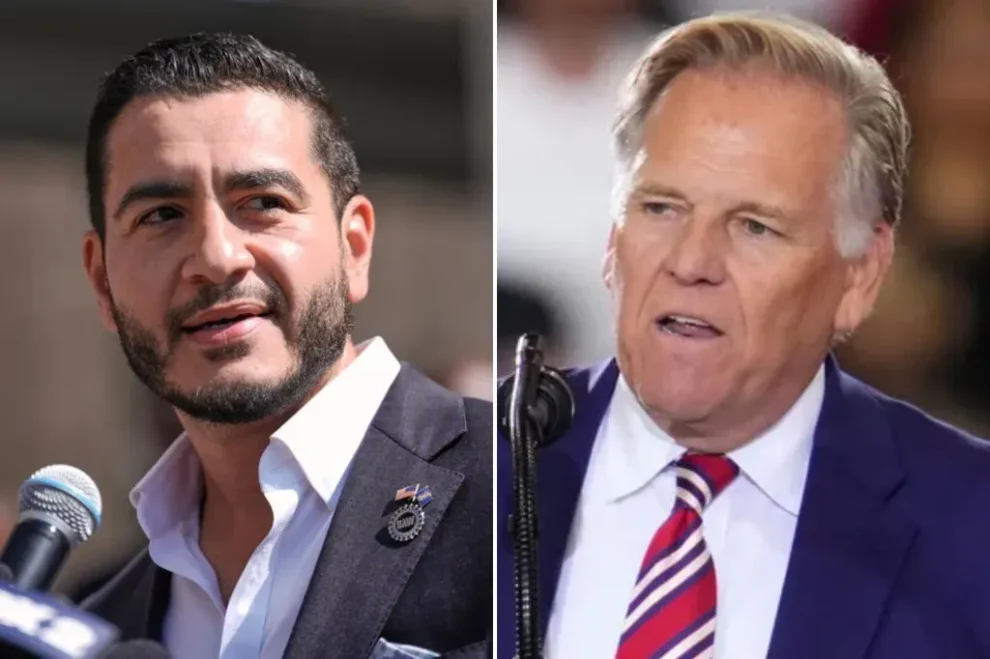
 Abdul el Sayed and Mike Rogers (AP photos)
El Sayed’s primary coalition was strongest among younger and progressive voters, who tend to be predominantly white, while Stevens performed better among black, older, and metro Detroit voters. A July Glengariff Group survey similarly found Stevens leading among black voters, while el Sayed performed better among younger, white, and outstate voters.
“El Sayed’s weakness with black voters is serious, but black voters are not a political group chat,” Nick E. Smith, a Democratic strategist and president of Polaris, told the Washington Examiner. “Age, ideology, income and geography matter.”
Smith said el Sayed’s Wayne County loss should be viewed as a warning sign despite his previous government position there.
“Having the resume doesn’t mean you have the relationship,” Smith said. “Voters weren’t handing out extra credit for previous employment.”
Some black Democrats are now openly withholding support or opposing el Sayed, raising questions about whether he can broaden his coalition before facing Republican Mike Rogers in November.
Rogers appears to be seizing on el Sayed’s struggles. On Thursday, the Republican nominee launched a “Democrats for Rogers” coalition featuring state Rep. Karen Whitsett, a conservative-leaning Democrat who said she’d support Rogers in the fall.
El Sayed’s struggle with black voters is not necessarily driven by a single issue. El Sayed’s support for the Uncommitted movement during the 2024 Democratic presidential primary remains a point of tension, particularly among voters who believed defeating President Donald Trump should have been the overriding priority. Detroit journalist Orlando Bailey recently said black voters remain “holding his feet to the fire” over that record.
But analysts caution against reducing the problem entirely to Israel and Gaza.
Voters in Detroit, Tsukerman said, are more likely to be looking for answers about jobs, schools, housing, crime, health care, small businesses, and economic opportunity — as well as whether black political leaders and communities will influence him.
“Pointing to his African background answers a question about his own identity rather than their political concerns,” Tsukerman said.
The stakes are heightened by a new AARP poll showing el Sayed leading Rogers by just 1 point, 48%-47%, with 5% undecided. El Sayed performs better among younger voters and women, while Rogers leads among older voters and men.
A separate Fox News poll conducted earlier in August found Rogers leading el Sayed 51% to 47%, while el Sayed held a 75% to 22% advantage among black voters. The differing results underscore the fluidity of the early general-election environment.
Former Vice President Kamala Harris, who struggled in parts of Wayne County such as Dearborn over concerns about Gaza, won black voters in Michigan, 87%-11%, according to CNN exit polling in 2024. She won Wayne County by 29 points; meanwhile, Sen. Elissa Slotkin (D-MI) won Wayne County by 32 points over Rogers.
But Rogers’ lead with older voters could compound el Sayed’s challenge with black voters.
“Rogers is stronger with older voters; el Sayed with younger voters,” Smith said. “Young voters bring energy. Older voters have the annoying habit of actually showing up for midterms. In a 48%-47% race, that matters.”
Tsukerman said the greatest danger for Democrats may not be black voters switching to Rogers, but simply deciding not to turn out.
“Rogers does not need thousands of black Democrats to vote for him,” she said. “He benefits if they simply decide they are not interested enough in el Sayed to vote in the Senate race.”
That could be consequential given how narrowly Rogers lost his previous Senate bid.
In 2024, Slotkin defeated Rogers by 19,006 votes, 48.6% to 48.3%. Even a relatively small decline in Democratic turnout in Detroit and Wayne County could alter the electoral math this time around.
“Several thousand fewer Democratic votes in Detroit, accompanied by relatively small Republican gains elsewhere, can erase a margin of that size,” Tsukerman said.
Jeff Burton, a former deputy executive director of the National Republican Congressional Committee and cofounding partner at Maven Advocacy, said el Sayed’s coalition has vulnerabilities beyond black voters, including Jewish voters and union households.
“El Sayed can excite younger progressives and Arab American voters, but they cannot replace black voters in Detroit, Jewish voters, and union households increasingly willing to vote Republican,” Burton told the Washington Examiner.
He cautioned that the broader political environment could ultimately determine how damaging those weaknesses prove to be.
“In a neutral political environment, those weaknesses could make him unelectable,” Burton said. “If the economy remains voters’ overriding concern, however, it may be the one issue big enough to paper over all of them.”
Democrats argue that Rogers has significant vulnerabilities of his own.
“There is no question this will be a tight election,” Democratic strategist Joe Caiazzo told the Washington Examiner. “However, Rogers has to defend the unpopular policies of Trump and MAGA Republicans that have led to this affordability crisis for Michiganders and all Americans.”
Republicans, Caiazzo said, will try to frame the race around el Sayed’s ideology rather than the economy.
For el Sayed, however, the challenge is that he cannot simply assume traditional Democratic voters will return to the party’s nominee in November.
“Neither party has a lifetime subscription to the black vote,” Smith said. “El Sayed’s younger, progressive and Arab American supporters can expand his coalition, but they can’t replace older black and other traditional Democratic voters.”
ABDUL EL SAYED OUTPERFORMS MIKE ROGERS IN LATEST MICHIGAN SENATE POLL
El Sayed now has to campaign on two fronts: persuading independents and suburban voters who may be skeptical of a progressive nominee, while rebuilding relationships with Democratic voters who already had a chance to choose him and declined.
“El Sayed can’t assume black voters who rejected him in the primary will return simply because there’s a ‘D’ next to his name,” Smith said. “He still has to earn the vote.”


