






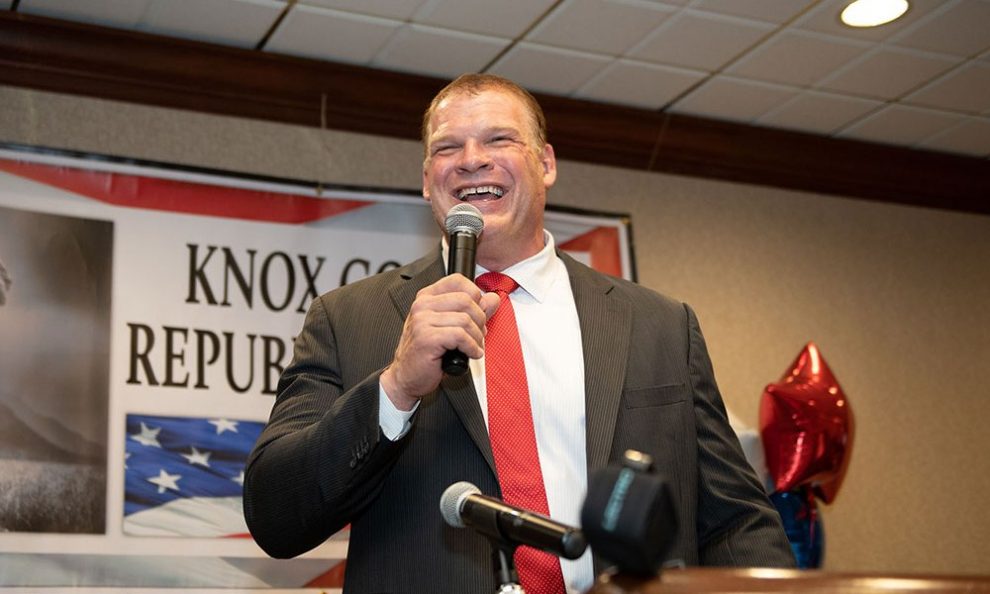
Knox County Mayor Glenn Jacobs, known worldwide as Kane, recorded a heartfelt video message for his constituents after eight committed suicide within 48 hours. His sober take on the human cost of the Covid-19 lockdown is too rare in today’s politics.
The coronavirus crisis and the government’s response are not going away anytime soon. Everyday that is becoming clearer.
Last week in Knox County, Tennessee, within a 48-hour period, eight suspected suicides were reported. That amounts to nearly 10 percent of 2019’s total of 83 for the county.
“That number is utterly shocking,” Jacobs said in a weekly video update. “It makes me wonder, is what we are doing now really the best approach?”
Halima Salman convicted of receiving ISIS military training in Syria, faces 10 years in prison
Harley-Davidson’s Decade-Long Electric Motorcycle Initiative Has Turned Disastrous
Rock Legend Donnie Iris Dies Less Than Three Weeks After Retiring from Performing
Federal officials identify 400 noncitizens registered to vote in Washington state: ‘Tip of the iceberg’
Cassidy Hutchinson avoids indictment after DOJ effort to charge her over Jan 6 testimony fails: sources
NYC Mocked as Mamdani Builds New ‘Sidewalk Sheds’ That Drain Water Toward Buildings, So Expensive City Refuses to Give Price Tag
Man accused of threatening to hijack United flight says it was a drunken joke
Report Claims Hegseth Has Asked GOP Candidate for Governor to Appoint Him to Senate Seat
Rep Tom Tiffany claims Kamala Harris’ visit signals weakness in David Crowley’s Wisconsin campaign
Russian diesel tankers close in on US ports as Trump, Putin deal triggers legal showdown
Watch: Outrageous Pro-El-Sayed Ad Blames Jewish State for Raising Price of Bananas, Eggs in Michigan
Haitian illegal immigrant charged in Walmart killing entered US via Biden parole program: DHS
Flavio Bolsonaro to be issued visa by State Department after fleeing Brazil
Right-Wing Presidential Candidate Flavio Bolsonaro Secretly Flees Brazil for US After Disputed Election: Report
Luxury real estate brothers sentenced to 30 years in prison for yearslong sex-trafficking scheme
“How can we respond to Covid-19 in a way that keeps our economy intact, keeps people employed, and empowers our people with the feeling of hope and optimism, not desperation and despair?” he asked.
Jacobs, who has libertarian tendencies and a very impressive grasp of Austrian economics, explained to his constituents that many so-called experts are offering them a false choice: healthy people or an open economy.
“In fact, we must have a healthy economy if we expect to have healthy people,” Jacobs said. “We don’t have a choice.”
In the same week that Knox County experienced its uptick in suicide, the jobless claims across America reached a record-shattering 6.6 million. That broke the previous record by a factor of five.
Flattening the curve may (or may not) be preserving hospital beds and resources, but as Jacobs keenly observes, “The unintended consequence is that we are creating another massive curve, a tidal wave that will overwhelm social services.”
Jacobs may be the most well-spoken politician on this impending national tragedy. In a saner society, he would be heralded as “America’s mayor.” Maybe one day he’ll have a bigger influence on Washington, D.C.
Unfortunately, there is a growing stereotype regarding who would be against the lockdowns around the world. Such a person must not care about the elderly or sick, but only about economic growth. This caricature is based in some truth, sadly, but not at all in the case of Jacobs.
Jacobs does not conceive of the economy as figures on a graph or mere busybodyness to keep dollars circulating. Rightly understood, the economy is about people, complete with their hearts and free will.
Halima Salman convicted of receiving ISIS military training in Syria, faces 10 years in prison
Harley-Davidson’s Decade-Long Electric Motorcycle Initiative Has Turned Disastrous
Rock Legend Donnie Iris Dies Less Than Three Weeks After Retiring from Performing
Federal officials identify 400 noncitizens registered to vote in Washington state: ‘Tip of the iceberg’
Cassidy Hutchinson avoids indictment after DOJ effort to charge her over Jan 6 testimony fails: sources
NYC Mocked as Mamdani Builds New ‘Sidewalk Sheds’ That Drain Water Toward Buildings, So Expensive City Refuses to Give Price Tag
Man accused of threatening to hijack United flight says it was a drunken joke
Report Claims Hegseth Has Asked GOP Candidate for Governor to Appoint Him to Senate Seat
Rep Tom Tiffany claims Kamala Harris’ visit signals weakness in David Crowley’s Wisconsin campaign
Russian diesel tankers close in on US ports as Trump, Putin deal triggers legal showdown
Watch: Outrageous Pro-El-Sayed Ad Blames Jewish State for Raising Price of Bananas, Eggs in Michigan
Haitian illegal immigrant charged in Walmart killing entered US via Biden parole program: DHS
Flavio Bolsonaro to be issued visa by State Department after fleeing Brazil
Right-Wing Presidential Candidate Flavio Bolsonaro Secretly Flees Brazil for US After Disputed Election: Report
Luxury real estate brothers sentenced to 30 years in prison for yearslong sex-trafficking scheme
Two social commentators who get this are Brendan O’Neill and Peter Hitchens, both of the United Kingdom, where a similarly extreme stay-at-home order is in place.
“The problem with catastrophe is actually that you survive it,” Hitchens told O’Neill on the latter’s podcast. “It’s not like nuclear war where everybody’s dead. Economic catastrophe leaves people alive, staring into space, ghosts of their former selves wondering what on earth has happened.”
O’Neill remarked that the economy isn’t about a line going up, but how people live, and whether or not they live sometimes.
“What they say is that this is a question of lives versus the economy, and they talk about the economy as if it’s just some kind of abstract machine, just numbers and money and profits, when in fact, the economy is people’s lives,” he said.
Killing the economy is killing people. Those who insist on social distancing and closing down everything “nonessential” should no longer be allowed to defend their position from an untouchable moral high ground.
Story cited here.


