







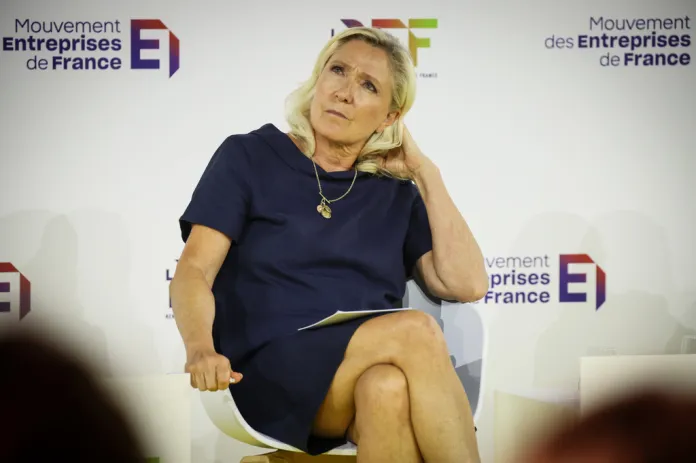
National Rally leader Marine Le Pen, a mainstay of right-wing French politics, could not be in a better position at the moment.
Coming off the first presidential debate of the election season, she is polling in a distant first-place among French voters who see her as a populist outsider resilient enough to be battered by the elites and still stay in the ring.
Le Pen is currently polling between 35% and 38% in national voter surveys, according to French outlet Le Monde. Hard-left candidate Jean-Luc Mélenchon, representing the France Unbowed party, is in a distant second-place with between 16% and 17%.
 in Paris, Thursday Aug. 27, 2026. (AP Photo/Thomas Padilla)</p>
<p> ” data-large-file=”https://conservativemodern.com/wp-content/uploads/2026/08/marine-le-pens-last-stand-national-rally-leader-polling-far-ahead-for-2027-presidential-election-after-three-previous-defeats.webp” src=”https://conservativemodern.com/wp-content/uploads/2026/08/marine-le-pens-last-stand-national-rally-leader-polling-far-ahead-for-2027-presidential-election-after-three-previous-defeats.webp” alt=”Marine Le Pen” class=”wp-image-4704212″ srcset=”https://conservativemodern.com/wp-content/uploads/2026/08/marine-le-pens-last-stand-national-rally-leader-polling-far-ahead-for-2027-presidential-election-after-three-previous-defeats-2.webp 1024w, https://conservativemodern.com/wp-content/uploads/2026/08/marine-le-pens-last-stand-national-rally-leader-polling-far-ahead-for-2027-presidential-election-after-three-previous-defeats-2.webp?resize=300,200 300w, https://conservativemodern.com/wp-content/uploads/2026/08/marine-le-pens-last-stand-national-rally-leader-polling-far-ahead-for-2027-presidential-election-after-three-previous-defeats-2.webp?resize=768,512 768w, https://conservativemodern.com/wp-content/uploads/2026/08/marine-le-pens-last-stand-national-rally-leader-polling-far-ahead-for-2027-presidential-election-after-three-previous-defeats-2.webp?resize=150,100 150w, https://conservativemodern.com/wp-content/uploads/2026/08/marine-le-pens-last-stand-national-rally-leader-polling-far-ahead-for-2027-presidential-election-after-three-previous-defeats-2.webp?resize=696,464 696w” sizes=”(max-width: 1024px) 100vw, 1024px”><figcaption class=) Far-right leader Marine Le Pen, candidate at presidential election waits at business meeting organized by the French business organization (MEDEF) in Paris, Thursday Aug. 27, 2026. (AP Photo/Thomas Padilla)
Far-right leader Marine Le Pen, candidate at presidential election waits at business meeting organized by the French business organization (MEDEF) in Paris, Thursday Aug. 27, 2026. (AP Photo/Thomas Padilla)If these trends hold, it is likely that the two candidates will box out all traditional parties from the second round of the presidential election — a major blow to the centrist, pro-European Union groups centered on current President Emmanuel Macron. And in a hypothetical runoff between Le Pen and Melenchon, polls suggest Le Pen would win 68% to Melenchon’s 32%.
With the momentum behind them, the National Rally recently adopted a new slogan for their 2027 election campaign: “Renaissance.”
The slogan is a gleeful taunt to Macron’s centrist Renaissance party. Renaissance sued the National Rally for infringing on their brand, accusing them of “parasitism” and attempting to confuse voters. That lawsuit failed after the Paris Judicial Court ruled there was no conflict and ordered the Renaissance party to pay Le Pen and National Rally approximately $11,586 to cover legal fees.
But the “Renaissance” slogan is also a sincere expression of rebirth for a candidate and party that sees themselves emerging from an onslaught of legal and political pressure to keep them out of the race.
Le Pen was convicted of embezzlement last year after using funds intended for European Union expenses for her own political work. The National Rally leader has maintained her innocence while acknowledging the inappropriate use of funds as a logistical mistake.
She announced her intention to run for president for a fourth time immediately following the end of her appeal case at a Paris court, which ultimately sustained her conviction but did not prevent her from launching a campaign.
Her playbook is not an unfamiliar one in current right-wing political trends — an emphasis on national autonomy, a skepticism toward supranational bodies such as the European Union, lip service to kitchen table issues like social welfare, and a rejection of mass immigration policies of the past.
Other parts of her platform are a bit novel, such as a plan for subsidizing a rollout of air conditioning for countries after record-breaking heat waves ravaged the continent and resulted in tens of thousands of casualties.
</p>
<p> ” data-large-file=”https://conservativemodern.com/wp-content/uploads/2026/08/marine-le-pens-last-stand-national-rally-leader-polling-far-ahead-for-2027-presidential-election-after-three-previous-defeats-1.webp” src=”https://conservativemodern.com/wp-content/uploads/2026/08/marine-le-pens-last-stand-national-rally-leader-polling-far-ahead-for-2027-presidential-election-after-three-previous-defeats-1.webp” alt=”French presidential candidates” class=”wp-image-4704213″ srcset=”https://conservativemodern.com/wp-content/uploads/2026/08/marine-le-pens-last-stand-national-rally-leader-polling-far-ahead-for-2027-presidential-election-after-three-previous-defeats-3.webp 1024w, https://conservativemodern.com/wp-content/uploads/2026/08/marine-le-pens-last-stand-national-rally-leader-polling-far-ahead-for-2027-presidential-election-after-three-previous-defeats-3.webp?resize=300,200 300w, https://conservativemodern.com/wp-content/uploads/2026/08/marine-le-pens-last-stand-national-rally-leader-polling-far-ahead-for-2027-presidential-election-after-three-previous-defeats-3.webp?resize=768,512 768w, https://conservativemodern.com/wp-content/uploads/2026/08/marine-le-pens-last-stand-national-rally-leader-polling-far-ahead-for-2027-presidential-election-after-three-previous-defeats-3.webp?resize=150,100 150w, https://conservativemodern.com/wp-content/uploads/2026/08/marine-le-pens-last-stand-national-rally-leader-polling-far-ahead-for-2027-presidential-election-after-three-previous-defeats-3.webp?resize=696,464 696w” sizes=”(max-width: 1024px) 100vw, 1024px”><figcaption class=) Candidates for a French presidential election pose for a photo at a business meeting organized by the Movement of the Enterprises of France, a business organization also known as MEDEF, in Paris, Thursday Aug. 27, 2026. From left are French conservative Party Les Republicains Bruno Retailleau, center-left party Place Publique co-president Raphael Glucksmann, far-right party National Rally leader Marine Le Pen, former French Prime Minister and head of Horizons party Edouard Philippe, head of MEDEF Patrick Martin, far-left La France Insoumise leader Jean-Luc Melenchon, Green Party leader Marine Tondelier and former French Prime Minister Gabriel Attal. (AP Photo/Thomas Padilla)
Candidates for a French presidential election pose for a photo at a business meeting organized by the Movement of the Enterprises of France, a business organization also known as MEDEF, in Paris, Thursday Aug. 27, 2026. From left are French conservative Party Les Republicains Bruno Retailleau, center-left party Place Publique co-president Raphael Glucksmann, far-right party National Rally leader Marine Le Pen, former French Prime Minister and head of Horizons party Edouard Philippe, head of MEDEF Patrick Martin, far-left La France Insoumise leader Jean-Luc Melenchon, Green Party leader Marine Tondelier and former French Prime Minister Gabriel Attal. (AP Photo/Thomas Padilla)The French left-wing has been struggling to match the surging relevance of the Right, in no small part due to infighting and refusal to build coalitions.
Raphaël Glucksmann, a member of the European Parliament, announced his bid to join the fray last week. He is positioning himself as a center-left alternative to the more radical Melenchon.
His polling numbers have hovered between 10% and 12%, signaling a decent base of support but not enough to meaningfully challenge Melenchon.
The Greens are currently running their own candidate, Marine Tondelier, who is campaigning while heavily pregnant. She has struggled to break into double digits in opinion polling, and now some within the party are considering whether or not they should sign a pact with France Unbowed and throw their weight behind Melenchon.
LE PEN TOPPING FRENCH POLLS AND RELIEVED OF ANKLE MONITOR, TOUTS ‘WINNING DUO’ WITH JORDAN BARDELLA
While Le Pen and Melenchon are far from ideologically similar, they share key overlaps that distinguish them from those candidates running close to the center — in particular, their distaste for France’s current relationship with the European Union.
Melenchon promised to “disobey anything coming from Europe that conflicts with the interests of the French people” during the debate last week, and he said he intends to “amend the treaty that forms the basis of the European Union, because otherwise we will perish politically, socially, and industrially.”
Le Pen, at the same debate, lamented how the French contribution to the EU has “skyrocketed in recent years, even though the European Union has not contributed much to our economy, other than a considerable number of standards, restrictions, and a wide variety of rules.”


