







Artificial intelligence could be the end of the jobs world as we know it. Or conversely, it could herald a new era of innovation and job creation.
The longer-term future of AI and its effects on the world of work remain largely unknown and the subject of inordinate speculation at either extreme. What we can be reasonably sure of about AI, however, is that it will continue to dominate current discussions about the future of work.
The debates come amid the deep embrace of AI by President Donald Trump’s administration. Trump, in his second, nonconsecutive term, is overseeing a “light-touch” regulatory philosophy that aims to build on already-existing American global dominance in the burgeoning field.
The Trump administration’s July 2025 “AI Action Plan” focused on accelerating innovation and expanding infrastructure, such as data centers, while the March 2026 National Policy Framework for AI has called on Congress to pass a unified federal standard for AI regulation, aiming to preempt a patchwork of state-level AI laws that the administration argues hinders innovation.
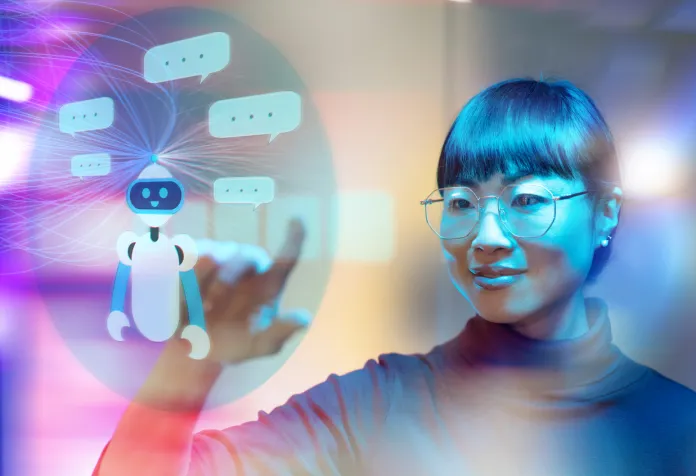
This is part of a global trend by many governments worldwide, including the United States, that are largely unfocused on what to “do” about AI. The U.S. has, in particular, left it to the market to decide, “establishing an urgency to create a race,” according to Cali Williams Yost, CEO and founder of Flex+ Strategy Group.
“It’s purely reactive,” she told the Washington Examiner. “It doesn’t support a more deliberate approach, and it’s not very effective.”
Such an approach may even suit the technology companies leading the race. Exploiting the lack of certainty and the government’s reactivity helps boost the relevance of the companies involved.
“The more dystopian view they project, the more people might think they need their products,” Fabian Stephany, a departmental research lecturer in AI and work at the Oxford Internet Institute, said in an interview.
AI industry chiefs want little regulation, and the Trump administration, whose top AI officials are linked with Palantir’s Peter Thiel, a notable Trump supporter, appears more than willing to let that be the case. In the absence of federal leadership, some states have enacted their own guardrails, but there is little evidence so far of any kind of AI policy regulation on the administration’s side.
The return of softer skills
Some initial effects of AI are already apparent. For example, the elimination of many entry-level jobs for humans in certain professions, as well as the distortion of the job application market, are results of the machines taking over.
But what might be getting lost in all of this is the subsequent need for greater concentration on certain well-established and nondigital human skills. Skills that younger professionals might not be quite as adept at compared with older generations, given multiple factors, not least growing up in a largely digital COVID-19 and post-COVID-19 world. Skills such as networking, problem-solving in real time without the use of machines, running meetings, critical thought, and the ability to read a room.
No generation should be targeted with the same brush as if everyone behaves in a certain way depending on when they were born, sources stressed. Much still depends on the environment people grow up in.
“Nobody likes to be put in a box,” said Amy Summers, a New York-based author and founder and president of Pitch Publicity, in an interview. “Who you become is much more about what you’ve been exposed to, the influence of your family, and the kind of household you grow up in. It’s never purely a generational thing.”
There are, however, some characteristics that fit certain age groups better than others, and it could be that each can learn from the other, sources say. The role of older generations, for example, with their personas hewn from a lifetime working and living in a nondigital world, could be vital in helping younger cohorts navigate an increasingly precarious work future.
“If ever there was a time when we needed leadership from baby boomers and Gen X around people skills, it’s now,” Summers said. “It’s not just about mentoring; it’s weaving mentorship into your leadership style.”
Similarly, members of Generation Z can also bring their skills and perceptions to the table. Their edge, familiarity with digital technology in general, can help them navigate the future of an increasingly digital world of work better than those who grew up in different generations.
“Intergenerational learning and support is critical,” Deb Feder, a business and practice strategy specialist, said in written commentary. “In addition, a willingness to learn how others are thinking through situations and challenges will allow older generations to stay relevant and engaged with all aspects of the workforce.”
Labor shortage
The discussion of AI versus humans in the workplace may take on even more relevance, given concerns about upcoming labor shortages.
As early as 2032, there could be a shortage of up to 5.25 million jobs, according to Georgetown University researchers. As baby boomers retire in large numbers, taking all of their manual trades with them, questions emerge as to who will take over such jobs. Who will replace the layers of solar panels and other infrastructure builders?
“There will be a seismic shift when it comes to retirements,” Stephany said. “These positions will need to be filled, but they won’t be filled by AI.”
Or they won’t be filled at all. Millions of jobs that are even now vacant in almost all industrialized countries will disappear forever, he said.
AI isn’t all negative, however. The increasing adoption of AI, for example, could help develop more traditional human skills. Delegating certain tasks to automation can free up managers to actually be what they are supposed to be — managers.
“Because of AI, human skills are in increasing demand,” Stephany said. “People can become better managers because they have more time to devote to things like team-building, ethical judgment, and people management.”
That said, there is also evidence that AI is stripping the ability to think critically, not just from younger workers but also among senior executives. By excessively delegating tasks to AI, such executives are failing to show leadership in making tough decisions, wrote Gustavo Razzetti, a workplace culture strategist.
It is vital to have divergent opinions in general, and those are not going to come from an overreliance on AI. Chatbots are designed to please you, not challenge, he said. This is where critical thinking comes into play the most, perhaps in particular for younger workers.
“It’s the ability to challenge your thinking, to hear hard feedback without collapsing, and to give it without pulling punches,” he said. “No algorithm develops that in you.”
Who’s going to manage?
All the sources interviewed for this article agreed that it was a fundamentally bad idea to strip away many entry-level jobs and hand them uniquely to AI. Such entry-level jobs have been an opportunity for newer workers to ask questions about collaboration and how to gain influence. Not only does the loss of such jobs make it extremely difficult for younger workers to gain valuable cultural immersion in the workplace, but worse still, how will they then manage people in the future?
“The mentoring ladder doesn’t just help junior employees today,” Razzetti said. “It gradually prepares them to lead people in the future. When the ladder’s bottom rungs disappear, the journey collapses.”
This is where a combination of enlightened workplaces and government can help.
“If organizations and policymakers rush to automate entry-level work without thinking about how people learn the fundamentals of leadership, we risk creating a future leadership gap,” Summers said.
Policymakers should be investing in people’s skills and education rather than relying on quick fixes such as a universal basic income for a possibly unemployed population, Stephany added.
Talk of mass unemployment with the development of AI may be extreme. But an overreliance on AI and obsession with its future could be affecting us in ways that might harm us and in ways we don’t even know yet.
“We are still people, we still have to relate to each other,” said Yost, the Flex+ Strategy Group founder and CEO. “AI can crunch the data, but people still have to build trust and credibility with the client. That is where the real value add lies; it is not something AI can do yet, if ever.”
CHRIS WRIGHT WARNS GAS PRICES MAY STAY HIGH THROUGHOUT THE SUMMER
There is undoubtedly dysfunction in the current world of work, but therein lie opportunities that may be being largely ignored. Different generations in the workplace can help each other navigate such troubled times.
“Mentorship flows both ways,” Summers said. “Younger generations bring fresh thinking, digital fluency, and the confidence to challenge outdated systems. When you combine that with the experience and perspective of older generations, it becomes a competitive advantage too many organizations are overlooking.”
Nick Thomas (https://nickthomas.journoportfolio.com/) is a writer based in Denver.


