

A left-wing activist group opposing President Donald Trump’s law enforcement crackdown in Washington, D.C., has been coaching residents on how to use jury duty as a form of political activism, explicitly encouraging them to “influence outcomes” in criminal cases.
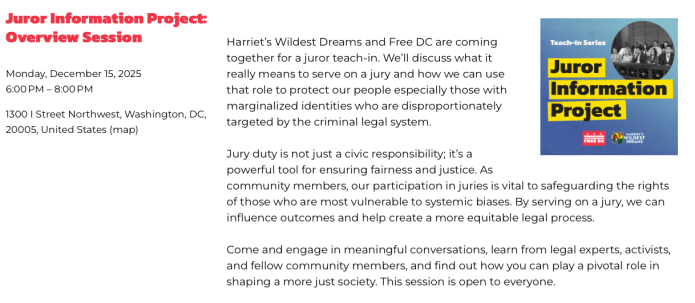
Free DC, a progressive organizing group that has emerged as one of the most visible opponents of the Trump administration’s federal crime and security surge in the capital, recently hosted a “juror teach-in” aimed at reframing jury duty as a political tool rather than a neutral civic obligation.
“Jury duty is not just a civic responsibility; it’s a powerful tool for ensuring fairness and justice,” the group said in promotional materials for the event. “By serving on a jury, we can influence outcomes and help create a more equitable legal process.”
The event, co-hosted with the group Harriet’s Wildest Dreams, encouraged participants to view jury service as a way to protect defendants the organizers say are disproportionately targeted by law enforcement, particularly amid increased federal activity in the District. The session was advertised as open to the public.
The Washington Examiner reached out to Free DC for comment but did not receive a response.
‘An enormous amount of power’
According to a recent Washington Post profile, the juror training was one of several events Free DC organized in a single week as it sought to integrate opposition to the Trump administration into everyday civic life in Washington.
At the December meeting, roughly two dozen attendees gathered in a downtown office building, where Free DC leaders urged residents to approach jury service skeptically, particularly in cases connected to federal law enforcement operations.
“As jurors, we have an enormous amount of power to decide whether this administration and its agenda are right or wrong,” Free DC co-founder Alex Dodds said at the event, according to the Post.
Jury rejections mount in federal court
The group’s focus on juries comes amid an extraordinary string of grand jury rejections in Washington federal court. Over the past several months, prosecutors have failed to secure felony indictments in multiple cases. At least seven grand jury rejections have occurred across five different cases since the administration’s crime and security surge crackdown began in August.
Among the most high-profile cases was that of a former Justice Department paralegal charged with felony assault after allegedly throwing a sandwich at a Customs and Border Protection officer in a busy nightlife corridor. A D.C. grand jury declined to indict, forcing prosecutors to downgrade the charge to a misdemeanor. A trial jury acquitted the defendant entirely in November.
The response to the sandwich thrower’s acquittal was met with mostly humorous reactions online, though the prospect of repeated rejections of criminal cases related to Trump’s crime crackdown prompted lawyers, including prominent trial attorney Robert Barnes, to suggest that the District “does more jury nullification than any jurisdiction in the history of our country.”
DC does more jury nullification than any jurisdiction in the history of the country. https://t.co/T583fZ3qB5
— Robert Barnes (@barnes_law) November 6, 2025
Josh Blackman, a professor at South Texas College of Law Houston, previously told the Washington Examiner that the sheer amount of repeated refusals by grand juries to bring charges against select defendants in the district could be construed by some critics as jury nullification, but he added in new remarks on Wednesday that there is usually no surefire way to indicate whether jury nullification has taken place.
“People have been talking about jury nullification for years,” Blackman said. “I don’t know how much the average person in Washington, DC knows the line between a felony and misdemeanor. They don’t. So it’s often very hard to even identify where nullification is even happening.”
In another case, a grand jury declined to indict a D.C. attorney accused of assaulting and threatening National Guard members deployed as part of the federal surge. That case was similarly reduced to misdemeanor charges.
Those outcomes follow a longer history of politically sensitive cases in which D.C. juries have declined to convict Democrat-aligned defendants, including the acquittal of Clinton campaign lawyer Michael Sussmann on charges that he lied to the FBI and the acquittal of former Obama White House counsel Greg Craig on false statement charges related to his foreign lobbying work.
Legal experts: not illegal, but notable
Legal experts say the jury coaching itself does not clearly violate the law, but they note that it could raise concerns depending on how it is carried out.
Blackman said there is generally no legal issue with broad discussions about jury nullification or jury power, provided organizers are not attempting to influence a specific case or target individuals summoned for jury duty.
“Unless you’re trying to influence a particular case or targeting people who are called for jury duty, I don’t think there’s a legal problem,” Blackman said. “Judges give instructions, and if they find that a juror can’t faithfully discharge their duty, the juror can be excused.”
However, Blackman said questions about participation in activist trainings could potentially arise during jury selection, particularly if there are concerns about bias, although grand jury selection typically involves far less vetting than trial juries.
“I think that would be fair game to ask during jury selection,” he said, adding that prosecutors typically have less opportunity to scrutinize individual grand jurors’ backgrounds in detail, unlike trial juries.
Mike Davis, former chief counsel for nominations for Senate Judiciary Committee Chairman Chuck Grassley, told the Washington Examiner the language used by Free DC suggests they are “not neutrally explaining civic duty.”
“When these groups tell people to use jury service to ‘protect our people’ and advance a political cause, they’re not neutrally explaining civic duty,” said Davis, who is also the founder the conservative judicial advocacy group Article III Project. “They’re encouraging prospective jurors to ignore the law and the judge’s instructions in favor of leftist ideology. That’s an effort to rig outcomes before a trial even begins.”
Free DC’s broader resistance strategy
Free DC has framed jury participation as one of several methods residents can use to resist federal authority. The group has also trained residents on how to film police encounters, respond to Immigration and Customs Enforcement activity, and confront federal agents operating in their neighborhoods.
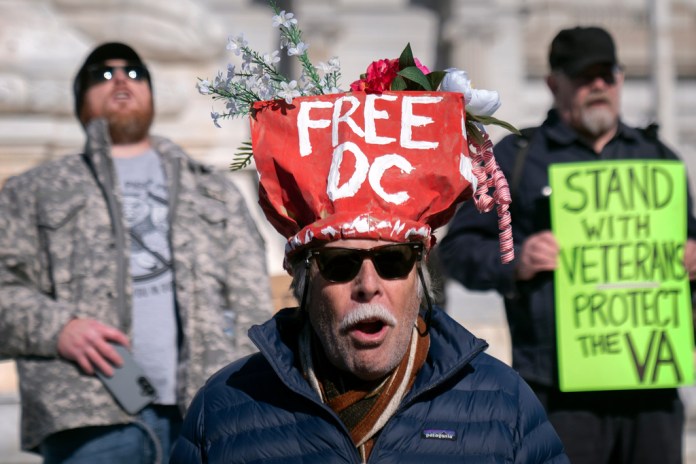
The organization traces its roots to the fight for the District’s autonomy and has cast Trump’s return to office as a direct threat to the city’s home rule. Its leaders have said they aim to mobilize more than 24,000 residents to sustain long-term opposition to federal intervention.
Leadership scrutiny and criminal records
The group’s leadership has also drawn scrutiny. An August Daily Caller report detailed criminal histories among several Free DC leaders.
Advisory councilman Darrell Gaston previously pleaded guilty in two separate cases involving assault-related charges and received community service sentences. Court records show Gaston was charged in 2016 with simple assault and attempted threats to do bodily harm and faced another assault conviction in 2018. He was also the subject of multiple civil complaints alleging harassment and assault while serving as a local elected official.
Dodds, Free DC’s campaign director, has faced multiple charges for crowding, obstructing, or incommoding tied to protest activity, with several cases resolved through bond forfeiture. Executive director Keya Chatterjee has similarly faced disorderly conduct and unlawful assembly charges dating back to 2016, according to court records.
Despite that background, Free DC bills itself as a force for “racial justice” and opposition to what it describes as the militarization of local communities. The group has organized protests, lobbied Congress, and in October announced plans to endorse candidates in the 2026 D.C. elections.
Clash over crime and public safety
Trump in August authorized the deployment of the National Guard and expanded federal law enforcement operations following violent incidents in the city, arguing that local leadership had failed to restore public safety.
The administration has defended the surge as necessary to curb crime and protect residents and visitors.
Davis said the damage from juries acting in more aggressively partisan ways is already causing more problems for the District.
JUDGE CONSIDERS RELEASING JAN. 6 PIPE BOMB DEFENDANT INTO HOME DETENTION
“We’re already seeing the damage in DC: serious crimes dismissed, charges downgraded, and criminals walking free while residents suffer the consequences,” Davis said. “Subverting the justice system from the jury box isn’t reform. It’s lawlessness, and it erodes public trust in the rule of law.”
As federal prosecutors continue to encounter resistance from D.C. juries, Free DC’s effort to openly politicize jury service has placed renewed attention on the role local jurors play in shaping the outcome of high-profile and politically charged cases, and on how civic institutions meant to operate impartially are increasingly being drawn into the city’s broader political battles.


