







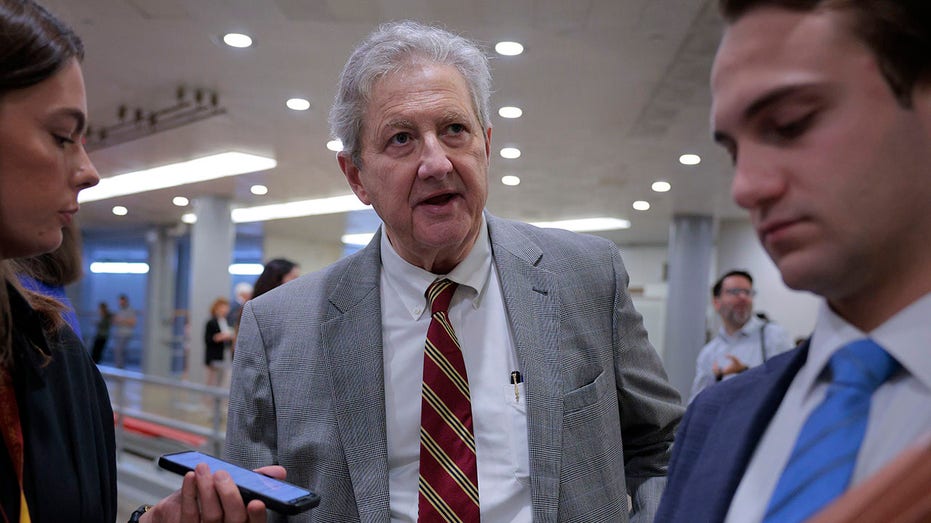
A Senate Republican warned Thursday that Ayatollah Ali Khamenei’s primary focus is shedding American blood as U.S.-Iran relations continue to simmer.
“The Ayatollah not only thinks that I’m going to hell because I don’t agree with his religion — he wants to kill me,” Sen. John Kennedy, R-La., said on the Senate floor Thursday.
“He wants to kill Americans and the Israelis and anybody who does not believe in his jihad and drink our blood out of a boot,” Kennedy continued. “And he’s acted on that, and that’s not acceptable.”
US POSITIONS AIRCRAFT CARRIERS, STRIKE PLATFORMS ACROSS MIDDLE EAST AS IRAN TALKS SHIFT TO OMAN
Kennedy’s message comes as tensions with Iran are escalating. At the core of the issue is Iran’s capability and Khamenei’s desire to build a nuclear weapon.
President Donald Trump gave the country’s leadership roughly 10 to 15 days to reach a nuclear agreement and warned that the inability to strike a deal could lead to U.S. military action in the region.
He renewed that edict during his State of the Union address earlier this week.
TRUMP’S IRAN ULTIMATUM ENTERS DECISIVE STRETCH AFTER STATE OF THE UNION
“I will never allow the world’s number one sponsor of terror … to have a nuclear weapon,” Trump said.
Kennedy cautioned that if the Trump administration were to broker a deal, it would need to have guardrails.
“If we make a deal with Iran, let’s make sure we have a protocol to enforce it, because in my experience in watching the Ayatollah through the years, I wouldn’t trust this man if he was three days dead,” he said.
SEN LINDSEY GRAHAM: IRAN IS FACING A BERLIN WALL MOMENT — HISTORY IS WATCHING US NOW
Meanwhile, lawmakers are wrestling with the exact nature of what a strike could look like and whether Congress should weigh in before Trump makes a decision.
Sens. Tim Kaine, D-Va., and Rand Paul, R-Ky., expect that their Iran war powers resolution will hit the Senate floor next week, which would curb Trump’s ability to strike the country without Congress’ approval.
Senate Majority Leader John Thune, R-S.D., said that the most important aspect of the Iran negotiations was “to prevent them from having nuclear capability.”
“But there are also other threats that they represent in the region, and we have a big presence in that region, as you know, so I think they’re looking at and working through what the options might be,” Thune said. “In my view, if you’re going to do something there, you better well make it about getting new leadership and regime change.”


