







Antisemitism is spiking in parts of Europe amid Israel’s war against Iran, as regional leaders blame popular strains of anti-Zionism for fueling bigotry against the Jewish people.
In Italy, the Union of Italian Jewish Communities says there has been a 400% increase in antisemitic attacks, citing its annual report. Four separate attacks across Europe targeting Jews in recent weeks have sparked alarm, with a radical Islamic extremist group known as Harakat Ashab al Yamin al Islamia claiming responsibility for all of them.
In France, authorities said they foiled a separate antisemitic attack against Jews in March, arresting two suspects accused of seeking to detonate an improvised explosive device near Bank of America offices in a “jihadist” assault for ISIS.
Antisemitism: What is the root?
The high-profile incidents allegedly perpetrated by radicalized Islamists at two synagogues, a school, and elsewhere have captured attention. But Binyomin Jacobs, a revered leading European rabbi based in the Netherlands who served for years on the board of the Cheder Orthodox Jewish school in Amsterdam that was recently attacked, said the underlying issue is rooted in the general populace’s tolerance and participation in “smaller” acts of antisemitism in everyday life.
In Jacobs’s view, a type of mob mentality is forming against Jews in Europe, driven in part by rage against the state of Israel. Actions the Jewish country has undertaken, including against Iran, serve as an “excuse,” the elderly rabbi said, for people to vent against European Jews.
“Anti-Zionism and Semitism became the same,” Jacobs mused. “In theory, it is not the same at all, but it has become so that people don’t know the difference anymore.”
Naomi Mestrum, director at the Center for Information and Documentation Israel in the Netherlands, echoed the thought, after the Jewish community was rattled by attacks on a Rotterdam synagogue, an Amsterdam school, and an Amsterdam office building in the Netherlands, alongside an attack on the Liege synagogue in nearby Belgium, which is closely linked to the Netherlands.
“I think antisemitism has always been there, and it has had a long history, and if Jews weren’t hated for their race, they were hated for something else, and I think that Jews are now being hated for their state,” she said.
Some right-wing figures have blamed the rise of Muslims in Europe for antisemitism fomenting on the continent. Jacobs argued that to do so ignores deeper societal toleration for targeting Jews. During World War II, 80% of Dutch Jews were murdered in the Holocaust, when there were “no Muslims at all” in the country, he said. Jacobs said his own parents survived the Holocaust due only to the acts of kindness from Dutch neighbors who hid them from the Nazis. The most popular reason for targeting Jews in the modern age, he said, is due to backlash against Zionism.
“It’s not fair to only blame it on Muslims. Antisemitism is like a mutating virus. In Europe, during the Crusades, we were allowed to be killed because of Jesus. In the Middle Ages, we were responsible for the wrong kind of diseases. Jews were guilty for the COVID virus, and then Jews were the ones who made the resistance medication against it. And today, I am a Zionist,” he said. “What I am saying is, every time you find another reason to hate Jews.”
Antisemitism: The impact on everyday life
Jews are being forced to take precautions in Europe to exist, becoming accustomed to living under heavy police and even military security measures, avoiding non-Jewish areas, and steering clear of publicly displaying visible signs of their faith or race if they wish to spare themselves from harassment, according to Jewish leaders in the region.
In the Netherlands, Jews are often “yelled and cursed” at for displaying pride in their heritage, Mestrum said. More and more children are applying for the Jewish school because they do not feel comfortable in their own school anymore, people hide the Star of David necklace “under their shirt to get into public transportation,” residents are “too afraid” to speak Yiddish or Hebrew in public, and “extreme” security measures have been in place “for decades,” she said, with special police forces at the doors of synagogues. Many Jewish Europeans are essentially segregated from the rest of society in Amsterdam and the surrounding areas.
“Every Jewish organization within the Netherlands has received threats or is dealing with the fact that you cannot walk on the street with a kippah anymore without being sworn at or yelled at,” Mestrum said. “We’ve had quite a few incidents of kids going to non-Jewish schools because we only have two Jewish schools within the Netherlands, where they were dealing with harassment or being bullied. Things like, ‘Hitler should have finished his job.’ We have security when we organize a Jewish event. When we organize an event, we do not tell the location of the event. We only tell the people who are visiting last minute where it is.”
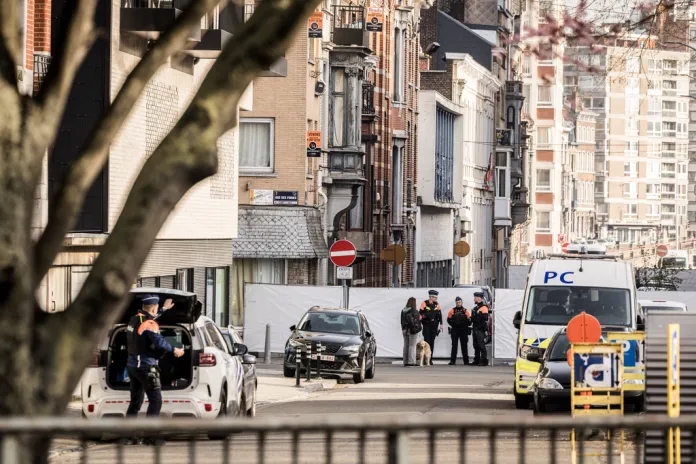
In places like Belgium, police and federal forces have held an enhanced presence at heavily Jewish quarters for years, including in Antwerp’s Jewish quarter following several violent antisemitic attacks in 2014. The government deployed military forces in March to help police protect Jewish schools and synagogues nationwide after the explosive attack on the historic Liege temple, which officials said marked the first such incident in the city since the Holocaust. Belgian Interior Minister Bernard Quintin said the enhanced security was necessary “against a backdrop of rising antisemitism.” Italian authorities have echoed the move, sending soldiers to guard Rome’s historic Jewish quarter and other sites.
Jacobs reiterated that stringent security measures have become a normal part of life in the Netherlands, including at the Amsterdam school recently attacked, where his daughter teaches and his great-granddaughter attends.
“If you’re somewhere, a Jewish marriage or a bar mitzvah, or a memorial — there always has to be police protection,” he said. “It’s normal. You don’t go to the synagogue service without police at the door. That’s irresponsible.”
Though he sees himself first and foremost as a proud Dutchman, he is aware that other residents see him differently, explaining, “The average person, they don’t know the difference between Israel and Jewish people.”
“I’m living here already about 12 or 13 generations — generations, you understand,” he said. “But my own house, the windows have been thrown in…. I can’t go somewhere without protection. It’s completely ridiculous, it’s not possible.”
Antisemitism: Iran and the rise of conspiracies
Jewish Federation of Greater Washington CEO Gil Preuss said the rise of influencers, such as Tucker Carlson, blaming Israel for the United States’s entrance into the Iran war, is to blame for some of the rise in outrage against Jews. Preuss escorted a group of dozens of French Jews to Israel last year after they no longer felt safe in France. In the U.S., it is becoming increasingly common in the GOP for people to identify as racist, specifically against Jews, he warned, pointing to a recent analysis from the Manhattan Institute. The study, which polled nearly 3,000 voters, concluded that 31% of the overall GOP is tolerant of or holds antisemitic views.
“Those are shocking numbers,” Preuss said. “There are now people on the Left and the Right who are just explicitly antisemitic, even though they may not fully say it, but even things like most recently, blaming Israel for the U.S. is entry into the war with Iran based on the assumption that the U.S. doesn’t have agency, that the leadership can’t make their own decisions, suggesting that somehow people were manipulated. I mean, that is such a classic antisemitic trope.”
Jacobs, the Dutch rabbi, said the war in Iran posed a convenient opportunity for antisemites to use Jews as a scapegoat.
“If tomorrow will be peace [in Iran], then don’t believe, don’t think antisemitism will stop, right?” Jacobs said. “It will just continue, right? It was a nice opportunity, in a negative way, to be antisemitic.”
In the Netherlands, Mestrum expressed concern that due to the ethnic group’s tiny minority presence, “most people have never met a Jew,” making it easier for disinformation and conspiracies about them to spread.
JEWISH ADVOCATES WARN FRANCE ENTERING ‘NEW PHASE’ OF ANTISEMITISM
“You have 40,000 Jews on a population of 18 million,” she said. “So if you only follow social media and see all the comments there, you kind of get the idea that those people that call themselves Jewish must be different, must be worse than others.”
“People do hide behind the walls of the synagogue and the schools just to feel that they can be who they are within their own community,” Mestrum added. “The strength of your society is shown by how you protect your minorities, and if you cannot protect your minorities anymore, I think your society is failing.”


