






House Minority Leader Hakeem Jeffries (D-NY) could be on another collision course with Senate Democrats over how to handle the next fight over government funding as Republicans ask for more time to negotiate a deal on the Department of Homeland Security.
Senate Democrats have not ruled out a temporary funding patch for DHS, even as Jeffries and many of his Democratic colleagues in the House are refusing to extend the deadline for two or more weeks.
Jeffries argues that Republicans, staring down a Feb. 13 deadline, have enough time to agree to reform immigration enforcement. Senate Democrats, though, are more open to keeping DHS limping along if the White House appears to be making a good-faith effort in budget talks.
Sen. Tim Kaine (D-VA), one of eight Senate Democrats to help end last year’s record-setting government shutdown, sidestepped whether his party should let DHS lapse at the end of next week.
“Rather than assume the lack of success, let’s try to work for success, and then if we can’t get there, then we’ll see,” Kaine told the Washington Examiner.
Some centrist Senate Democrats have also encouraged colleagues to “keep as many options on the table as possible.” Senate Minority Leader Chuck Schumer (D-NY), for his part, has shown a greater willingness to cut a deal and brokered an initial two-week extension with President Donald Trump last week, but so far won’t tip his hand on Jeffries’s red line.
Democrats are still in the early stages of negotiating with the White House, releasing a list of reforms on Wednesday night meant to rein in DHS after federal agents killed two U.S. citizens in Minneapolis.
But they will quickly have to decide whether to keep the department open or risk a partial shutdown at the end of next week, with Senate Majority Leader John Thune (R-SD) preparing to file a funding patch Monday or sooner.
The rest of the government has been funded through September, but Congress punted the question of DHS, which covers emergency response management and airport security on top of immigration enforcement, until mid-February as part of a larger spending bill.
Jeffries can more easily reject another extension, given that House Republicans can move legislation at a simple majority, and he’s broken with Schumer twice before — last March, when Schumer handed Thune the votes to avert a shutdown, and again this week.
Senate Democrats do not have the same luxury, however, thanks to the 60-vote filibuster threshold, and must agree to bring to the floor any deal to fund the government.
Both Jeffries and Schumer have attempted to present a united front in negotiations with the White House. On Tuesday, they held a one-on-one meeting at the Capitol and met jointly with a larger group of House and Senate Democrats Wednesday morning.
Schumer is giving himself far more flexibility, though, to navigate the funding fight and has not drawn the same hard line as Jeffries. On Wednesday, Jeffries refused to support a “fallback” plan to keep DHS spending flat for the rest of the fiscal year if Congress cannot reach a deal.
“We need to resolve this issue by Feb. 13,” Jeffries told the Washington Examiner.
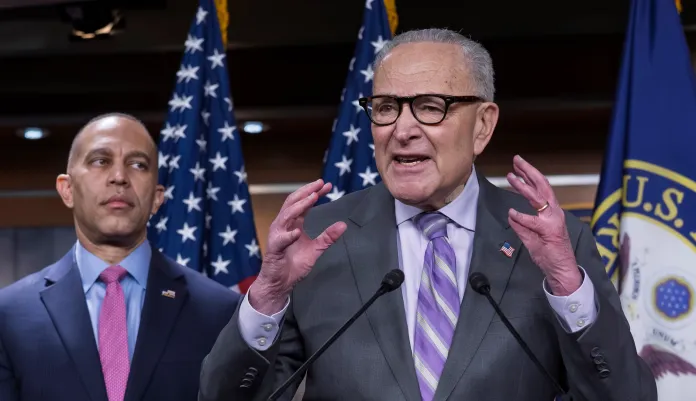
In the meantime, Republicans are placing early blame at the feet of Democrats, calling their list of demands “ridiculous” and threatening to keep the Senate in session if they can’t pass an extension.
Thune originally wanted a six-week funding patch but settled for two weeks in negotiations with the Democrats.
“We’ve got a now one-week-and-one-day timeframe in which to do this, which is entirely unrealistic, and a Democrat Party in both the House and the Senate which seems a lot less interested in getting a solution to this than they do in having a political issue,” Thune said in a floor speech.
Schumer on Thursday accused Republicans of grandstanding over the proposal, which includes tighter warrant requirements and a ban on face masks.
“If Republicans don’t like our proposals, pouting is not going to make the chaos in the streets go away,” Schumer said in his floor remarks.
THUNE SPARS WITH JEFFRIES OVER DHS FUNDING: ‘AFRAID OF HIS OWN SHADOW’
Thune’s threat to keep the Senate in session could help spur a temporary deal, as senators are preparing to leave for the Munich Security Conference at the end of next week.
The White House, meanwhile, has offered a number of olive branches outside of legislative action, announcing a drawdown of immigration agents in Minneapolis and requiring body cameras on all remaining officers in the city.


