






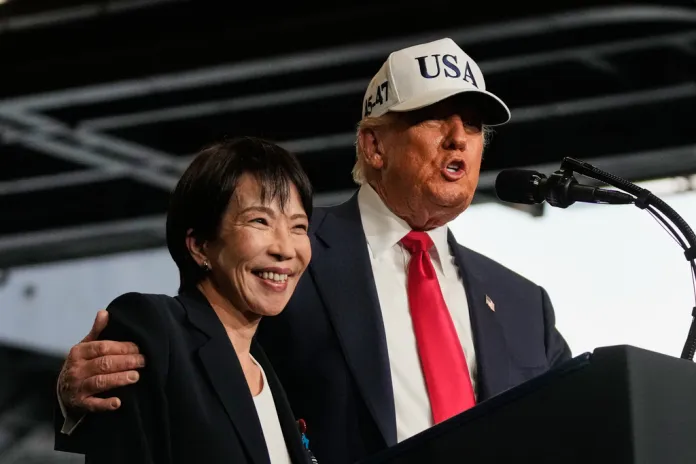
Japanese Prime Minister Sanae Takaichi is heading to the White House this week, hoping to leave with assurance that President Donald Trump has her back on trade and international security.
The country’s first female prime minister has already proven her Trump-whisperer credentials during the president’s visit to the islands last year, where he praised her as a “bold and wise” ally. Now, she will need to iron out her country’s role in Trump’s vision for the future.
“The Japanese government is very aware of the exposure that their country has to the international system. Things like the ‘rules-based international order’ are not just theoretical or diplomatic concepts,” Kristi Govella, Japan Chair at the Center for Strategic and International Studies, told the Washington Examiner. “They are actually seen as existential to the ability of the country to maintain a stable environment and to pursue its own national interest.”
She continued: “So I think that the recent turn — not just in the U.S., but in many countries — towards economic nationalism or towards a focus on domestic interest is distressing for Tokyo.”
After winning a landslide victory earlier this year that put her Liberal Democratic Party in the driver’s seat, Takaichi now needs to deliver on the fundamental, kitchen-table issues facing the Japanese economy.
Japan was flabbergasted when the United States, its most important ally since the end of World War II, imposed steep tariffs on “Liberation Day” last year. Then-Prime Minister Shigeru Ishiba described the situation as a “national crisis” due to the country’s reliance on U.S. markets.
The two governments eventually ironed out a more agreeable arrangement in September, bringing the tariffs down to 15% and committing Japan to invest approximately $550 billion in the U.S.
“The top priority is for Japan to demonstrate that they are an important partner who is contributing to the interests of the U.S. I think part of that is going to be through investment,” Govella explained, noting this would include “contribution to defense in various ways” such as “cooperation” on the “Golden Dome.”
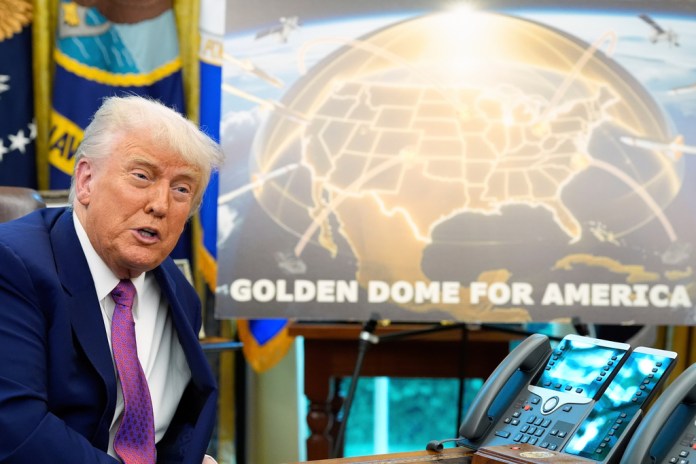
Takaichi is expected to approach Trump about including Japan in the planned “Golden Dome” missile defense system during their summit, with a plan that would launder Japanese civil resources into mutually beneficial defense infrastructure.
The system, based on the Israeli “Iron Dome,” would utilize satellite technology to detect and intercept missile attacks or enemy aircraft within its area of surveillance. The Japanese government is roughly two years away from completing its own network of satellites to track moving objects.
Japan could offer this network for use within the Golden Dome, providing crucial proximity to powers like China and North Korea, and in return reap the benefits of America’s top-tier missile defense.
The White House summit will also be Takaichi’s last chance to meet face-to-face with Trump before his meeting with Xi Jinping in Beijing next month.
China’s top diplomat, Foreign Minister Wang Yi, has signaled a positive posture ahead of Trump’s arrival — calling 2026 a “landmark year of sound, steady and sustainable development of China-U.S. relations.”
Trump has been mercurial in his relationship with Xi since returning to office, at times calling him a friend and at others reiterating his belief that the U.S. has been ripped off by Chinese entities. Meanwhile, Beijing has been waging information warfare against Tokyo since Takaichi signaled her willingness to aid Taiwan in a hypothetical invasion.
Takaichi will seek to impress upon Trump the need for solidarity against the Chinese Communist Party.
“This is an opportunity for Takaichi and Trump to talk frankly and for Takaichi to remind Trump of the shared interests of the US and Japan — how Tokyo feels about various issues related to China prior to him going [to Beijing in April],” Govella explained.
CHINA’S ALL-OUT CAMPAIGN AGAINST JAPAN INCLUDES AI WARFARE, BLACKLISTS, AND WWII GRIEVANCES
Takaichi may also face uncomfortable questions regarding Japan’s support for the ongoing U.S. intervention in Iran, a topic her government has done its best to avoid addressing.
“I have not spoken with [Trump]. The United States must have its reasons. I will listen to him,” Takaichi told lawmakers at a House of Representatives Budget Committee meeting on Monday.
A source close to the government told the Yomiuri Shimbun this week that while Japan wants to remain “in step with the United States to maintain deterrence for the Japan-U.S. alliance,” they also “want to avoid getting deeply involved in the Iran issue.”


