





For a second meeting in a row, the Federal Reserve has decided to keep the benchmark interest rate constant, which directly influences short-term interest rates throughout the economy.
The Fed decided March 18 to leave the federal funds rate as is, with no imminent sign of another cut to come. But if anything, Fed Chairman Jerome Powell sounded more worried about the upside risk of inflation in the aftermath of Operation Epic Fury. The central bank’s leader, who said that “higher energy prices will push up overall inflation” as a result of the war in Iran, said a rate hike is not “off the table.”
Next, in its Summary of Economic Projections, the Fed upgraded the median projection for personal consumption expenditures inflation in 2026 from 2.4% to 2.7%. And raised its projection for core PCE inflation from 2.5% to 2.7%.
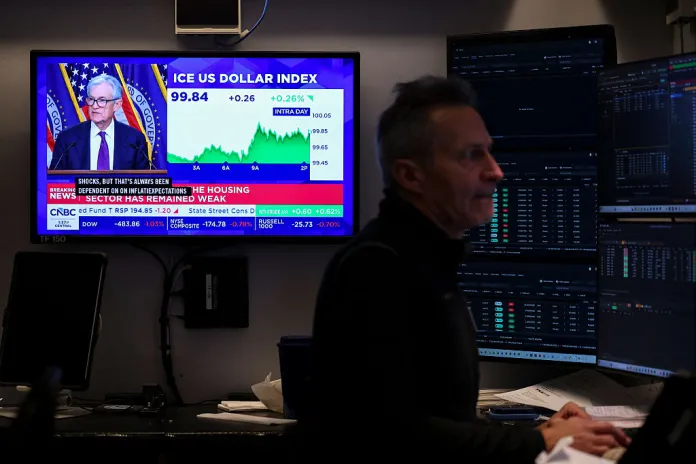
Indeed, the promising consumer price index print that found both headline and core inflation were at five-year lows in February was based on data from just before President Donald Trump initiated his incursion into Iran. And while the president has continued to beckon the Fed for further rate cuts, domestic oil prices have indeed already risen.
But, as I have suspected since the start of the war and previewed in previous editions of Tiana’s Take, the United States has remained curiously insulated from the oil price inflation suffered by much of the rest of the globe.
After the overnight speculative panic from a fortnight ago that shot oil prices across the board to nearly $120 per barrel in the early premarket trading hours of March 9, oil prices quickly settled back down to $100. But then, something interesting happened: oil prices have bifurcated.
West Texas Intermediate, the benchmark for domestic oil prices, has remained at or below $100 per barrel for nearly two weeks, while Brent Crude, the benchmark for international oil prices, has crept back up toward $110. This double-digit spread is orders of magnitude greater than the historical average spread of fewer than $5.
The spread between the U.S. and Asia is even greater, with Dubai and Oman crudes — the benchmarks for Asian markets — trading at some $150 per barrel.
Part of this is a product of simple geography. Whereas a fifth of global oil shipments traverse through the much-besieged Strait of Hormuz and all oil flows into a global market, the impact is still disparate. Whereas the U.S. sources fewer than 5% of its oil from the strait, China relies on the waterway for half its imports, and Japan and South Korea rely on it for at least 70%.
Furthermore, there’s the inconvenient fact that the U.S. became a net exporter of oil for the first time since 1949 during Trump’s first term. And we gained access to the greatest known oil reserve with the ouster of Venezuelan dictator Nicolas Maduro during his second term.
Thus, while the global oil supply shock is very real, the inflationary effect may be more limited than Trump’s haters anticipated. Adjusted for inflation and converted into today’s dollars, oil surged past $150 per barrel after President Barack Obama’s 2011 war in Libya, or 50% higher than today’s Iran bump. In absolute terms, the $5-per-gallon that resulted from Russia’s 2022 invasion of Ukraine was an even greater jump than that of March thus far.
Obviously, if the strait were to remain closed and this wartime status quo persisted into the summer, even greater economic pain would be felt across the planet. But not only did Trump promise that the war would last weeks, not months, the disparate impact of the strait’s closure may actually help wrap up the war by forcing our fickle and feckless allies to actually act like friends and join the fight.
QATARI STATE OUTLET AL JAZEERA RUNS OP-ED PROCLAIMING US-ISRAEL ‘WAR STRATEGY IS WORKING’
Powell readily admitted that “nobody knows” how the economic impact on the inflation borne by consumers will play out. And as importantly, nobody knows how the political reality will push the actual oil supply. Yet, it seems increasingly possible that the disproportionate pain felt by our Eastern Hemisphere allies will cajole them to do by necessity what Trump tried to ask them to do nicely: help the U.S., Israel, and the new, strange, and iron-strong Gulf alliance to take back control of the strait from the suicidal Iranian regime.
The U.S. doesn’t need to escape any semblance of pain to get what we want, just to feel it less than the rest of the world. We may have started this war, but as long as the rest of the world has to pay the brunt of the price, our allies may have to join us at last.


