




President Donald Trump’s administration has struggled for months with over-promising and under-delivering on a peace deal with Iran. Now, it’s approaching its latest bid for peace with rhetoric that promises little and leaves what will be delivered as a question mark.
The White House has claimed that its memorandum of understanding, set to be signed alongside Iranian officials in Switzerland on Friday, has “solved a threat Washington spent forty years managing.” Critics and allies alike are confused and even outraged by that claim, asserting that the deal at best resets the board to the pre-war status quo.
A U.S. official speaking to reporters on Wednesday via a phone conference characterized the memorandum as a first step to normalizing the Islamic Republic, describing the economic benefits as an incentive for Iran to “dial up their good behavior.”
READ IN FULL: The 14-point peace agreement with Iran
“This is fundamentally an agreement that allows us to open the Strait of Hormuz immediately, commits the Iranians to destroying the nuclear dust, and then gives us a dial where if the Iranians dial up their good behavior, we respond by dialing up the kind of economic and sanctions relief that could make them a more prosperous country,” a senior U.S. official told reporters on the press call.
The deal establishes a 60-day period of negotiation between Washington and Tehran, during which transit of the Strait of Hormuz will be unimpeded and all hostilities in the region — including between Hezbollah and Israel in southern Lebanon — will cease. The strait had been open before Operation Epic Fury commenced in February, and neither Hezbollah nor Israel has signed onto the MOU.
Iran affirms in the memo that it will not pursue the creation of nuclear weapons, an official position it has maintained for decades. They will also allow for the disposal of its stockpiled nuclear dust.
In return, the U.S. is offering a generous buffet of sweeteners. Iranian officials will negotiate with the Gulf States to craft a $300 billion reconstruction plan, the U.S. will temporarily waive sanctions on Iranian oil exports, and frozen Iranian assets will be freed up if Tehran demonstrates sincerity in meeting its obligations.
U.S. officials are putting a lot of weight on the assumption that Iran will act in good faith and be held accountable by its neighbors.
“I’m sure the Iranians will assert their rights as aggressively as they can,” the senior U.S. official admitted to reporters, contending that toll-free access to the strait will continue past the 60-day window “because the Persian Gulf States will never agree to an arrangement that doesn’t permit toll-free access … for themselves and their industries.”
The official hammered home the point that the memo “doesn’t require us to do anything — to ever pay a cent of money to the Iranians, to ever contribute money to this reconstruction fund.
“If they do what they have to do, we will permit the investment and the reconstruction of their country,” the official said. “If they do what they say that they’re going to do, and they change their behavior as a country, that would be great for everybody.”
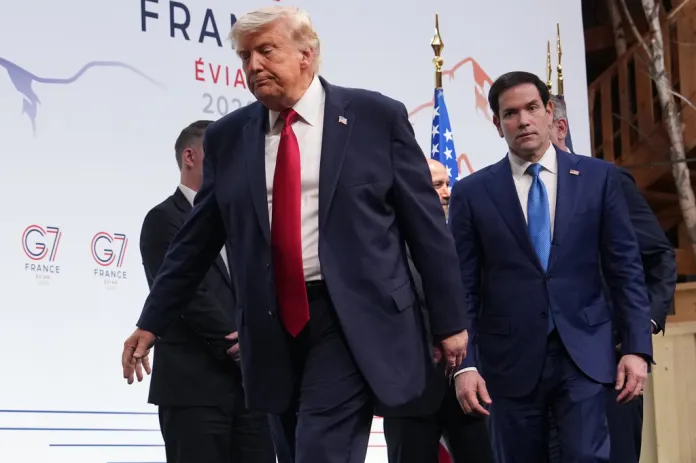
Trump echoed this sense of vague faith in Iranian sincerity during a press conference at the G7 summit that took place simultaneously with the phone conference. He told reporters that some aspects of long-term peace aren’t even mentioned in the text of the document, but will be honored upon threat of resuming the war.
“Some things aren’t even mentioned in the agreement,” Trump said. “But we have an understanding of certain things without writing it. And if they don’t honor that, we’ll probably go back to bombing them until they honor it.”
At the same conference, Trump offered a surprisingly honest assessment that the deal was necessary because the “alternative would be a worldwide depression.”
The president justified allowing Tehran to maintain its remaining ballistic missile arsenal by pointing out “other people have some” and Iranians “don’t want to be firing missiles right now” anyway.
‘Worst foreign policy blunder in decades’
Sen. Bill Cassidy (R-LA), who lost his reelection bid in the Republican primary amid opposition from Trump, called the deal “the worst foreign policy blunder in decades.”
“Iran’s nuclear ambitions were not curbed, and they have learned that threatening the Strait of Hormuz works and will undoubtedly leverage it in the future. Now, Iran gets to build brand-new infrastructure under this deal,” Cassidy said Wednesday. “Before the war, the strait was open, Iran was being crushed by sanctions, and 13 service members were still alive. Now, 13 Americans are dead, families have paid billions at the pump, sanctions will be lifted, and the bombing has stopped.”
Reza Pahlavi, the son of the last Shah and crown prince of Iran, declared it “morally wrong and strategically misguided” for the U.S. to “do a deal with a regime that murdered more than 40,000 protestors in two days in January.” He warned that any negotiated deal with the Iranian government would prove fruitless in the long-term.
“Dealing with this regime will fail and we will all face the consequences,” the crown prince said. “The regime’s 47-year war against the Iranian people continues. Just as it has never made peace with its own citizens, it will never truly make peace with the world.”
Fox News presenter Trey Gowdy, a former assistant U.S. attorney and South Carolina congressman, said he initially “didn’t believe” the text of the MOU — arguing the U.S. was holding all the leverage in the situation but is failing to gain anything with the agreement.
“We literally had our foot on their throat militarily, economically,” Gowdy said Wednesday. “We had an economic stranglehold on that country. So when you go back to the status quo ante before the blockade, how are we better off? What did we get?”
He continued: “Do you really think Iran has abandoned its nuclear ambition? Do you believe them? What do you think they are going to do with $300 billion? What are they going to do with the oil revenue? Do you think they are going to build schools? Do you think they are going to make women’s lives better? Or are they going to continue to target America and Israel? I happen to think the latter.”
One Republican lawmaker offering token support for the deal is Sen. Lindsey Graham (R-SC), who offered a lukewarm defense of “trying” to negotiate the denuclearization of the Islamic Republic.
“I just had a very lengthy and productive discussion with [Special Envoy Steve Witkoff] about the state of play regarding Iran,” Graham said Wednesday afternoon. “After this discussion, it is my opinion that signing the MOU will be beneficial to the United States, in as much as the Strait of Hormuz will begin to open, and the hostilities with Iran will stop.”
He continued: “Whether or not the United States can reach an acceptable, verifiable deal with Iran regarding its nuclear program and other issues is yet to be determined, but I see little downside to trying.”
IRANIAN COMMUNICATIONS OFFICIAL SAYS COUNTRY WILL NO LONGER HAE INTERNET BLACKOUTS, EVEN IN CRISES
Hezbollah chief Naim Qassem said in a televised address on Wednesday that the peace deal is a “great victory” for Iran.
Trump said during a bilateral meeting with Indian Prime Minister Narendra Modi on Wednesday that although he thinks the deal will proceed on time, “you never know” because “I’ve gone into deals that were 100%, and they don’t happen.”


