







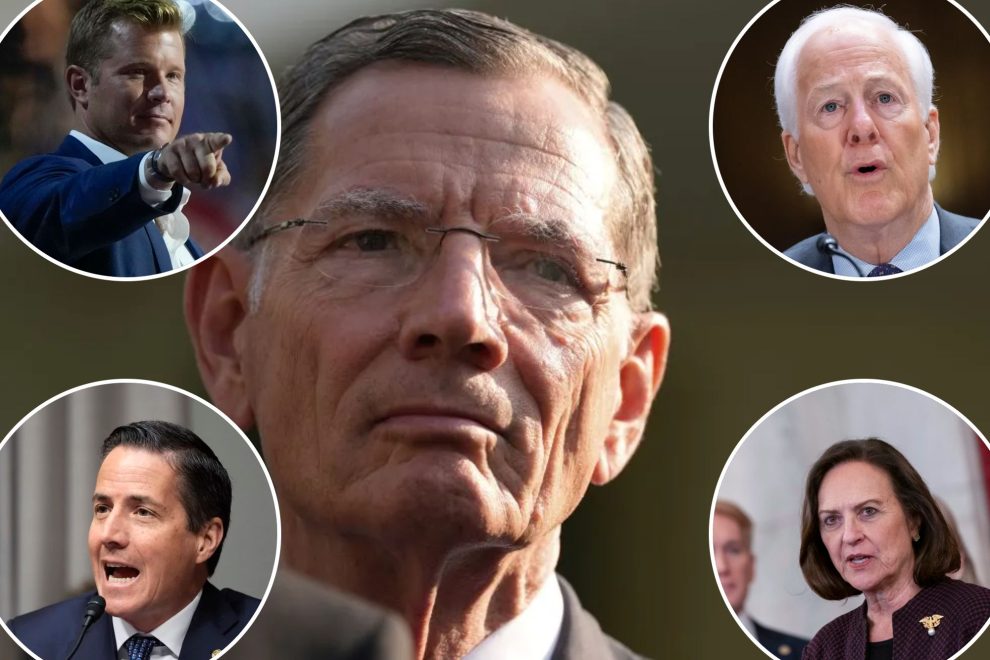
EXCLUSIVE — Sen. John Barrasso (R-WY) is counting on an eclectic group of freshmen and senior senators as he carries out one of the most difficult jobs in Washington: keeping Republicans together.
Since taking over as Senate majority whip last year, Barrasso has stacked his team with a dozen Republicans who span the ideological spectrum and reflect old and new blood within the conference.
He’s rewarded a crop of young and ambitious members, adding Sen. Tim Sheehy (R-MT), one of four first-term senators on Barrasso’s whip operation, earlier this month. At the other end are steady hands such as Sen. John Cornyn (R-TX), a former member of leadership who served for years in Barrasso’s post.
“It’s a really good team, well-connected to the entire Republican conference,” Barrasso said in a rare sitdown interview with the Washington Examiner. He opened up about how he chose new members when vacancies arose — and, more importantly, how that team wrangles votes with a narrow, three-seat majority and a mercurial president who is both the glue of the Republican Party and, at times, an agent of chaos.
THUNE SAYS TRUMP RELATIONSHIP STILL ‘STRONG’ DESPITE SAVE ACT ROUGH PATCH
Speaking of President Donald Trump, Barrasso referred to him unprompted as a member of the whip team and credited him with working the phones on difficult votes. Trump has butted heads with more centrist Republicans, but he’s repeatedly won over conservative holdouts, both when the Senate was passing his tax law last summer and as part of periodic spending fights.
“He’s been an incredibly helpful member of the whip team,” Barrasso said. “I talk to him regularly. He helps us in ways that make a difference in the outcome of the votes.”
Or put another way: “If this is a stagecoach, he’s riding shotgun.”
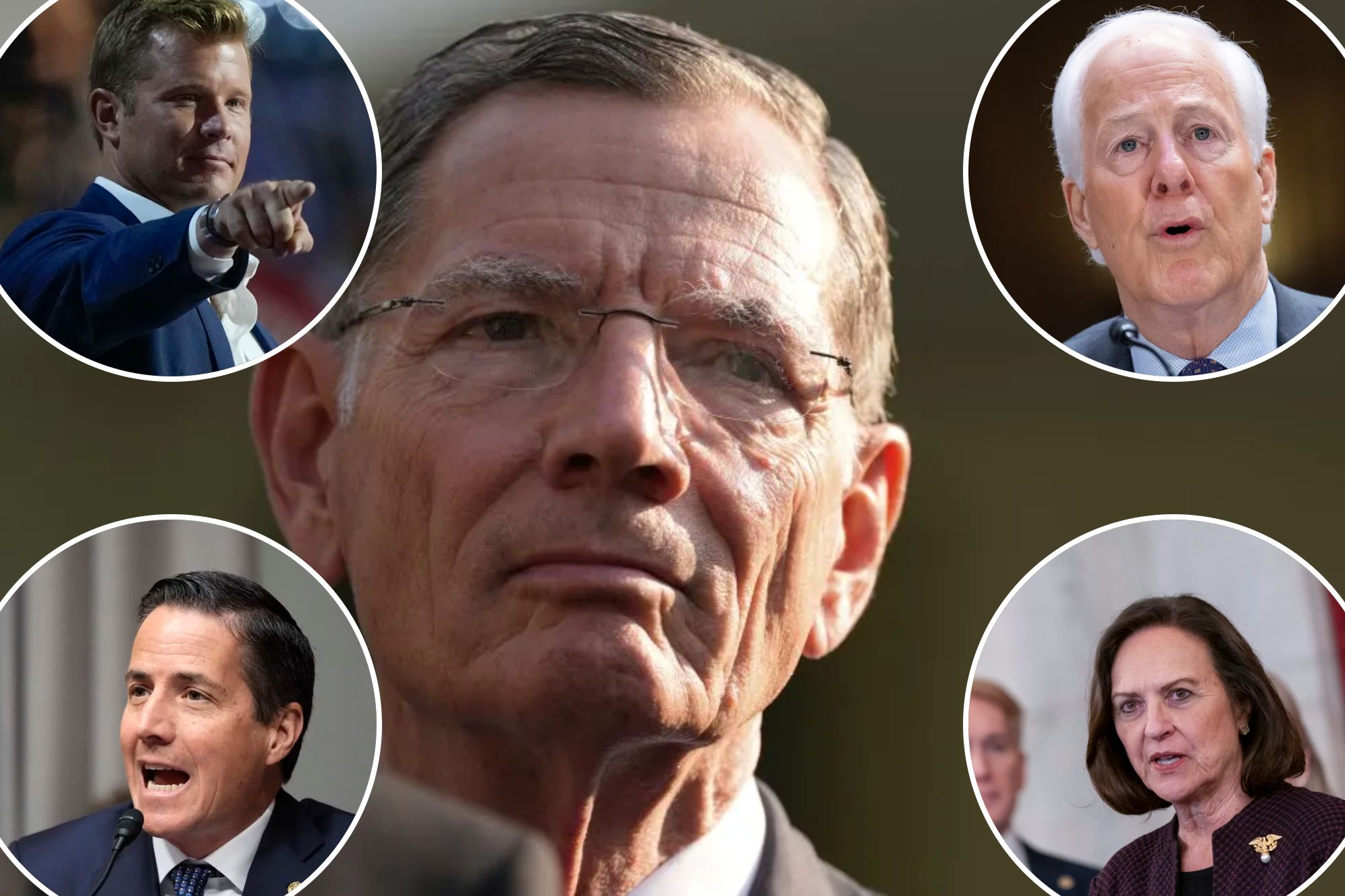
As for the official members, Barrasso’s choices signal whose stock is rising within the conference, particularly among newer senators.
He brought on Sen. Bernie Moreno (R-OH), in part, because of how he jumped in when Republicans were repealing California’s pollution rules last spring, recounting how he considered Moreno an “ex officio” member at the time due to his prior career as a luxury car dealership magnate.
When asked about Sheehy, who at 40 is the youngest GOP member of the Senate, Barrasso called him “well-spoken on the issues.”
“He’s out there,” Barrasso said. “He’s knowledgeable.”
Moreno took over for Sen. Thom Tillis (R-NC) in July, soon after Tillis announced his retirement and stepped back from the role. Sheehy is taking over for Markwayne Mullin, who left the Senate last month to serve as Trump’s secretary of homeland security.
All hands on deck
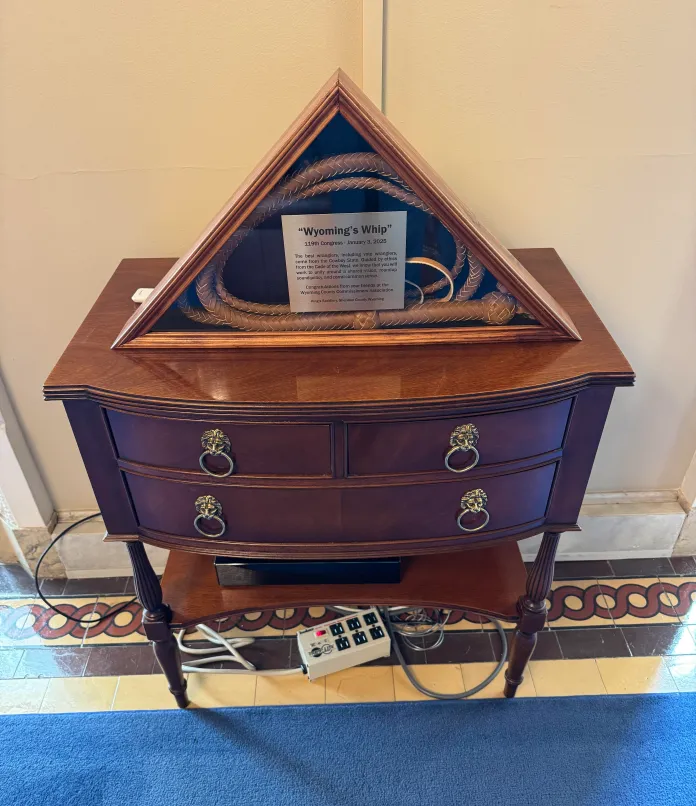
Barrasso has an actual whip on display in his leadership suite, a token of support from county commissioners in his home state of Wyoming. But he quipped that sharing the load across the 12-member team has allowed him to keep it under glass, and he spent much of the interview discussing how a division of labor has been key to getting holdouts on board with the GOP agenda.
“I joke that, as the whip, when you have 53 senators, I can get you 47 votes for anything,” Barrasso said. “We as a team can get you 47 votes for anything. The next step is to move beyond that.”
MIDTERM ELECTIONS HANG OVER SENATE ALITO SPECULATION
Much of that work boils down to sussing out members’ concerns on any given vote, a full-time job that Barrasso said is largely about listening.
“You listen more than you talk,” Barrasso said. “What’s on people’s minds? What are you hearing? What is somebody concerned about with this bill? What do they need to make sure we get it passed? And how can we make sure we get the votes we need?”
When it comes time to address those reservations, Barrasso said he keeps his rolodex close at hand, offering to connect members with someone in the administration who can speak to the particulars of a bill or help broker a compromise.
“It doesn’t necessarily have to be the president on every issue,” Barrasso said, “but it can be a Cabinet secretary or a deputy secretary or someone in the White House … whether it’s Susie Wiles or one of the folks close to the president.”
That strategy proved particularly effective in January, when five Republicans broke rank and voted to rebuke Trump’s military operation in Venezuela.
After a lobbying blitz from senior administration officials, including Secretary of State Marco Rubio, enough of those Republicans reversed course to defeat a Democrat-led effort to rein in the president’s war powers.
“People just need reassurance,” Barrasso said, running through the ramifications members weigh on any politically touchy vote. “Well, if we say this and we vote for this, what’s going to happen about this? And I mean, that’s politics and that’s how this place works.”
Sen. Deb Fischer (R-NE), one of Barrasso’s deputies, described information-sharing as one of the main duties of the job.
“Nobody’s ever pressured me, I don’t pressure people,” she said. “If people are unsure or haven’t settled on how they’re going to vote, then you try to give them the information that they have questions about.”
For a personal touch, Barrasso tries to match undecided Republicans with members of his team likely to be most persuasive. He said that Sen. Dan Sullivan (R-AK), another deputy whip, was “vital” to the all-hands-on-deck push that convinced Sen. Lisa Murkowski (R-AK), Sullivan’s home state colleague, to support the GOP tax law.
Murkowski, the deciding vote, eventually got to “yes” last July after hours of bartering that won her exemptions to the bill’s welfare reforms for Alaska.
Skill set also comes into play as Barrasso delegates to his deputies. He noted the expertise Sen. Mike Crapo (R-ID), his chief deputy, drew from when negotiating the finer details of the tax bill.
Crapo is the Senate’s top tax writer as chairman of the Finance Committee.
MIKE JOHNSON TO SKIP DEFUNDING PLANNED PARENTHOOD IN NEXT PARTY-LINE BILL
Mullin, before he left for the Department of Homeland Security, was Barrasso’s go-to deputy for keeping Senate Republicans aligned with the GOP House, owing to his strong relationships there. Barrasso said he has not named a new liaison but that Sen. Jim Banks (R-IN) is helping bridge the gap as a former House member who chaired the Republican Study Committee, the largest caucus of conservatives in the lower chamber.
“That’s a pretty significant attachment to the House,” Barrasso said.
‘Sometimes you need to just get to 50’
Keeping senators united is a challenge for any vote-counter, but especially so in Trump’s second term. Republicans are in the throes of trying to get one, and possibly two, more party-line bills passed through Congress before the end of the year and have faced near-uniform resistance from Democrats.
The first task is passing funding for immigration enforcement through reconciliation, a budget process that sidesteps the Senate filibuster. Then comes the bigger challenge of fitting a hodge-podge of priorities, including elements of Trump’s election security bill, into another reconciliation bill sometime this fall, when the midterm elections will weigh even more heavily on in-cycle incumbents.
Barrasso seems satisfied with Republicans’ relatively small margins in the Senate. Leadership can lose as many as three Republicans on any vote without Democratic help. By contrast, House Republicans have a two-vote margin in a chamber that is more than four times as large.
“It’s better than whipping with a two-vote majority, or a one-vote majority,” Barrasso said.
Still, Trump’s agenda has pushed Senate Republicans to the breaking point this Congress, and Democrats have had some success capitalizing on GOP divisions.
Republicans almost unanimously rejected a vote to rein in Trump’s war powers in Iran on Wednesday, a remarkable degree of unity considering that simpler challenges in Trump’s first term passed easily, but Democrats have managed to peel off GOP senators at times, especially when it comes to Trump’s tariffs.
THUNE WARNS REPUBLICANS AGAINST ‘COUNTERPRODUCTIVE’ FILIBUSTER VOTE
Even when Republicans are successful, Barrasso has sometimes been forced to count on Vice President JD Vance to overcome a 50-50 deadlock. So far, Vance has cast eight tie-breakers as president of the Senate.
“I’d like to get 53 on everything,” Barrasso said. “The reality is, sometimes you need to just get to 50 and have the vice president near at hand to break the tie, which is how we passed the Working Families Tax Cuts bill.”
Senate wild cards
Part of the challenge comes down to keeping Republicans in the “yes” column. When asked about Tillis, one of three GOP “no” votes on the tax law and a wild card for Pete Hegseth’s scandal-plagued nomination as war secretary, Barrasso acknowledged that Tillis’ indecision sent leadership scrambling.
“Well, the challenge that you talk about is one where somebody … that is whipped yes, I’m going to be for something, then, at the last minute, decides they’ve changed their mind and had some revelation, some decision, or heard something, or somebody called,” he said.
“You don’t want to lose that vote,” Barrasso added.
In the case of Hegseth, Tillis ultimately voted “yes,” helping round out Trump’s Cabinet at the outset of his term. Barrasso cited the speed of those confirmations, as well as a rule change that let Republicans confirm lower nominees in large batches, as major accomplishments.
“The Democrats were not helping at all,” Barrasso said. “They were slowing us down.”
Of the looming votes on reconciliation, Barrasso reiterated leadership’s position that a “very targeted” bill to fund immigration enforcement was necessary so that Republicans could quickly end a two-month shutdown at DHS.
Barrasso helped convince Trump last week to support the two-step plan, which gets around Democrats’ unwillingness to fund Immigration and Customs Enforcement after the death of two protesters in Minneapolis.
Funding other parts of the agency, including the Transportation Security Administration, will come through the regular appropriations process and is awaiting a vote in the House.
RUBIO REASSURES SENATE REPUBLICANS ON IRAN AS US PURSUES NUCLEAR DEAL
Asked about Trump’s level of involvement in reconciliation, Barrasso predicted he will play a “very important” role.
“He’ll be a member of our whip team,” Barrasso said. “Either a silent member or a vocal member, depending on exactly how we find ourselves.”


