



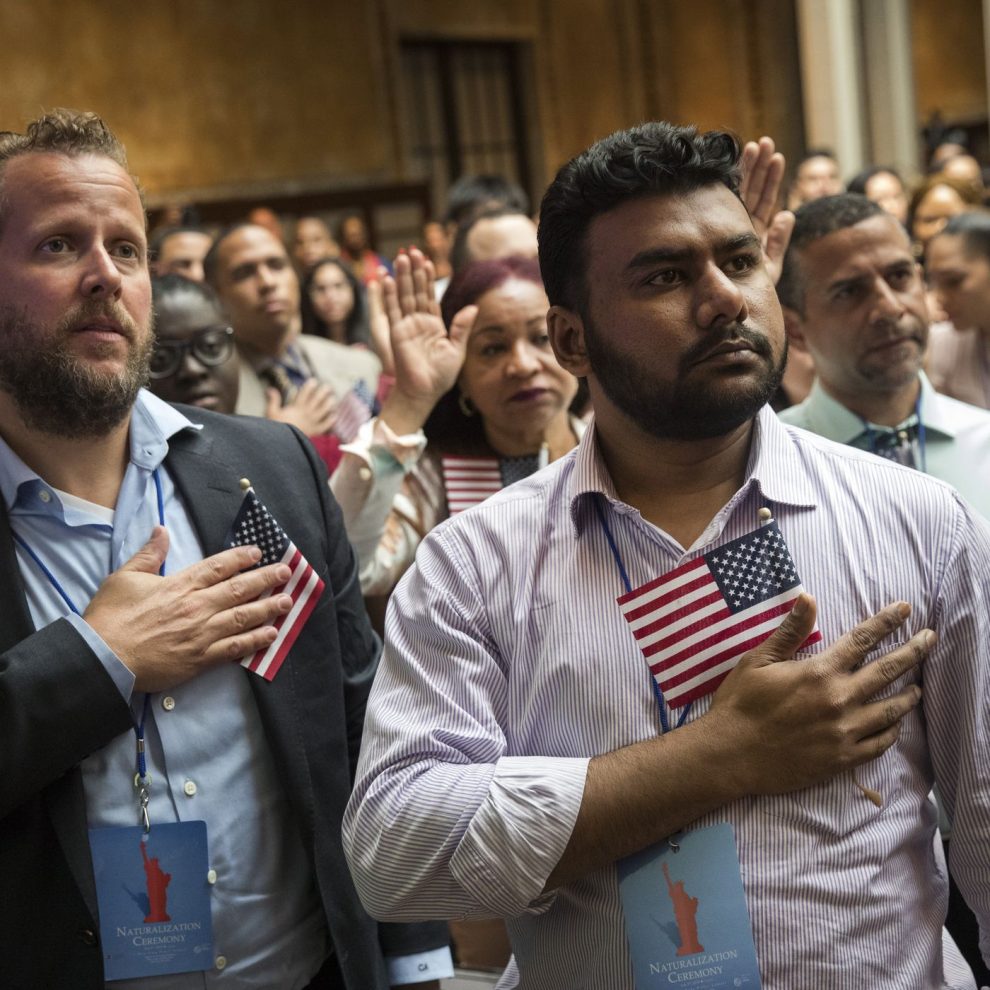
Immigrants who get tested or treated for the coronavirus will not be penalized when applying for citizenship under a public charge rule that restricts green cards for those who use taxpayer-funded services.
In a statement, the U.S. Citizenship and Immigration Services said that it is encouraging anyone with symptoms of the COVID-19 to seek medical treatment.
“Such treatment or preventive services will not negatively affect any alien as part of a future Public Charge analysis,” the agency said.
“To address the possibility that some aliens impacted by COVID-19 may be hesitant to seek necessary medical treatment or preventive services, USCIS will neither consider testing, treatment, nor preventative care (including vaccines, if a vaccine becomes available) related to COVID-19 as part of a public charge inadmissibility determination,” the agency continued.
The public charge rule went into effect last week after the Supreme Court in January allowed the Trump administration to enforce it.
Halima Salman convicted of receiving ISIS military training in Syria, faces 10 years in prison
Harley-Davidson’s Decade-Long Electric Motorcycle Initiative Has Turned Disastrous
Rock Legend Donnie Iris Dies Less Than Three Weeks After Retiring from Performing
Federal officials identify 400 noncitizens registered to vote in Washington state: ‘Tip of the iceberg’
Cassidy Hutchinson avoids indictment after DOJ effort to charge her over Jan 6 testimony fails: sources
Man accused of threatening to hijack United flight says it was a drunken joke
Watch: Outrageous Pro-El-Sayed Ad Blames Jewish State for Raising Price of Bananas, Eggs in Michigan
Haitian illegal immigrant charged in Walmart killing entered US via Biden parole program: DHS
Flavio Bolsonaro to be issued visa by State Department after fleeing Brazil
Right-Wing Presidential Candidate Flavio Bolsonaro Secretly Flees Brazil for US After Disputed Election: Report
Luxury real estate brothers sentenced to 30 years in prison for yearslong sex-trafficking scheme
Judge who apologized to accused would-be Trump assassin lights up DOJ in Hunter Biden FBI case
Jordanian Military Goes After Targets in Syria in Response to Terrorists Killing Christians
‘Beloved’ daredevils who scaled Empire State Building inching toward deal after proposal stunt: attorney
Judge slams federal prosecutors over new charges against ex-FBI officials
The rule essentially restricts immigrants entering the United States if the government believes they will rely on public assistance such as welfare or health care and housing benefits. Lower federal courts had blocked the rule from enforcing before the high court ruling.
Ken Cuccinelli, acting deputy secretary of the Department of Homeland Security, assured lawmakers last week in a closed-door briefing that immigrants seeking coronavirus testing or treatment would not be penalized.
Several Democratic lawmakers praised the USCIS announcement.
Rep. Joaquin Castro, D-Texas, called it “an important first step,” according to CQ Roll Call.
“COVID-19 does not differentiate between the wealthy and poor or immigrants and citizens – therefore, we must close any gaps in our health system so that everyone has the same access to care right now,” he said in a statement.
Halima Salman convicted of receiving ISIS military training in Syria, faces 10 years in prison
Harley-Davidson’s Decade-Long Electric Motorcycle Initiative Has Turned Disastrous
Rock Legend Donnie Iris Dies Less Than Three Weeks After Retiring from Performing
Federal officials identify 400 noncitizens registered to vote in Washington state: ‘Tip of the iceberg’
Cassidy Hutchinson avoids indictment after DOJ effort to charge her over Jan 6 testimony fails: sources
Man accused of threatening to hijack United flight says it was a drunken joke
Watch: Outrageous Pro-El-Sayed Ad Blames Jewish State for Raising Price of Bananas, Eggs in Michigan
Haitian illegal immigrant charged in Walmart killing entered US via Biden parole program: DHS
Flavio Bolsonaro to be issued visa by State Department after fleeing Brazil
Right-Wing Presidential Candidate Flavio Bolsonaro Secretly Flees Brazil for US After Disputed Election: Report
Luxury real estate brothers sentenced to 30 years in prison for yearslong sex-trafficking scheme
Judge who apologized to accused would-be Trump assassin lights up DOJ in Hunter Biden FBI case
Jordanian Military Goes After Targets in Syria in Response to Terrorists Killing Christians
‘Beloved’ daredevils who scaled Empire State Building inching toward deal after proposal stunt: attorney
Judge slams federal prosecutors over new charges against ex-FBI officials
Rep. Norma Torres, D-Calif., an opponent of the public charge rule, also commended the agency.
“I see this as a signal from the USCIS that they recognize that American lives potentially are at risk due to this public charge rule,” Torres said. “We have to encourage people to come forward. I want to make sure that everyone in the household that might have been in contact with somebody that has been infected with coronavirus is able to get tested and get treatment.”
Story cited here.


