





The federal courts are dealing with a barrage of immigration-related lawsuits, with more filed over the past year than any period in history.
The influx of tens of thousands of immigration cases just since last fall threatens to derail President Donald Trump’s illegal immigration crackdown and clog the courts.
Between March 2021 and Trump’s first few months in office, the average number of cases filed in federal court fluctuated from 500 to 1,000 cases. Last September, immigration attorneys began increasingly filing suits as the number of illegal immigrants being arrested by federal immigration authorities surged to record highs.
More than 41,000 lawsuits were filed in the 12 months leading up to March 2026, according to the Transactional Records Access Clearinghouse at New York’s Syracuse University, a nonpartisan data research center that analyzes federal immigration statistical information.
In March alone, 9,911 new lawsuits were filed in federal court and showed no sign of reversing course. The dramatic surge is “striking” and “unusual,” TRAC noted.
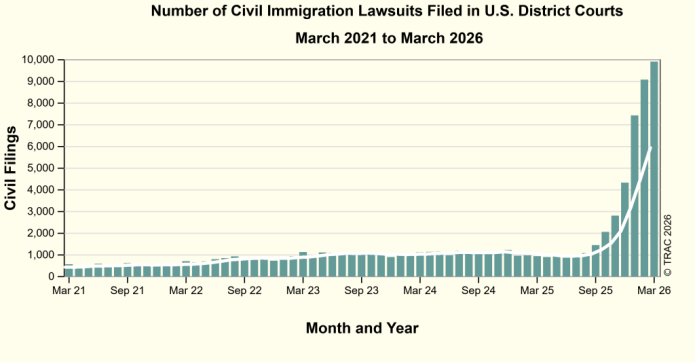
The biggest reason for the uptick in immigration-related cases filed is that illegal immigrants in U.S. Immigration and Customs Enforcement custody are increasingly choosing to file habeas corpus petitions in federal court, which is outside immigration court.
Habeas petitions are requests that a non-immigration judge order an illegal immigrant in detention to be brought before that court, as opposed to an immigration court, and the government attorney at ICE defend why that person must be detained. In effect, habeas corpus defendants claim that their detention is illegal.
Detainees have a constitutional right to file a habeas suit, and because some ICE arrests are based on administrative warrants, not judicial warrants, immigration attorneys have had success challenging the grounds for detention in many cases.
Although immigration courts are intended to decide immigration cases, habeas cases are being filed in federal court, where more sympathetic judges are often ruling that the federal government cannot detain people indefinitely without a judicial warrant.
In March 2025, 105 of the total 945 immigration civil cases filed in federal court were habeas cases. In March this year, more than 9,000 of the 9,911 cases filed that month were habeas cases.
“Habeas lawsuits increased by over 85 times during the past year, while naturalization suits were 1.8 times higher than in March 2025,” TRAC concluded.
In Minnesota, groups such as the American Immigration Council or the American Immigration Lawyers Association file a habeas petition to a federal judge, who more often than not grants temporary release to the detained immigration enforcement target.
More than 300 district judges in Minnesota and elsewhere had rejected the government’s mandatory detention policies, ordering detainees released or granted bond hearings as of earlier this spring. That has fueled a surge of copycat filings nationwide. All the while, appeals courts have yet to address whether the administration’s interpretation of the Immigration and Nationality Act comports with the law.
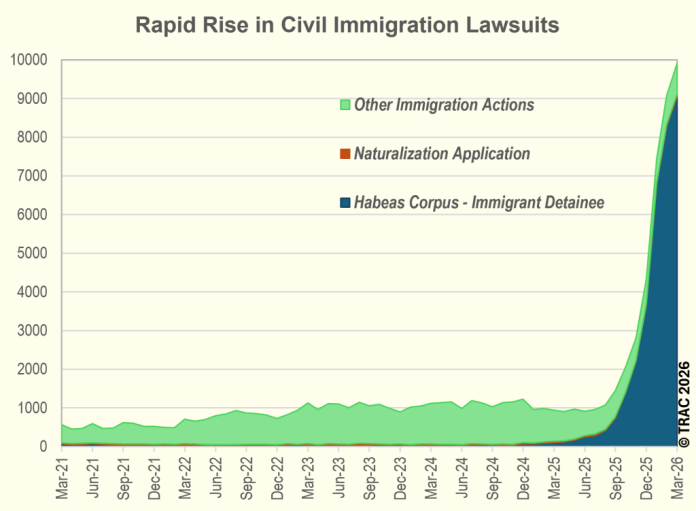
The Western District of Texas has seen more habeas cases filed than any other federal judicial district in the country. It racked up nearly 3,500 cases between October 2025 and March 2026, followed by the Eastern District of California and the Southern District of Texas.
BORDER PATROL ARRESTS IN FLORIDA QUIETLY SURGE
Andrew Arthur, resident fellow in law and policy for the Center for Immigration Studies in Washington, predicted that the legal stand-off that detainees are building between the immigration and federal courts over the government’s legal ability to detain illegal immigrants may be headed for the Supreme Court.
“[In February, a] Fifth Circuit panel concluded that under section 235(b) of the Immigration and Nationality Act (INA), DHS can hold such aliens pending removal proceedings without releasing them on bond,” Arthur wrote in a blog post. “Ignore the countless district court habeas corpus decisions saying the opposite: This question is headed to the one tribunal that matters — the Supreme Court.”


