





A proposed merger that would form the biggest local TV company the country has ever seen risks driving up monthly TV bills for tens of millions of Americans, undercutting President Donald Trump’s affordability drive ahead of the 2026 midterm elections.
The proposed merger between Nexstar Media Group and Tegna would put nearly 80% of U.S. households under one broadcaster’s reach, giving the combined company major influence over the retransmission fees that drive cable and live-TV bills.
The deal is advancing just as Trump has made affordability the centerpiece of his agenda after Republican losses in the 2025 off-year elections. But critics warn the merger, which depends on the Federal Communications Commission (FCC) loosening long-standing media ownership limits, would do the opposite by driving up monthly TV bills for tens of millions of Americans ahead of the 2026 midterm elections.
FULL LIST OF EXECUTIVE ORDERS, ACTIONS, AND PROCLAMATIONS TRUMP HAS MADE AS PRESIDENT
An industry insider put it more bluntly, calling the timing “politically baffling.”
“It seems like a bad idea to me,” the person said. “There is a lot of concern about affordability, and you’re going to hear even more of it between now and the election. Moving forward with something that raises costs isn’t a wise political move.”
Beyond the effect on consumer costs, journalists and media analysts warn the merger could trigger major newsroom consolidation and layoffs across the country, shrinking local reporting at a moment when many communities are already losing their only source of local news.
Under current federal rules, no broadcaster is allowed to own enough TV stations to reach more than 39% of U.S. households. But since June, the FCC, at the direction of Commissioner Brendan Carr, has been reviewing whether to keep, raise, or eliminate that Reagan-era ownership cap. The Nexstar-Tegna merger cannot move forward unless the agency changes that limit, making the ownership-cap review one of the most consequential and least understood regulatory decisions now underway in Washington.
In September, the FCC began its required four-year review of broadcast ownership rules and is now seeking public comment on whether limits like the national ownership cap should stay in place. Whatever the agency decides will directly determine whether the Nexstar-Tegna merger moves forward.
Nexstar already owns more than 200 stations, the largest of any broadcaster. Tegna owns 64 more. If the FCC relaxes the cap and signs off on the merger, the combined company would control 265 stations across 44 states and Washington, D.C., giving Nexstar nearly twice the national reach that current rules allow and dramatically reshaping the landscape of local television.
Supporters say cap is outdated, holding local TV back
Supporters of changing the rules say the Nexstar-Tegna merger is exposing a bigger issue: the national ownership cap itself. The FCC’s 39% limit was created decades ago, when most Americans relied on a handful of broadcast channels and the internet didn’t exist. Back then, regulators worried that too much ownership in too few hands would reduce local voices.
Today, industry groups argue the world has flipped. They say local TV stations are now competing with an entirely different set of giants, TikTok, YouTube, Netflix, and national cable networks, none of which face any ownership limits at all. Under those conditions, they argue, broadcasters are being forced to compete under rules written for a media landscape that disappeared years ago.
The National Association of Broadcasters, which is not taking a position on the Nexstar-Tegna merger, has been one of the loudest voices calling for the FCC to modernize these limits so local stations can grow, invest in newsrooms, and keep live sports accessible on free over-the-air channels.
“Local broadcasters are not asking for special treatment; we are asking for the ability to compete in today’s media landscape,” NAB president and CEO Curtis LeGeyt said in a statement provided to the Washington Examiner.
“Lifting the arbitrary 39% limit … will allow station groups to invest in local journalism, sports rights and the technology that keeps communities informed during emergencies, especially in smaller markets,” he added.
TRUMP ADVISES THAT ANYONE BURNING AMERICAN FLAG WILL BE IMPRISONED FOR A YEAR
In an interview at the Milken Institute earlier this year, FCC Chair Brendan Carr echoed those concerns, calling the national ownership cap “an arcane, artificial limit” that prevents local broadcasters from competing on equal footing with tech and streaming giants. Carr argued the rules were built for “a media marketplace that no longer exists,” and said modernizing them would help sustain local reporting at a time when many communities are losing their last remaining news sources.
NAB notes newspapers continue to shut down at a rapid pace, leaving many communities with no local reporters. They say broadcast stations are increasingly the only source of vetted, on-the-ground journalism, but can’t expand or share resources across markets because of ownership caps written for the analog era.
The FCC’s broader review of media ownership rules, now underway, will determine whether those limits stay in place. That decision will directly affect whether the Nexstar-Tegna merger is allowed to move forward.
A merger that could mean higher TV bills
A combined Nexstar-Tegna would command enormous leverage in one of the most sensitive parts of the TV business: retransmission fees, the payments cable, satellite, and live-TV streaming providers must pay local stations to carry their channels. Those fees aren’t absorbed by the companies; they are passed directly onto customers’ monthly bills.
Those fees have exploded in recent years. According to an American Television Alliance analysis, broadcasters are now charging customers 2,000% more for “free” over-the-air TV than they did in 2010, even though far fewer people are actually watching broadcast channels today. The average household went from paying about $1.47 a month in retransmission fees to about $21.71, a massive jump that outpaces almost anything else in the economy.
At the same time, consolidation has accelerated. In 2011, the five largest station owners controlled 128 stations. Today, they control nearly 700. As ownership has concentrated, retransmission fees have soared by more than 1,300%, increases that land squarely on consumers.
POLITICAL VIOLENCE ON THE RISE IN THE US: A TIMELINE OF KEY INCIDENTS
Blackouts, when negotiations break down and broadcasters pull their channels, have also surged. There have been more than 2,400 blackouts since 2010, cutting viewers off from news, sports, and major events. They almost always end the same way: with higher fees that customers ultimately pay.
What the companies tell Wall Street
Sinclair, one of the largest station groups in the country, told investors this fall that large-scale consolidation across the broadcast industry would unlock $600 million to $900 million in annual “synergies,” with the biggest gains coming from “distribution revenue optimization.” In plain terms, analysts say, that means higher retransmission fees.
Sinclair has also signaled it wants to take part in this wave of consolidation. The company is widely reported to be exploring a major transaction, potentially with E.W. Scripps, underscoring just how financially attractive the post-merger landscape could be for big station owners.
On its quarterly earnings call, Nexstar told investors the Tegna deal would produce roughly $300 million a year in combined savings and new revenue. The company’s CFO added that in broadcast mergers, nearly half of the expected “synergies” usually come from net retransmission revenue, the money broadcasters earn from carriage agreements with cable, satellite, and live-TV streaming providers. Nexstar never said those fees would increase, but the comments made clear that a major share of the financial benefit from the merger is tied to retransmission-related revenue.
Merged Nexstar-Tegna would intensify price pressures, experts say
A communications-industry insider said a merged company controlling two or even three of the major network affiliates in dozens of markets would have “outsized power” in fee negotiations.
“If you’re a cable or streaming provider and [Nexstar owns] two or three major stations in your city, you can’t lose all of them at once, your customers would revolt,” the insider said. “That kind of leverage inevitably drives prices up, and consumers pay the difference.”
A broadcast law attorney agreed, noting that when one owner controls multiple Big Four affiliates in a market, “the threat isn’t losing one major network, it’s losing two.” Providers, he said, “have no real alternative,” and higher fees trickle down to households because “that’s how the system is designed.”
Consumers won’t see any of this happening. Retransmission contracts are confidential, and providers rarely break out which stations are responsible for increases. Lines labeled “broadcast TV fee” reveal nothing about why the amount changes or who set it.
“Most people aren’t going to know why their bill went up,” the attorney said. “The agreements are confidential, the increases are buried in line items, and to the average viewer, the whole process is completely opaque.”
DEMOCRATS NEED TO TEMPER THEIR EXPECTATIONS OF A 2026 BLUE WAVE
He summed up the dynamic this way: “The big get bigger. And when they get bigger, they get more leverage. That leverage translates into higher fees, and those fees show up on your bill.”
Nexstar disputes the idea that consolidation will drive up viewers’ bills. In a statement provided to the Washington Examiner, the company said the content its stations provide “includes valuable programming for cable, satellite, and streaming platforms — live sports, including the Olympics and NFL, popular prime-time entertainment shows, and local news and weather reports, and the fees we charge are commensurate with that value and the marketplace.”
Newsroom turmoil: Merger threatens local journalism
When Nikki Davidson joined WOI-TV in Des Moines in 2014, the station had just been swept into Nexstar’s latest buyout from Citadel. As a weekend anchor and weekday reporter, she immediately noticed how the newsroom shifted under its new corporate owner. Within days, she said, staff had already given Nexstar a nickname that stuck: “Death Star.”
Davidson said the newsroom’s early optimism didn’t last. Reporters were expected to produce more stories with fewer people, overtime was discouraged as workloads increased, and staffing cuts meant many journalists were covering assignments alone.
“Good journalism takes time, and nobody had time,” she said. “When you’re juggling multiple stories a day by yourself, being thorough becomes almost impossible.”
HEGSETH SLAMS BIDEN’S ‘KID GLOVES APPROACH’ TO NARCO-TERRORISM IN DEFENSE OF DRUG BOAT STRIKES
The pressure took a toll. Despite anchoring, reporting, and routinely landing lead stories, Davidson said she went into debt and ultimately left for a higher-paying job six hours away. She now works as an independent journalist. “I loved local news, but the system made it unsustainable,” she said.
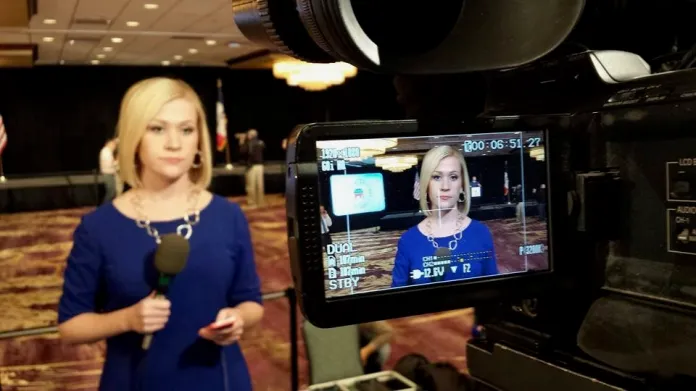
Her willingness to speak openly is rare. Many TV journalists are locked into strict contracts and noncompete clauses that can require thousands of dollars to break, leaving them fearful of challenging the country’s largest station owner.
“Everyone talks about these problems in private,” Davidson said. “But when one company owns so much of the industry, people worry about their careers if they speak up.”
Her experience reflects a broader pattern that has followed Nexstar acquisitions for more than a decade. When Nexstar bought Newport Television’s stations in 2012, layoffs followed in Salt Lake City, Little Rock, and Syracuse, eliminating entire departments at some stations and cutting veteran staff with decades of experience. Similar reductions hit KLRT, KARK, and WSYR, where consolidation meant fewer photographers, fewer editors, and a heavier workload for those who remained.
In late 2024, Nexstar confirmed a company-wide workforce reduction of 2%, roughly 260 jobs, with the bulk of cuts again concentrated in its local television stations. “While it is difficult to make these sorts of changes … they will impact less than 2% of our workforce,” the company said at the time.
Davidson worries the proposed Nexstar–Tegna merger would replicate that pattern on a national scale. “You can’t stretch newsrooms thinner and pretend the journalism won’t suffer,” she said. “Communities will feel the impact.”
Concerns about working conditions have also surfaced in filings before federal regulators. In an Aug. 5 submission to the FCC, the National Association of Broadcast Engineers and Technicians and the Communications Workers of America said a survey of Nexstar employees painted a troubling picture. According to the filing, a majority of respondents reported earning less than a living wage for their metro area, many said they rely on family help or public assistance to get by, and more than half said they had delayed medical treatment or buying groceries because they could not afford them.
Nexstar strongly disputes the idea that consolidation harms newsroom quality or working conditions. In a statement, spokesman Gary Weitman said the company “has a lengthy track record of providing attractive, competitive compensation packages and safe, secure working environments for our employees, including those represented by unions.” He said Nexstar intends to “protect and preserve local broadcast journalism as a critical element” of its programming and argued that the company’s scale allows it to invest in local newsrooms, technology, and community-focused reporting.
TRUMP PARDONS AND COMMUTATIONS: NOTABLE ACTS OF CLEMENCY IN HIS SECOND TERM
Weitman said Nexstar’s growth strengthens, rather than undermines, the journalism its stations provide, pushing back on suggestions that the company’s expansion is detrimental to reporters or viewers.
Where things stand
Carr said in October that the commission had made no final decision on whether to lift the national ownership cap, the move required for the merger to proceed.
The stakes around that decision have only grown. Carr is scheduled to testify before the Senate Commerce Committee on December 17, where lawmakers in both parties are expected to press him on the ownership-cap review as well as his recent demand that ABC suspend Jimmy Kimmel Live! over comments about conservative activist Charlie Kirk. That move drew bipartisan criticism for appearing to use regulatory power in a speech dispute, an unusual controversy to surface amid an ownership review.
President Donald Trump has also expressed unease with loosening ownership limits. In a recent Truth Social post, he warned that changing the cap could strengthen networks he frequently criticizes.
For now, the merger is in a holding pattern while regulators work through the formal review process. The FCC has set its deadlines, challenges to the deal are due by December 31, replies by late January, and only after that will commissioners start weighing the full record. The agency hasn’t given any hint of when it will make a final call, and these decisions often take time once the comment window closes.
TRUMP SIGNALS CAUTION ON RAISING MEDIA OWNERSHIP LIMITS
The Justice Department is also reviewing the deal on the antitrust side, but it hasn’t released a public timeline either. Both agencies have to sign off before anything can move forward.
The Washington Examiner has reached out to both the FCC and the White House for comment.
The FCC’s decision early next year will determine far more than whether one merger goes forward. If regulators lift the ownership cap, Nexstar’s takeover of Tegna becomes possible and could reshape the economics of local broadcasting for years. If they do not, the deal collapses immediately and the debate over media consolidation shifts back to Congress, where members of both parties are already signaling interest in tighter oversight. Either way, the decision will be felt on monthly bills, in local newsrooms, and across the political fight lines heading into 2026.


