Despite the lopsided losses suffered by Iran in its war with the United States and Israel, Iran was able to hold its own through economic damage inflicted through its blockade of the Strait of Hormuz. But this strategy has a short shelf life. When Iran implemented its blockade of the strait in March, the seaborne […]
Despite the lopsided losses suffered by Iran in its war with the United States and Israel, Iran was able to hold its own through economic damage inflicted through its blockade of the Strait of Hormuz. But this strategy has a short shelf life.
When Iran implemented its blockade of the strait in March, the seaborne trade of one-fifth of the world’s oil ground to a halt, triggering economic chaos around the world. This “energy card” proved to be Iran’s ace in the hole and forced Washington to switch its war aims from the maximalist demands of regime change in the opening days of the conflict to the more reserved nuclear negotiations and desperate attempts to restore the status quo of the strait.
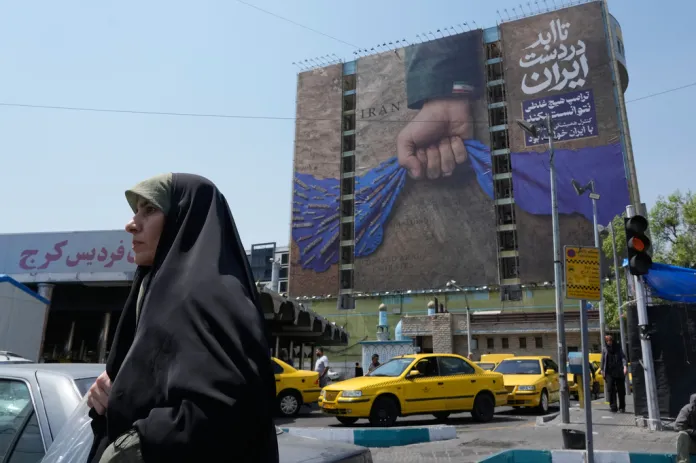
” data-large-file=”https://conservativemodern.com/wp-content/uploads/2026/07/how-long-can-iran-play-its-energy-card.webp” src=”https://conservativemodern.com/wp-content/uploads/2026/07/how-long-can-iran-play-its-energy-card.webp” alt=”Iran Hormuz” class=”wp-image-4648189″ srcset=”https://conservativemodern.com/wp-content/uploads/2026/07/how-long-can-iran-play-its-energy-card-2.webp 1024w, https://conservativemodern.com/wp-content/uploads/2026/07/how-long-can-iran-play-its-energy-card-2.webp?resize=300,200 300w, https://conservativemodern.com/wp-content/uploads/2026/07/how-long-can-iran-play-its-energy-card-2.webp?resize=768,512 768w, https://conservativemodern.com/wp-content/uploads/2026/07/how-long-can-iran-play-its-energy-card-2.webp?resize=150,100 150w, https://conservativemodern.com/wp-content/uploads/2026/07/how-long-can-iran-play-its-energy-card-2.webp?resize=696,464 696w” sizes=”(max-width: 1024px) 100vw, 1024px”>A woman walks past a billboard that shows a graphic depicting a military personnel’s hand holding the Strait of Hormuz in his fist with signs which read in Farsi: “In Iran’s hands forever,” “Trump couldn’t do a damn thing,” “The control of Strait of Hormuz will be Iran’s forever,” in Vanak Square, in northern Tehran, Iran, Thursday, April 16, 2026. (AP Photo/Vahid Salemi)
However, subsequent developments have begun to counteract this strategy and could render it almost useless within a year.
The Gulf’s current overland capacity
At the start of the war, only two overland pipelines allowed the Gulf countries to transport oil and gas overland, bypassing the Strait of Hormuz, one in Saudi Arabia and the other in the United Arab Emirates.
The longest and largest, Saudi Arabia’s Petroline, was built during the Iran-Iraq War of the 1980s to avoid the scenario playing out in the current war. The pipeline crosses 750 miles across the country east to west, and before the war, could transport 5 million barrels per day. After the strait was closed, the country converted a gas pipeline to transport crude oil, boosting Saudi Arabia’s overland oil transport to 7 million bpd.
The UAE relies on a single pipeline to bypass the strait — the Habshan-Fujairah pipeline — completed in 2012, and which can transport up to 1.8 million barrels per day. The UAE’s gas and oil-rich regions are located on the western side of the country, so most of its shipping naturally occurs in western ports such as Dubai. The 235-mile-long pipeline transports oil and gas through the desert to the Port of Fujairah on the Gulf of Oman.
The UAE began construction on a second pipeline before the war, but the closure of the strait added new urgency at a May board meeting, Abu Dhabi Crown Prince Sheikh Khaled bin Mohamed bin Zayed instructed the state-owned Abu Dhabi National Oil Company to fast-track the construction of a second pipeline to transport oil and liquified natural gas overland to ports in the east of the country, located beyond the strait. The West-East pipeline is now expected to be completed sometime next year.
Under the OPEC quota, the UAE produced 3.2 million to 3.6 million barrels per day — nearly all of which can be transported through the two oil pipelines once the second is complete. However, the country left the organization in May, and its new target for 2027 is around 5.2 million bpd. The increased production means the country will need to build a third pipeline to ship its full capacity overland, something UAE Minister of Foreign Trade Thani Al Zeyoudi toldBloomberg will soon be underway. He also said in the May interview that the UAE was moving to cut its reliance on the strait to “zero.”
On Monday, the Financial Times reported that DP World, the UAE’s flagship port operator, was constructing a port and a container terminal in Fujairah on its eastern coast, the receiving end of its pipelines, shifting much of its port capacity beyond the strait. The country’s primary container port, Jebel Ali on the western coast, dropped to 5%-10% of its prewar activity after the war started.
Iran’s energy card timeline
Hussain Abdul-Hussain, a research fellow at the Foundation for Defense of Democracies with a focus on the Gulf, put the completion of this UAE pipeline — sometime in 2027 — as the timeline for when Iran’s energy card will begin to run out.
Before the war, 20 million barrels of oil passed through the strait per day. Seven million bpd already flows through Saudi Arabia’s Petroline. Another 1.8 million bpd flows through the UAE’s Habshan-Fujairah pipeline. Iraq currently sends 250,000 bpd through its Kirkuk-Ceyhan Oil Pipeline, which goes through Turkey to the Mediterranean.
Iraq is currently looking at reviving its Kirkuk-Baniyas pipeline, which was constructed in 1952 and passes through Syria but has long since fallen into disuse.
“The Iraqi Prime Minister Zaidi is about to sign on the repair and revival of this pipeline. If this happens, and which can be fairly soon, because this only needs repair — it’s not like you’re building anything. This will allow Iraq to send 1 million barrels, circumventing Hormuz,” Hussain told the Washington Examiner.
While much better than before, this is still a fraction of Iraq’s 4.2 million-4.3 million bpd output. Hussain suggested Baghdad will probably seek to build more pipelines to the Mediterranean to further reduce its reliance on the strait.
The second UAE pipeline will add another 1.8 million bpd overland throughput. Hussain speculated that a third pipeline will be coming soon and expedited with Kuwait’s help.
“I think the Emiratis will do their best to help out the Kuwaitis. The two governments have become really close over the past year, and especially in the four and a half months since the start of the war with Iran,” he said. Hussain reasoned that the UAE is likely to help the Kuwaitis send some of their oil through the extended pipeline, sparing some capacity for Kuwaiti use in exchange for royalties, then push through the third pipeline.
“If Hormuz continues being like this … I wouldn’t be surprised if … the Kuwaitis are now in talks with the Emiratis to build this pipeline,” he said.
The Strait of Hormuz is the only waterway connecting the Persian Gulf with the wider ocean, and has become a critical choke point in the war with Iran. (Grace Hagerman/Washington Examiner)
Zeyoudi has already said a third pipeline is in the works, and with Kuwait’s backing, the construction process could be expedited. The second pipeline, due to be completed next year, goes from Abu Dhabi in the northwest to Fujairah in the east, but Hussain speculated the new pipeline is likely to begin in Dubai, where the UAE’s main port can take oil traffic in, and travel east across a much shorter route. Taking the time spent constructing the second pipeline and subtracting some distance, Hussain clocked the most likely timeline to construct the third pipeline as one year.
Assuming the third pipeline will have the same capacity as the other two, the UAE could begin exporting 5.4 million bpd overland around the strait next year if construction begins soon.
By mid-2027, the Gulf states could collectively be sending 13.4 million bpd overland around the strait, a substantial enough amount to relieve the crippling pressure on energy markets. In the worst-case scenario where the Iraqi and third UAE pipelines aren’t completed in time, the Gulf will still be exporting 11.2 million bpd.
While not reaching the prewar totals of 20 million bpd, 13.4 million bpd is “good enough for the market,” Hussain said.
“Instead of having the Brent [crude oil] jump to $130 and $140, it’ll probably be around $75 or $80,” he reasoned, compared to the $65 prewar figure.
By mid-2027, the Gulf countries will at the very least have enough overland pipelines to lessen the Strait of Hormuz blockade’s impact to the extent that the global economy can weather the shock without major issue. This gives Tehran roughly a year to use its best card against the U.S., after which it won’t be able to exercise any decisive leverage against its adversary.








</p>
<p> ” data-large-file=”https://conservativemodern.com/wp-content/uploads/2026/07/how-long-can-iran-play-its-energy-card-1.webp” src=”https://conservativemodern.com/wp-content/uploads/2026/07/how-long-can-iran-play-its-energy-card-1.webp” alt=”A map showing the location of the Strait of Hormuz.” class=”wp-image-4529054″ srcset=”https://conservativemodern.com/wp-content/uploads/2026/07/how-long-can-iran-play-its-energy-card-3.webp 1024w, https://conservativemodern.com/wp-content/uploads/2026/07/how-long-can-iran-play-its-energy-card-3.webp?resize=300,200 300w, https://conservativemodern.com/wp-content/uploads/2026/07/how-long-can-iran-play-its-energy-card-3.webp?resize=768,513 768w, https://conservativemodern.com/wp-content/uploads/2026/07/how-long-can-iran-play-its-energy-card-3.webp?resize=150,100 150w, https://conservativemodern.com/wp-content/uploads/2026/07/how-long-can-iran-play-its-energy-card-3.webp?resize=696,465 696w” sizes=”(max-width: 1024px) 100vw, 1024px”><figcaption class=) The Strait of Hormuz is the only waterway connecting the Persian Gulf with the wider ocean, and has become a critical choke point in the war with Iran. (Grace Hagerman/Washington Examiner)
The Strait of Hormuz is the only waterway connecting the Persian Gulf with the wider ocean, and has become a critical choke point in the war with Iran. (Grace Hagerman/Washington Examiner)


