







Multiple countries in the Middle East have been the targets of retaliatory airstrikes led by Iran and its proxies following the joint U.S.-Israeli operation against the Islamic regime over the weekend.
In response, several Persian Gulf states have condemned Iran and threatened the mobilization of forces to thwart further attacks and safeguard their own security. While none have formally entered the conflict, some have shot down aerial projectiles launched by Iran.
Monday morning, Qatar shot down two Iranian jets, marking the first time a country has shot down aircraft rather than just missiles. The Qatari Foreign Ministry said it downed two Iranian SU-24 bombers, as well as seven ballistic missiles and five drones.
Qatar, Saudi Arabia, Kuwait, Bahrain, and the United Arab Emirates have all been attacked by Iran in some capacity. These countries contain U.S. bases or forces in the region.
Iran’s aerial attacks have largely been concentrated in the UAE. According to Israeli political analyst Amit Segal, 63% of Iranian ballistic missiles were aimed at the global tourist destination. Despite the large amount of enemy fire, the UAE has been very successful in intercepting the missiles.
Among the most notable cities that came under Iranian fire was Dubai, where hundreds of attack drones and ballistic missiles damaged a luxury hotel and the nearby airport. At least three people — foreign nationals from Pakistan, Nepal, and Bangladesh — were killed in the UAE. At least another 58 casualties were wounded in the country.
Hundreds more were injured across the Middle East at the hands of Iran.
The UAE swiftly denounced Iran’s retaliatory strikes, warning that “any infringement on the sovereignty of any state constitutes a direct threat to the security and stability of the entire region.” Saudi Arabia took its response one step further, saying it would “mobilize all its capabilities to assist [neighboring countries] in any measures they undertake.”
Their alliance is notable, considering the Saudis and Emiratis have been at odds over divergent economic interests and foreign policies. The two nations now find themselves aligned against Iran at a time of crisis for the region.
Similarly, Qatar affirmed its right to respond with force under international law after Iran damaged its civilian and energy infrastructure and claimed civilian casualties. Although there are no confirmed deaths in Qatar, at least 16 people have been wounded.
Beyond civilian and energy infrastructure, the Iranian military focused its attacks on regional U.S. bases in Bahrain and Kuwait.
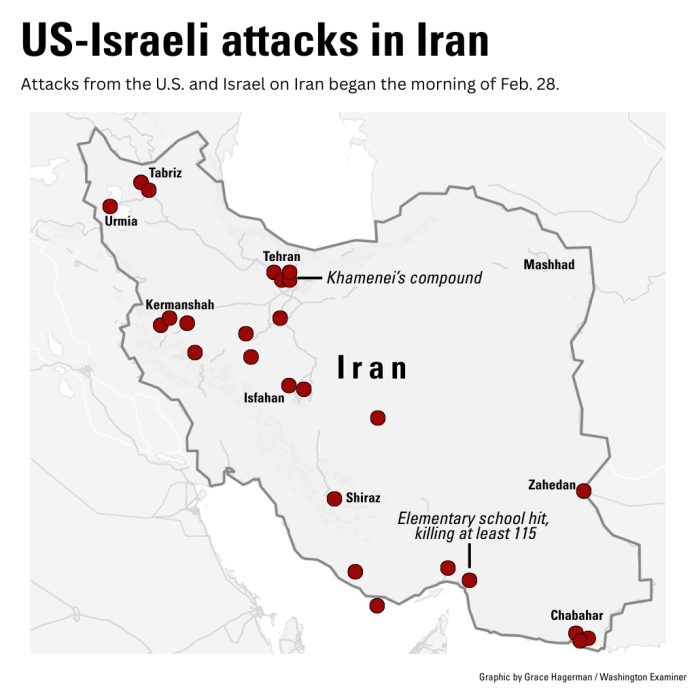
At least four U.S. troops have died so far, according to U.S. Central Command. Joint Chiefs of Staff Chairman Gen. Dan Caine said “additional losses” should be expected as the campaign against Iran continues for the next few weeks.
Hezbollah joined Iran in launching retaliatory strikes toward Israel, killing at least 11 people. The Jewish state deployed strikes in return against the Lebanon-based terrorist group, resulting in an estimated 31 deaths.
As a result, the Lebanese government banned Hezbollah from launching further strikes and conducting “military activities” as the joint U.S.-Israeli strikes continue to unfold.
DAN CAINE SAYS ADDITIONAL FIREPOWER HEADED TO MIDDLE EAST AND HEDGES OPERATION TIMELINE
While monitoring its airspace for enemy breaches, Kuwait mistakenly shot down three U.S. F-15 fighter jets. Caine said the incident involving friendly fire is under investigation.
Bahrain also activated its air defense systems to intercept Iranian missiles and drones. The country severed ties with Iran a decade ago, so it is no friend to the Islamic regime.


