






Democrats spent months debating why Republicans appeared to have an advantage in the digital media ecosystem following their disastrous 2024 election performance.
Party operatives argued that conservatives had built an expansive network of podcasts, livestreams, and online personalities capable of reaching voters who had tuned out traditional political messaging. Joe Rogan, at one point a supporter of Sen. Bernie Sanders (I-VT) who backed President Donald Trump in the run-up to 2024, became the most recognizable symbol of that phenomenon, instigating a growing debate inside Democratic circles over whether the party had its own influential digital voice, or whether it needed one.
Increasingly, that conversation has centered on progressive streamer Hasan Piker.
</p>
<p> ” data-image-caption=”</p>
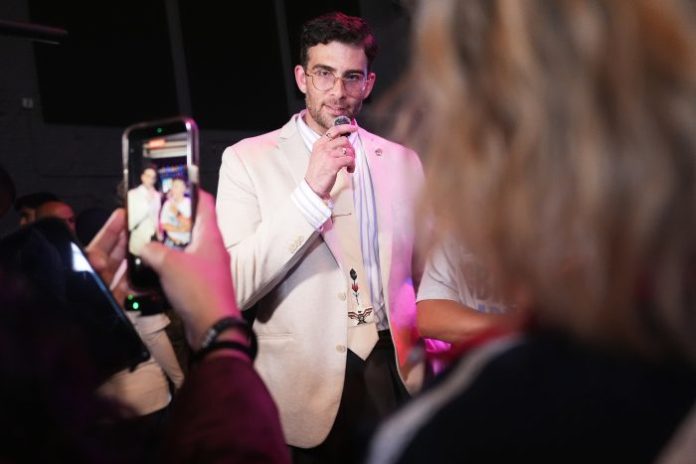
<p>Hasan Piker speaks during a primary election night event for Abdul el Sayed, a progressive candidate in the Democratic primary for U.S. Senate in Michigan, Tuesday, Aug. 4, 2026, at the Majestic Theatre in Detroit. (AP Photo/Julia Demaree Nikhinson)</p>
<p> ” data-large-file=”https://conservativemodern.com/wp-content/uploads/2026/08/hasan-piker-becomes-both-a-democratic-kingmaker-and-political-liability.jpg” src=”https://conservativemodern.com/wp-content/uploads/2026/08/hasan-piker-becomes-both-a-democratic-kingmaker-and-political-liability.jpg” alt=”Hasan Piker speaks during a primary election night event for Abdul El-Sayed, a progressive candidate in the Democratic primary for U.S. Senate in Michigan, Tuesday, Aug. 4, 2026, at the Majestic Theatre in Detroit. (AP Photo/Julia Demaree Nikhinson)” class=”wp-image-4675570″ srcset=”https://conservativemodern.com/wp-content/uploads/2026/08/hasan-piker-becomes-both-a-democratic-kingmaker-and-political-liability-2.webp 700w, https://conservativemodern.com/wp-content/uploads/2026/08/hasan-piker-becomes-both-a-democratic-kingmaker-and-political-liability-2.webp?resize=300,200 300w, https://conservativemodern.com/wp-content/uploads/2026/08/hasan-piker-becomes-both-a-democratic-kingmaker-and-political-liability-2.webp?resize=150,100 150w, https://conservativemodern.com/wp-content/uploads/2026/08/hasan-piker-becomes-both-a-democratic-kingmaker-and-political-liability-2.webp?resize=696,464 696w” sizes=”(max-width: 700px) 100vw, 700px”><figcaption class=) Hasan Piker speaks during a primary election night event for Abdul el Sayed, a progressive candidate in the Democratic primary for Senate in Michigan, Tuesday, Aug. 4, 2026, at the Majestic Theatre in Detroit. (AP Photo/Julia Demaree Nikhinson)
Hasan Piker speaks during a primary election night event for Abdul el Sayed, a progressive candidate in the Democratic primary for Senate in Michigan, Tuesday, Aug. 4, 2026, at the Majestic Theatre in Detroit. (AP Photo/Julia Demaree Nikhinson)With millions of followers across Twitch, YouTube, and other social media platforms, Piker has become one of the most recognizable figures in progressive online media. His interviews, livestreams, and political commentary have attracted a loyal following among younger voters, making him an increasingly appealing stop for Democratic candidates hoping to reach audiences that consume little traditional news.
That influence was on display during Michigan’s Democratic Senate primary, in which Piker campaigned alongside eventual nominee Abdul el Sayed. After el Sayed’s victory, Piker forcefully defended the candidate against critics who questioned his electability and accused opponents of unfairly targeting him.
“Like everyone being like, ‘Abdul has a f*** ton of work to do mending bridges,’ here’s the f***ing take nuke for you, OK? You are all unbelievably Islamophobic pieces of s***,” Piker said during a Twitch livestream. “You literally called the dude a f***ing terrorist for months on end … when he has, like, two f***ing degrees.”
The remarks underscored both Piker’s appeal and the challenge he presents for Democrats. His unapologetic style connects with supporters who see him as an authentic voice unconstrained by party talking points. To critics, however, that same rhetoric reinforces concerns that Democrats risk associating themselves with a person whose confrontational style could alienate moderate voters.
“You are who your friends are, and Abdul El-Sayed’s are radical leftists who hate America,” former Republican Rep. Mike Rogers, who was uncontested in the Michigan GOP primary, posted on social media Wednesday. He will face el Sayed in November.
The divide has become increasingly visible inside the Democratic Party itself as well.
Rep. Brad Schneider (D-IL), co-chairman of the Congressional Jewish Caucus and chairman of the centrist New Democrat Coalition, has described Piker as an “unapologetic antisemite” and argued that Democrats should not elevate his platform. Rep. Haley Stevens (D-MI), el Sayed’s opponent, criticized progressive rivals for appearing with Piker during Michigan’s Senate primary, contending that such associations make it more difficult to compete in swing-state general elections. Sen. Elissa Slotkin (D-MI) has also criticized efforts to integrate Piker into Democratic campaign events, while Sen. John Fetterman (D-PA) has repeatedly warned the party about embracing what he has described as the online “dirtbag Left.”
Veteran Democratic strategist James Carville has been among the party’s most outspoken critics, warning that if Piker became one of the defining voices of the Democratic Party, he would no longer recognize the coalition he helped build. Yet others argue Democrats risk making the opposite mistake by rejecting one of the few progressive media figures capable of reaching millions of younger voters.
“Many Democrats spent all of 2025 complaining that they didn’t have a Joe Rogan, and now that a streamer with millions of young viewers has actually shown up, half the party wants to throw him out of the tent,” said Thom Hartmann, a political analyst, nationally syndicated progressive radio host, and author of the forthcoming book, Who Killed the American Dream?: The Greatest Political Crime Ever Told.
Hartmann points to el Sayed’s Michigan primary victory as evidence that online engagement can translate into political momentum.
“Abdul el Sayed, who held campus rallies with Piker and got outspent by more than 8 to 1, beat the candidate Washington picked,” Hartmann told the Washington Examiner. “Nobody’s voting for Marx or for Hasan Piker for king. They’re voting for a raise and Medicare for all.”
James Christopher, a Democratic strategist, believes both sides of the debate risk oversimplifying the issue.
“Hasan Piker may help Democrats reach younger voters, but treating him as the party’s answer to Joe Rogan illustrates why many political communications campaigns fail,” Christopher said.
Christopher argues authenticity, not campaign spending, is what gives digital personalities influence.
“When advising clients, I stress that money cannot manufacture authenticity,” he told the Washington Examiner. “Campaigns often assume more spending will solve an influence problem, but once a relationship appears transactional, the messenger loses the independence that made the endorsement valuable.”
He contrasted Democratic investments in influencer outreach with President Donald Trump’s strategy of appearing on podcasts whose hosts had already established credibility with their audiences.
“Rogan is controversial, but his audience sees him as an independent validator who follows his instincts rather than a party script,” Christopher said. “Piker also has a real and loyal following, but his content occupies a narrower ideological lane. Democrats should use his reach while also earning attention from audiences beyond the progressive Left.”
Nick E. Smith, a Democratic strategist and the president of Polaris New York, similarly argues that controversy alone should not determine whether candidates engage with influential media personalities.
</p>
<p> ” data-large-file=”https://conservativemodern.com/wp-content/uploads/2026/08/hasan-piker-becomes-both-a-democratic-kingmaker-and-political-liability.webp” src=”https://conservativemodern.com/wp-content/uploads/2026/08/hasan-piker-becomes-both-a-democratic-kingmaker-and-political-liability.webp” alt=”Abdul El-Sayed, a progressive candidate in the Democratic primary for U.S. Senate in Michigan, talks poolside with streamer Hasan Piker at a party for content creators supporting his campaign, Monday, Aug. 3, 2026, in Detroit. ” class=”wp-image-4676693″ srcset=”https://conservativemodern.com/wp-content/uploads/2026/08/hasan-piker-becomes-both-a-democratic-kingmaker-and-political-liability-3.webp 1024w, https://conservativemodern.com/wp-content/uploads/2026/08/hasan-piker-becomes-both-a-democratic-kingmaker-and-political-liability-3.webp?resize=300,200 300w, https://conservativemodern.com/wp-content/uploads/2026/08/hasan-piker-becomes-both-a-democratic-kingmaker-and-political-liability-3.webp?resize=768,512 768w, https://conservativemodern.com/wp-content/uploads/2026/08/hasan-piker-becomes-both-a-democratic-kingmaker-and-political-liability-3.webp?resize=150,100 150w, https://conservativemodern.com/wp-content/uploads/2026/08/hasan-piker-becomes-both-a-democratic-kingmaker-and-political-liability-3.webp?resize=696,464 696w” sizes=”(max-width: 1024px) 100vw, 1024px”><figcaption class=) Abdul el Sayed, a progressive candidate in the Democratic primary for Senate in Michigan, talks poolside with streamer Hasan Piker at a party for content creators supporting his campaign on Monday, Aug. 3, 2026, in Detroit. (AP Photo/Julia Demaree Nikhinson)
Abdul el Sayed, a progressive candidate in the Democratic primary for Senate in Michigan, talks poolside with streamer Hasan Piker at a party for content creators supporting his campaign on Monday, Aug. 3, 2026, in Detroit. (AP Photo/Julia Demaree Nikhinson)“Every major podcast or streaming personality has some level of controversy. Joe Rogan certainly does,” Smith told the Washington Examiner. “The real question isn’t whether someone is controversial — it’s how big their audience is and what kind of controversy they’re associated with.”
Smith said Republicans have generally shown greater willingness to embrace influential media figures despite controversy if those personalities energize voters, while Democrats have historically been far more cautious.
“If Piker continues to grow his audience, Democrats will engage with him because they can’t afford to ignore millions of young voters,” Smith said. “But they’re unlikely to ever fully embrace him in the way Republicans embraced Joe Rogan.”
Others reject the Rogan comparison entirely.
</p>
<p> ” data-large-file=”https://conservativemodern.com/wp-content/uploads/2026/08/hasan-piker-becomes-both-a-democratic-kingmaker-and-political-liability-1.webp” src=”https://conservativemodern.com/wp-content/uploads/2026/08/hasan-piker-becomes-both-a-democratic-kingmaker-and-political-liability-1.webp” alt=”Streamer Hasan Piker canvasses for progressive candidates in a restaurant, ahead of the Michigan Democratic primary, Monday, Aug. 3, 2026, in Detroit.” class=”wp-image-4676700″ srcset=”https://conservativemodern.com/wp-content/uploads/2026/08/hasan-piker-becomes-both-a-democratic-kingmaker-and-political-liability-4.webp 1024w, https://conservativemodern.com/wp-content/uploads/2026/08/hasan-piker-becomes-both-a-democratic-kingmaker-and-political-liability-4.webp?resize=300,200 300w, https://conservativemodern.com/wp-content/uploads/2026/08/hasan-piker-becomes-both-a-democratic-kingmaker-and-political-liability-4.webp?resize=768,512 768w, https://conservativemodern.com/wp-content/uploads/2026/08/hasan-piker-becomes-both-a-democratic-kingmaker-and-political-liability-4.webp?resize=150,100 150w, https://conservativemodern.com/wp-content/uploads/2026/08/hasan-piker-becomes-both-a-democratic-kingmaker-and-political-liability-4.webp?resize=696,464 696w” sizes=”(max-width: 1024px) 100vw, 1024px”><figcaption class=) Streamer Hasan Piker canvases for progressive candidates in a restaurant, ahead of the Michigan Democratic primary on Monday, Aug. 3, 2026, in Detroit. (AP Photo/Julia Demaree Nikhinson)
Streamer Hasan Piker canvases for progressive candidates in a restaurant, ahead of the Michigan Democratic primary on Monday, Aug. 3, 2026, in Detroit. (AP Photo/Julia Demaree Nikhinson)David Greenberg, a Rutgers University distinguished professor of journalism and media studies and history, argues Piker occupies a far more controversial place within Democratic politics.
“Hasan Piker is not the equivalent of Joe Rogan — he’s the equivalent of Nick Fuentes,” Greenberg told the Washington Examiner. “Democrats cannot be intellectually or morally consistent by attacking Trump and the Republicans for tolerating Fuentes while refusing to denounce Piker.”
Irina Tsukerman, the president of Scarab Rising, believes Piker’s rise illustrates a broader transformation in political communication.
WHAT WENT WRONG WITH THE POLLS IN THE MICHIGAN SENATE RACE?
“Hasan Piker is becoming both a Democratic kingmaker and a political liability because those roles now reinforce each other,” she said, arguing that his ability to mobilize politically disengaged young voters gives candidates access to an audience traditional media often cannot reach. At the same time, she told the Washington Examiner, his most inflammatory remarks can quickly become ammunition for political opponents seeking to define Democratic candidates by association.
Whether Democrats ultimately embrace Piker or distance themselves from him may depend less on the streamer himself than on whether his audience continues to translate into electoral success. For now, Piker embodies the party’s broader struggle to navigate a political landscape increasingly dominated by online creators rather than traditional gatekeepers. The question facing Democrats is no longer whether they need a Rogan of their own. It is whether they are prepared to live with the political consequences that come with having one.


