






Republicans will face their latest unity test Thursday in a Senate vote to curtail President Donald Trump’s ability to use further military force in Venezuela without congressional approval after capturing former dictator Nicolas Maduro.
The vote on a so-called War Powers Resolution will garner at least some bipartisan support, but it’s unclear if the measure can muster enough Republicans to reach the simple majority it requires to pass and be sent to the GOP-led House.
Although several Senate Republicans remained publicly on the fence going into the morning vote, a vast majority of the party was prepared to fall in line with Trump’s ambitions abroad by opposing the resolution. A classified briefing from administration officials on the eve of the vote did little more than confirm senators’ partisan positions, aside from a handful of on-the-fence Republicans.
“I’m glad Maduro and his wife are in custody. I suspect they have a compelling reason to be convicted,” Sen. Thom Tillis (R-NC), who is retiring from Congress next year, said. “But if we’re going to have continued engagement and the next phase, I think it’s got to be subject to [war powers].”
Sen. Lisa Murkowski (R-AK), a centrist, was also noncommittal.
“I’m going to have some conversations with a couple of colleagues,” she said.
A similar war powers measure failed in November, with Murkowski and Sen. Rand Paul (R-KY) as the only GOP defectors.
But that was before several events that could sway the minds of lawmakers. That includes more U.S. airstrikes against alleged Venezuelan drug boats: the secret raid by American special forces in Caracas that plucked Maduro from power so he could face federal narcoterrorism charges in New York; Trump’s escalating rhetoric the U.S. could acquire Greenland by force; and the seizure of a Russian-flagged oil tanker in the North Atlantic, which allegedly came from Venezuela after evading a U.S. Navy blockade.
Sen. Tim Kaine (D-VA) and Paul, the resolution’s co-authors, made the pitch that the administration’s claims that it was conducting a “law enforcement operation” to enforce the 2020 drug trafficking indictment were far outside the legal bounds of a president’s constitutional authority without a green light from Congress.
“How do you indict for breaking an American law?” Paul questioned during a joint press conference.
“Then use it as a pretext for military innovation?” Kaine added.
Paul said that while Maduro has “been a disaster,” the case made by his Republican colleagues that Venezuelans will be better off free from a murderous dictator should be moot.
“The debate really isn’t about good or evil, bad or good,” Paul said. “The question is about who has the power to take the country to war.”
With their 53-47 majority, Republicans can typically spare four votes. Paul’s support for the resolution is offset by Sen. John Fetterman’s (D-PA) opposition, whose position has shifted. He’s voted both for and against two prior efforts by senators to rein in Trump’s military actions against Venezuela.
Sens. Mitch McConnell (R-KY), the former Senate GOP leader, Susan Collins (R-ME), and Todd Young (R-IN) are also considered wildcards. Collins remained noncommittal prior to the briefing.
“I’m still reviewing the language,” she said earlier this week. “The language has changed from the previous versions of the resolution, so we’re taking a look at that.”
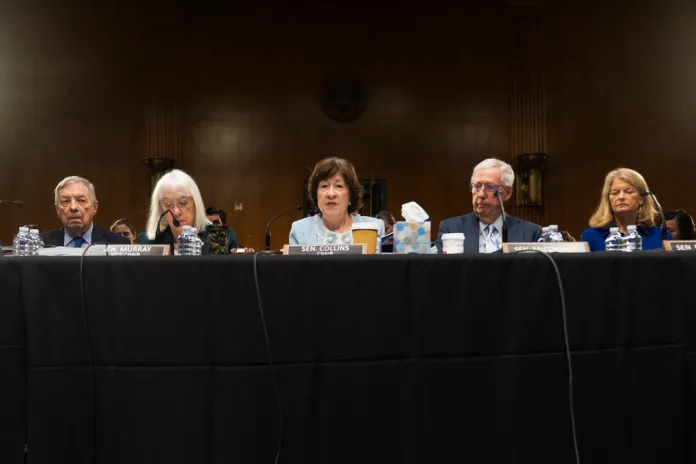
The Wednesday briefing by administration officials marked the first for most senators since Maduro’s capture and followed a past playbook of meeting with lawmakers behind closed doors ahead of voting to curtail Trump’s ability to take unilateral military action.
Secretary of State Marco Rubio, who was among the briefers and himself a former senator, said the administration was in the midst of selling off up to 50 million barrels of Venezuelan oil that the U.S. will use to leverage the country’s transition to a new government. The strategy, Rubio suggested, would ensure U.S. troops are not needed on the ground.
“They are not generating any revenue from their oil right now. They can’t move it, unless we allow it to move because we have sanctions, because we’re enforcing those sanctions. This is tremendous leverage. We are exercising it in a positive way,” Rubio told reporters. “They understand that the only way they can move oil and generate revenue and not have economic collapse is if they cooperate and work with the United States.”
In the House, Democrats are scrambling for a war powers resolution of their own to hit the floor this week but have run into procedural hiccups. With recent deaths and vacancies, House Republicans would have no votes to spare.
Rep. Don Bacon (R-NE), a centrist who has supported Democrats’ war powers resolutions in the past, said he’d be “inclined to support one.”
DEMOCRATS WALK VENEZUELA TIGHTROPE AS SOME PRAISE MADURO’S OUSTER
“I support the administration, but I think we should protect Article One authorities,” Bacon said. “I would vote for a war powers resolution to force the administration to come before us, say, ‘Here’s our plan, do you authorize it or not?’ I would likely vote yes, then, depending on what we hear.”
No matter the outcome in the Senate, Kaine vowed that Democrats will propose additional war powers resolutions targeting countries where Trump has already conducted military strikes, such as in Nigeria, or suggested future military action is possible, such as in Cuba, Colombia, Mexico, and Greenland.
David Sivak and Rachel Schilke contributed to this report.


