







Keiko Fujimori won the Peruvian presidential election on her fourth try, making Peru the latest in a trend of Latin American countries shifting right since President Donald Trump took office.
Fujimori, the daughter of former strongman President Alberto Fujimori, embraced her father’s controversial legacy, which has defined Peru’s politics since the 1990s. The new president will have to deal with one of the most dysfunctional political scenes in the Western Hemisphere, being the ninth president in just 10 years. Former President Dina Boluarte resigned in October after facing one of, if not the lowest, approval ratings of any democratically elected leader.
PERU REMOVES HISTORICALLY UNPOPULAR PRESIDENT BOLUARTE AFTER THREE YEARS OVER CRIME SURGE
Peru has one of the most closely divided electorates in the world, with the past three elections having been decided by less than 1 percentage point.
Keiko Fujimori’s victory marks a major rightward shift for a country that has largely seen left-wing governments rule for the past 20 years. Peru now joins a Latin America-wide trend of countries ejecting left-wing governments in favor of right-wing ones.
</p>
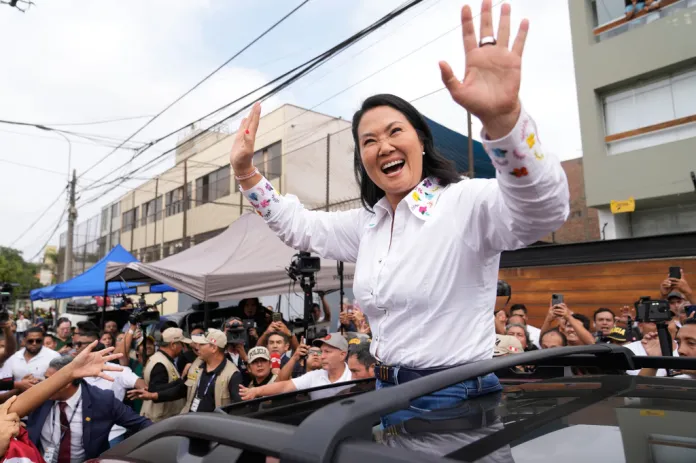
<p> ” data-large-file=”https://conservativemodern.com/wp-content/uploads/2026/06/five-countries-in-latin-america-have-elected-pro-trump-governments-since-his-election.webp” src=”https://conservativemodern.com/wp-content/uploads/2026/06/five-countries-in-latin-america-have-elected-pro-trump-governments-since-his-election.webp” alt=”Keiko” class=”wp-image-4630939″ srcset=”https://conservativemodern.com/wp-content/uploads/2026/06/five-countries-in-latin-america-have-elected-pro-trump-governments-since-his-election-2.webp 1024w, https://conservativemodern.com/wp-content/uploads/2026/06/five-countries-in-latin-america-have-elected-pro-trump-governments-since-his-election-2.webp?resize=300,200 300w, https://conservativemodern.com/wp-content/uploads/2026/06/five-countries-in-latin-america-have-elected-pro-trump-governments-since-his-election-2.webp?resize=768,512 768w, https://conservativemodern.com/wp-content/uploads/2026/06/five-countries-in-latin-america-have-elected-pro-trump-governments-since-his-election-2.webp?resize=150,100 150w, https://conservativemodern.com/wp-content/uploads/2026/06/five-countries-in-latin-america-have-elected-pro-trump-governments-since-his-election-2.webp?resize=696,464 696w” sizes=”(max-width: 1024px) 100vw, 1024px”><figcaption class=) FILE – Presidential candidate Keiko Fujimori, of the Popular Force party, waves after voting during the presidential runoff election in Lima, Peru, June 7, 2026. (AP Photo/Martin Mejia, File)
FILE – Presidential candidate Keiko Fujimori, of the Popular Force party, waves after voting during the presidential runoff election in Lima, Peru, June 7, 2026. (AP Photo/Martin Mejia, File)Latin America is made up of roughly 20 countries in the strict sense of the word, but Belize, Suriname, and Guyana are usually lumped in due to geographical proximity. Of these, 12 have right-wing, Trump-friendly governments, including those in transition, while nine have left-wing governments. Five of the newly right-wing governments were elected after President Donald Trump took office, possibly reflecting his policy towards Latin America.
The rightward shift is all the more remarkable given Latin America had just experienced the peak of its left-wing “Pink Tide” in 2023, a year when only six countries, and no major economies, had right-wing governments.
The Blue Tide
After Brazilian President Lula’s inauguration on Jan. 1, 2023, only El Salvador, Ecuador, Costa Rica, Paraguay, Panama, and the Dominican Republic stood as dams against the Pink Tide, with right-wing prospects in the continent at an all-time low. This fit well with the Biden administration, which shared many of the priorities of the ruling left-wing governments throughout Latin America.
The Pink Tide was backed by economic weight, as all five of South America’s biggest economies — Brazil, Colombia, Peru, Argentina, and Chile — were under left-wing control.
The first major reversal came in December 2023, when the bombastic right-wing libertarian Javier Milei won Argentina’s general election. He won on a platform promising radical economic reforms to reverse the malaise the country had found itself in, casting blame on the predominant left-wing ideology that had dominated the country for decades. His victory was a major blow to the Left in Latin America, as Argentina was long seen as one of its most durable and sizable bastions. Left-wing governments ruled in 16 out of the 20 years before Milei took office.
The ensuing years proved that Milei’s victory wasn’t an anomaly, but a new pattern. Panama was the next domino to fall when right-wing President Jose Raul Mulino won the May 2024 election, taking power from the former left-wing President Laurentino Cortizo on July 1.
Bolivia saw a shocking reversal when the right-wing President Rodrigo Paz won the October 2025 runoff election, ending over two decades of near-unbroken socialist rule. The Left in the country wasn’t going down without a fight, however, and former President Evo Morales has engineered a virtual siege of the country through country-wide strikes and road blockades.
Chile was another of the most notable shifts, as the young left-wing President Gabriel Boric was viewed as a promising young leader in one of the most modern Latin American countries. He was ousted by the right-wing Jose Antonio Kast, who assumed the presidency on March 11 after winning the Dec. 14, 2025, runoff. Kast’s victory was viewed as the most significant rightward shift of the country since the end of former dictator Augusto Pinochet’s rule in 1990.
While appeals to better relations with the U.S. have featured in several elections, Trump played his most prominent role in Honduras, endorsing and assisting the right-wing Nasry Asfura, who won the Dec. 24, 2025, election that ousted the former left-wing President Xiomara Castro.
June 21 saw one of the biggest thorns in Trump’s side removed, when the right-wing Abelardo Gabriel de la Espriella beat a left-wing rival favored by incumbent socialist President Gustavo Petro.
Espriella was endorsed by Trump and is often directly compared to him. He’s known as “El Tigre” and has advocated for a hardline policy against drugs in line with that of Trump’s. The Trump administration has repeatedly bumped heads with Petro’s government over the latter’s liberal drug policy, something Espriella is set to reverse when he takes office on Aug. 7.
</p>
<p> ” data-large-file=”https://conservativemodern.com/wp-content/uploads/2026/06/five-countries-in-latin-america-have-elected-pro-trump-governments-since-his-election-1.webp” src=”https://conservativemodern.com/wp-content/uploads/2026/06/five-countries-in-latin-america-have-elected-pro-trump-governments-since-his-election-1.webp” alt=”Tigre” class=”wp-image-4630949″ srcset=”https://conservativemodern.com/wp-content/uploads/2026/06/five-countries-in-latin-america-have-elected-pro-trump-governments-since-his-election-3.jpg 1024w, https://conservativemodern.com/wp-content/uploads/2026/06/five-countries-in-latin-america-have-elected-pro-trump-governments-since-his-election-3.jpg?resize=300,200 300w, https://conservativemodern.com/wp-content/uploads/2026/06/five-countries-in-latin-america-have-elected-pro-trump-governments-since-his-election-3.jpg?resize=768,512 768w, https://conservativemodern.com/wp-content/uploads/2026/06/five-countries-in-latin-america-have-elected-pro-trump-governments-since-his-election-3.jpg?resize=150,100 150w, https://conservativemodern.com/wp-content/uploads/2026/06/five-countries-in-latin-america-have-elected-pro-trump-governments-since-his-election-3.jpg?resize=696,464 696w” sizes=”(max-width: 1024px) 100vw, 1024px”><figcaption class=) Presidential candidate Abelardo de la Espriella of the opposition Defenders of the Motherland movement addresses supporters from inside a bulletproof booth at a celebration rally after runoff election results showed him leading in Barranquilla, Colombia, Sunday, June 21, 2026. (AP Photo/Ivan Valencia)
Presidential candidate Abelardo de la Espriella of the opposition Defenders of the Motherland movement addresses supporters from inside a bulletproof booth at a celebration rally after runoff election results showed him leading in Barranquilla, Colombia, Sunday, June 21, 2026. (AP Photo/Ivan Valencia)Rounding out the rightward shift is Peru. Election day was June 7, but the slow vote-counting process and narrow margin meant Fujimori’s imminent victory was only established when vote-counting stopped on Monday. Fujimori’s victory is a major win for the Latin American Right, and if she serves out her term, it will be the first stable, unambiguously right-wing government since her father stepped down in 2000.
The rightward turns of Chile, Colombia, and Peru are the biggest victories for the right, as they’re some of the biggest heavyweights of the region. With Argentina under right-wing control, four of South America’s five biggest economies are now under right-wing governments.
Where the Pink Tide holds
The ascendancy of the right across Latin America comes with some caveats. The two biggest economies in Latin America, Brazil and Mexico, remain under firm left-wing rule. Combined, the two make up over half of the region’s GDP.
Mexico is the left’s best bastion, with President Claudia Sheinbaum enjoying relatively high polling numbers and the country’s right-wing virtually nonexistent. Brazil has a durable and embittered right-wing, but Lula is still comfortably leading Flavio Bolsonaro in the most recent polls.
The right-wing wave across the region also isn’t unanimous, with two small countries, Suriname and Uruguay, going in the opposite direction since Trump’s election.
In Uruguay, President Yamandu Orsi won his runoff election on Nov. 24, 2024, just weeks after Trump won. He took over from the right-wing former President Luis Lacalle Pou, who ruled from 2020 to 2025.
In Suriname, the left-wing President Jennifer Geerlings-Simons took power last year after assembling a left-wing coalition from the results of the May 25, 2025, election. She took over from former President Chan Santokhi, who was usually characterized as a centrist and ruled from 2020 to 2025.
Just ahead of the right-wing wave, in Guatemala, left-wing President Bernardo Arevalo won the Aug. 20, 2023, election, taking over from the right-wing former President Alejandro Giammattei, who ruled from 2020 to 2024. Arevalo’s victory marked the zenith of the Pink Tide.
Belize and Guyana had leftward shifts in 2020. Cuba and Nicaragua are both widely considered communist dictatorships, with no right-wing or opposition to speak of.
The left-wing governments have clashed with the Trump administration on numerous occasions, particularly in Brazil, Mexico, and Colombia. Colombia faced some of the worst attacks from Trump, with Washington even sanctioning some officials and altering its official designation as a country cooperating in the War on Drugs, until a recent period of detente.
In Mexico, the main areas of contention have been the War on Drugs and immigration, though Sheinbaum has chosen to cooperate in a limited manner. She has walked a thin line between appeasing her base with language defiant against Washington, while also refraining from drawing the ire of Trump. In practice, this has largely entailed defiant rhetoric alongside significant concessions to Washington, including close cooperation in lethal operations against drug cartels.
Relations with Trump have also waxed and waned in Brazil, with early battles over free speech, made worse by one of the country’s top judges battling with Elon Musk’s X. Tensions have likewise dissipated in recent months with increased dialogue.
An opening for the Shield of the Americas
Trump has significantly revamped the United States’s relationship with Latin America during his second term, becoming more assertive aside from what’s colloquially known as the “Donroe Doctrine.” The U.S. has become much more assertive in its dealings with its southern neighbors, asserting its right to intervene in what it considers to be its own hemisphere.
This was best seen in Operation Absolute Resolve in January, when Delta Force commanders captured Venezuelan dictator Nicolas Maduro from the heart of Caracas after months of military threats and a blockade. Cuba has since been the subject of a similar blockade, and fears of further military operations have grown.
Institutionally, Trump has moved to cement the right-wing wave with the creation of a hemisphere-wide effort to form an alliance of like-minded nations. In March, he created an alliance called the Shield of the Americas, composed of right-wing or right-of-center governments. It is intended to provide support for right-wing governments throughout the continent, especially regarding matters of illegal immigration, organized crime, and terrorism.
US DENOUNCES ATTEMPTED ‘COUP’ IN BOLIVIA AFTER LEFT-WING STRIKERS PARALYZE COUNTRY
Trump has forged close relationships with members of the alliance, such as Milei and El Salvador’s Nayib Bukele. The U.S. has directly joined Ecuador’s open war against organized crime and drug cartels, carrying out joint military operations with the government.
Fujimori’s victory in Peru has solidified the certainty of a right-wing wave across Latin America, just three years after the entire region was under left-wing rule. Whether this can be maintained, or if it will mark just another pendulum swing, may rely in part on Trump’s handling of the region.


