



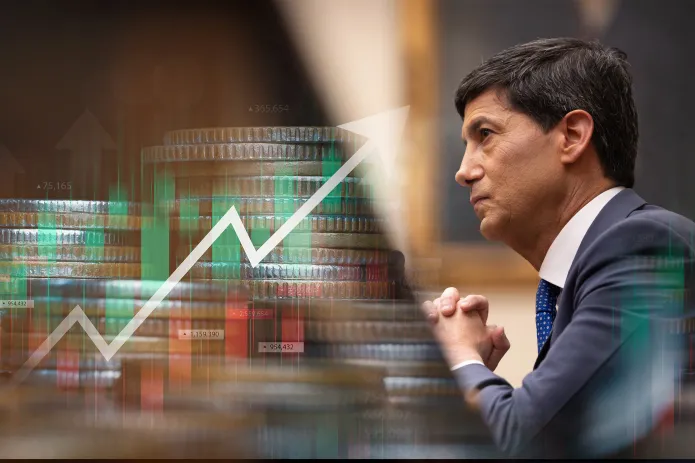
Federal Reserve Chairman Kevin Warsh has vowed that the central bank is fully committed to lowering inflation to its 2% target.
Warsh, who replaced Jerome Powell as Fed chairman in May, testified July 14 before the House Financial Services Committee, where he was repeatedly asked about the Fed’s efforts to drive inflation down after years of too-hot price growth.
Despite President Donald Trump’s desire for the Fed to lower rates, Warsh reiterated that his No. 1 goal right now is to see inflation return to healthy levels.
Warsh said that at his first Fed meeting as chairman, there was “no willingness to tolerate higher prices.”
“There was a commitment that was unambiguous and unanimous that we’re going to deliver,” the chairman said. “And we’re not finding acceptable the higher inflation that has endured in this country for more than five years.”
</p>
<p> ” data-large-file=”https://conservativemodern.com/wp-content/uploads/2026/07/fed-is-laser-focused-on-inflation-drop-warsh-says.webp” height=”683″ width=”1024″ src=”https://conservativemodern.com/wp-content/uploads/2026/07/fed-is-laser-focused-on-inflation-drop-warsh-says.webp” alt=”business kevin warsh federal reserve inflation” class=”wp-image-4652866″ style=”width:823px;height:auto” srcset=”https://conservativemodern.com/wp-content/uploads/2026/07/fed-is-laser-focused-on-inflation-drop-warsh-says-1.webp 3000w, https://conservativemodern.com/wp-content/uploads/2026/07/fed-is-laser-focused-on-inflation-drop-warsh-says-1.webp?resize=300,200 300w, https://conservativemodern.com/wp-content/uploads/2026/07/fed-is-laser-focused-on-inflation-drop-warsh-says-1.webp?resize=768,512 768w, https://conservativemodern.com/wp-content/uploads/2026/07/fed-is-laser-focused-on-inflation-drop-warsh-says-1.webp?resize=1024,683 1024w, https://conservativemodern.com/wp-content/uploads/2026/07/fed-is-laser-focused-on-inflation-drop-warsh-says-1.webp?resize=1536,1024 1536w, https://conservativemodern.com/wp-content/uploads/2026/07/fed-is-laser-focused-on-inflation-drop-warsh-says-1.webp?resize=2048,1365 2048w, https://conservativemodern.com/wp-content/uploads/2026/07/fed-is-laser-focused-on-inflation-drop-warsh-says-1.webp?resize=150,100 150w, https://conservativemodern.com/wp-content/uploads/2026/07/fed-is-laser-focused-on-inflation-drop-warsh-says-1.webp?resize=696,464 696w, https://conservativemodern.com/wp-content/uploads/2026/07/fed-is-laser-focused-on-inflation-drop-warsh-says-1.webp?resize=1068,712 1068w, https://conservativemodern.com/wp-content/uploads/2026/07/fed-is-laser-focused-on-inflation-drop-warsh-says-1.webp?resize=1920,1280 1920w” sizes=”(max-width: 1024px) 100vw, 1024px”><figcaption class=) Federal Reserve Chairman Kevin Warsh. (Washington Examiner illustration; Getty Images)
Federal Reserve Chairman Kevin Warsh. (Washington Examiner illustration; Getty Images)The Fed has what is referred to as a dual mandate: price stability and maximum employment. When inflation is rising, the major tool to fix it is raising interest rates. In general, Fed officials hope that higher rates will lead to less borrowing and spending, thereby lowering inflationary pressures.
The Fed also has long had a 2% target for inflation. During the hearing, Warsh said he was on Capitol Hill to “double down” on that commitment to bringing inflation down to that level. But the chairman also acknowledged how consumers are feeling pinched by years of high inflation.
“As we discuss privately, I’ll say publicly: My broader definition of price stability is a change in prices such that households and businesses don’t have to worry about it, don’t have to think about it,” Warsh told lawmakers.
Warsh has spoken frequently about his desire to return the Fed to its core remit and has said he believes the Fed has strayed from its mandate in recent years. The chairman has said he thinks the Fed under previous leadership has pressed beyond its statutory authority, for instance, into climate change policy.
Rep. Roger Williams (R-TX) asked about how Warsh intends to ensure the Fed stays focused on things such as inflation and employment.
“I can make that commitment to you, congressman, because that’s how we keep politics out,” Warsh told the panel. “That’s how we stay independent in the conduct of monetary policy. The Federal Reserve is not a repair shop for broken statutes, or we aren’t empowered to go wander into areas outside of our remit.”
During the hearing, Warsh was also repeatedly asked about Fed independence and his ability to silo the unique federal agency from influence from the White House.
Rep. Nydia Velazquez (D-NY) asked Warsh whether he believes that he works for Trump.
“If I’m permitted to say, we’re an independent central bank,” he responded. “We’re honored to be independent. Our independence came from you.”
He was also asked what he would do if Trump targeted him or fellow Fed governors because he was upset about interest rate policy.
“I would continue to do my job,” Warsh said.
Also, while Trump frequently criticized Powell for not cutting interest rates, he has seemed to back off on such an aggressive posture with Warsh for the time being.
The Washington Examiner spoke with Trump by phone on July 10, and the president indicated that he will defer to Warsh on interest rates.
“There should be a reduction, but I’ll go with the chairman,” Trump said.
Some good inflation news already
On the same day as Warsh’s Capitol Hill testimony, the Bureau of Labor Statistics reported its update to the consumer price index. In June alone, prices fell by 0.4%, the largest such decrease since 2020.
The decline in prices in the month was caused primarily by a 10% drop in the price of gas, which was downstream of the resumption of oil tanker traffic through the Strait of Hormuz, a key global supply chokepoint, following the agreement between the United States and Iran.
But the relief may be short-lived. Oil prices have popped back up in recent days as that agreement has eroded and tankers have faced threats transiting the strait, leaving uncertainty about the trajectory of gasoline prices.
“This is great news for Kevin Warsh and the Fed,” said David Russell, global head of market strategy at TradeStation. “Everyone expected energy to drop, but there was also good news in car prices, shelter, and apparel. However, these trends might not last if renewed conflict in the Middle East lifts oil prices. Disinflation gets harder going forward if energy doesn’t keep falling.”
The report is welcome news for the Trump administration, which has been working to highlight any progress in lowering inflation. Still, inflation is above the Federal Reserve’s target of 2%, and many investors and Fed watchers expect an interest rate increase this year.
The bump in inflation since the start of 2026 was driven in large part by higher energy prices, which have soared since the Iran war began.
Trump has seen his economic approval ratings fall dramatically since he entered office, in large part because of voter discontent with affordability issues. The higher inflation this year threatens to imperil Republicans in the midterm elections.
Core inflation, a measure that strips out volatile food and energy prices, fell three-tenths of a percentage point to 2.6% for the year ending in June.
Families are feeling the strain of higher prices for goods and services they use routinely. For instance, restaurant prices have gone up 3.4% in just the past year. The price of beef and veal has risen nearly 12% over the past year. Fruit and vegetable prices have increased by 5.3%, on average.
Clothing prices have risen by 3.9%, and electricity prices have risen 4%.
On the other hand, families looking to buy cars are seeing some relief. Used car prices have fallen 1.8% from June 2025, and new car prices have been flat over the past year. Chicken prices have also fallen more than 2%, and butter has dropped by 8.7%.
This latest CPI report comes after the Fed voted to hold interest rates steady at its meetings in January, March, April, and at new Fed Chairman Warsh’s first meeting in June.
Given the hotter inflation prints in recent months, investors think the odds of a rate cut this year are essentially nonexistent. In fact, a rate increase might even be on the table, given the higher inflation and underlying strength in the labor market.
Despite the higher inflation rate, experts don’t think the country is at the beginning of another massive inflation tsunami as was experienced in 2021 and 2022, which saw annual price growth pushing as high as 9%.
When inflation began spiking in early 2021, the economy was emerging from the pandemic, and the government was pumping stimulus money into the economy while the Fed held interest rates near zero for an extended period.
One factor boosting the odds that the Fed increases rates in the next few months is that the labor market has remained resilient.
TRUMP SAYS HE WILL DEFER TO FED CHAIRMAN KEVIN WARSH ON RATE HIKE BEFORE MIDTERM ELECTIONS
The economy has added jobs at a pace strong enough to keep unemployment trending down. The economy added 57,000 jobs last month.
The unemployment rate fell one-tenth of a percentage point to 4.2%, the Bureau of Labor Statistics reported on July 2. That is low by historical standards.
Zach Halaschak (@zhalaschak) is the economics reporter for the Washington Examiner.


