Michigan Democratic Senate candidate Abdul el Sayed is facing fresh scrutiny over his views on Iran after he stopped short of unequivocally condemning the Islamic Revolutionary Guard Corps at a University of Michigan town hall Wednesday. The exchange comes as el Sayed faces renewed questions about his relationship with controversial Twitch streamer Hasan Piker and […]
Michigan Democratic Senate candidate Abdul el Sayed is facing fresh scrutiny over his views on Iran after he stopped short of unequivocally condemning the Islamic Revolutionary Guard Corps at a University of Michigan town hall Wednesday.
The exchange comes as el Sayed faces renewed questions about his relationship with controversial Twitch streamer Hasan Piker and the fallout from past comments surrounding the Sept. 11 terrorist attacks.
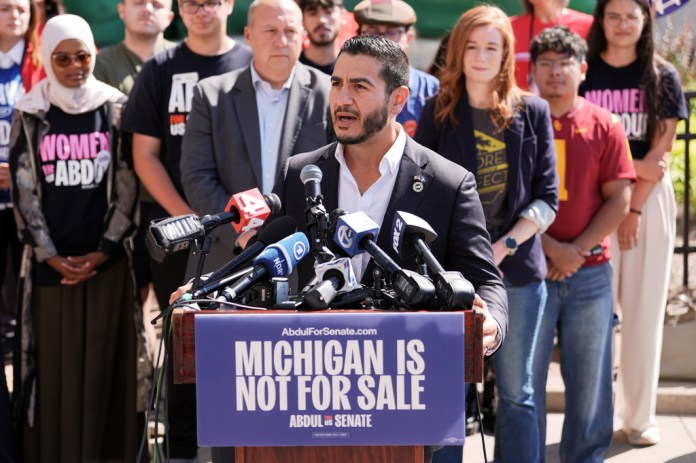
” data-large-file=”https://conservativemodern.com/wp-content/uploads/2026/09/el-sayeds-iran-and-9-11-problems-keep-growing.jpg” src=”https://conservativemodern.com/wp-content/uploads/2026/09/el-sayeds-iran-and-9-11-problems-keep-growing.jpg” alt=”Abdul el Sayed speaks during a news conference.” class=”wp-image-4738472″ srcset=”https://conservativemodern.com/wp-content/uploads/2026/09/el-sayeds-iran-and-9-11-problems-keep-growing.webp 1024w, https://conservativemodern.com/wp-content/uploads/2026/09/el-sayeds-iran-and-9-11-problems-keep-growing.webp?resize=300,200 300w, https://conservativemodern.com/wp-content/uploads/2026/09/el-sayeds-iran-and-9-11-problems-keep-growing.webp?resize=768,512 768w, https://conservativemodern.com/wp-content/uploads/2026/09/el-sayeds-iran-and-9-11-problems-keep-growing.webp?resize=150,100 150w, https://conservativemodern.com/wp-content/uploads/2026/09/el-sayeds-iran-and-9-11-problems-keep-growing.webp?resize=696,464 696w” sizes=”auto, (max-width: 1024px) 100vw, 1024px”>Abdul el Sayed speaks during a news conference at the Spirit of Detroit shortly after winning the Democratic nomination for Senate in Michigan on Aug. 5, 2026, in Detroit. (AP Photo/Julia Demaree Nikhinson)
The episode gives Republicans another opening to press el Sayed on foreign policy and his associations as he heads into the general election against Republican Mike Rogers. But a new poll also suggests the GOP’s effort to make Piker a central issue may have limits: Many voters do not know who the social media figure is.
At Wednesday’s University of Michigan event, an Iranian American audience member confronted el Sayed about his position on the Iranian regime and the Guard, recounting the persecution her family had experienced.
She asked the Senate candidate to say whether he stood unequivocally against the Guard and the Islamic Republic of Iran.
Rather than directly condemning the Guard, el Sayed turned to his opposition to U.S. military intervention and regime-change efforts in the Middle East. He said he stands with democratic movements but argued that the United States should not make a practice of intervening militarily to topple foreign governments.
The questioner pressed him again, telling him he still had not answered whether he stood against the Guard.
El Sayed again returned to his opposition to regime change, saying the U.S. should not be “in the business of regime change.”
George E. Bogden, a former Trump administration official, told the Washington Examiner that the exchange could add to questions about el Sayed’s judgment and priorities.
“When a candidate cannot give a simple yes to condemning a designated foreign terrorist organization, it leaves open questions that no amount of policy detail can fully close,” Bogden said.
He added that the Guard exchange, along with the controversy surrounding Piker and el Sayed’s past comments on 9/11, could create a broader political problem.
“These controversies could become a liability because they raise a larger question about judgment and priorities,” he said. “Building a statewide coalition requires earning the confidence of people who do not already agree with you. El Sayed needs to explain how his economic policies would deliver results and answer straightforward questions about foreign policy without retreating into a different debate. Michigan deserves seriousness on both fronts.”
Republicans have sought to make Piker synonymous with el Sayed, who campaigned alongside the streamer before the Democratic primary. Rogers has repeatedly highlighted the relationship in campaign advertising, portraying Piker as evidence of the company el Sayed keeps.
And el Sayed has repeatedly tried to redirect the campaign toward affordability, healthcare, and economic issues, arguing that Michigan voters care more about everyday costs than a California-based streamer.
“Hasan Piker’s business model of generating attention via shocking rhetoric harmed Abdul el Sayed in Michigan’s primary election,” Democratic strategist Seamus Love told the Washington Examiner. “Even so, I don’t believe his loose connection to Piker or an isolated moment regarding the IRGC and regime change will impact el Sayed’s chances in November.”
Love said Rogers faces his own challenges in building a statewide coalition, pointing to his previous statewide loss and questions Republicans have raised about his ties to Michigan.
“Take el Sayed for what you want, but nobody can question where he lives or who he wants to serve in the Senate — it’s Michigan and Michiganders,” Love said.
The 9/11 controversy
Republicans have tried to make the Piker controversy potent because of comments the streamer made in 2019, when he said that “America deserved 9/11.” Piker later walked back the remark and said he did not mean that the U.S. deserved to be attacked.
In April, el Sayed said, “Of course I don’t think 9/11 was justified,” and later told NBC News’s Meet the Press that Piker’s comment was “a dumb statement.”
While there is no evidence that el Sayed believed America deserved to be attacked, that distinction does not eliminate the political question surrounding his decision to campaign with Piker.
Geopolitical analyst Irina Tsukerman, president of Scarab Rising, told the Washington Examiner that the Iran controversy makes that question more difficult because it creates a second instance in which el Sayed’s response to a question about violence abroad has centered on U.S. conduct.
“When an Iranian American asked el Sayed to condemn the IRGC and spoke about what the regime had done to her family, el Sayed went into U.S. intervention, regime change, and America’s record in the Middle East,” Tsukerman said. “Iranian Americans who watched relatives face prison, persecution, or threats from the Islamic Republic may wonder why their experience prompted an answer about Washington.”
“Opposition to another war with Iran does not require several minutes of qualification before condemning the IRGC,” she added.
Political strategist James Christopher told the Washington Examiner that as el Sayed’s popularity grows, so does scrutiny about his positions on Iran and 9/11.
“It also gives an opponent a straightforward contrast — condemn the remarks and present themselves as standing with Americans who still view Sept. 11 as a defining national trauma,” he said.